
Introduction
You're posting consistently, showing up every day, putting in the hours — and your revenue still looks the same as it did six months ago. Sound familiar?
This is one of the most common patterns Jacinta Devlin sees across the female entrepreneurs she works with. The problem isn't the business idea, and it isn't the effort. As she puts it directly: "You almost certainly don't have a social media problem — you have a strategy problem dressed up as a social media problem."
Hiring a strategic business coach can absolutely change that trajectory. But timing matters.
Hire too early — before you have traction or clarity on what you're selling — and you're paying for direction you're not ready to act on. Hire reactively, when things have already collapsed, and you'll spend twice the energy undoing damage before you can move forward.
This article breaks down the specific business stages, warning signs, and readiness signals that tell you when a coaching investment will actually pay off — and when you should hold off.
Key Takeaways
- Investing at the right business stage — not just when motivation peaks — is what determines whether coaching actually pays off
- Clearest readiness signals: revenue has stalled despite consistent effort, or you're scaling without the systems to support it
- Hiring too early (before any product/service validation) means building sophisticated plans on an unsteady foundation
- The cost of waiting — guessing, stalling, spinning your wheels — often exceeds the coaching fee itself
- The right coach builds strategy around your specific business, not a generic template
Why Timing Is Everything With a Strategic Business Coach
A strategic business coach delivers the highest return when you have something to work with — a product, a service, some early traction — and the genuine commitment to execute on a plan, not just consume advice.
Reactive vs. Intentional Hiring
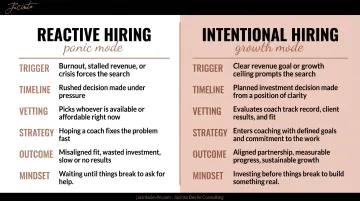
There's a meaningful difference between hiring out of panic and hiring with purpose:
- Reactive hiring: Engaging a coach mid-crisis focuses the engagement on damage control, not growth — and the window to compound momentum has often already closed
- Intentional hiring: Coming in with a working concept, some traction, and readiness to execute is where coaching actually compounds — you're building on something real
A 2023 paper on the ICF Research Portal identifies a critical but underserved support window for small businesses: years three through eight, when startup momentum has faded but sustainable profitability isn't yet assured. That's the gap where strategic coaching delivers outsized impact — and where most business owners try to white-knuckle it alone.
The women who break through fastest in Jacinta's programs are the ones who stopped waiting for the perfect time and got strategic support while they still had momentum to build on.
The Best Time to Hire Based on Your Business Stage
There isn't one single "right moment" — there are four distinct stages where coaching delivers its highest return.
Starting Out and Building from Zero
If you have a clear business concept but no roadmap for generating income, a coach is worth the investment. The risk is hiring before you've validated your product/service at all.
The right trigger: you know what you're selling and who you're selling it to, but you need help building the strategy to sell it consistently.
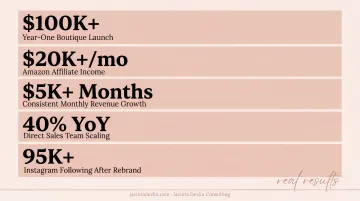
Jacinta's 12-Week Business Launch Program is built for exactly this stage — women who are ready to launch but don't want to spend months figuring it out through YouTube videos and half-finished courses. Her team builds the brand, website, funnels, email system, and launch plan, while Jacinta coaches the strategy behind it. Lisa K. (Fleur de Lis Boutique Florida) went from zero to $100,000+ in year one using this approach.
Making Consistent Money but Hitting a Ceiling
This is one of the highest-ROI moments to hire. You're generating revenue, but the same month keeps repeating. Growth has plateaued. Hustle alone isn't breaking through.
That ceiling is almost always a systems and strategy problem, not an effort problem. According to 2019 research from American Express and Womenable, 87.9% of women-owned businesses generate under $100K annually — which means the majority of female entrepreneurs are stalled in exactly this range, not for lack of trying.
Carissa P., a top Park Lane Jewelry leader, felt overwhelmed and unfocused before working with Jacinta. With a personalized strategy, she achieved 40% year-over-year business growth.
Ready to Scale to Consistent $10K+ Months
Scaling without infrastructure doesn't produce more revenue — it produces more chaos. More clients, more manual work, more burnout, and a business that runs you instead of the other way around.
Before scaling, you need:
- Sales funnels that convert while you sleep
- Email marketing automations (welcome sequences, nurture flows, abandoned cart)
- A repeatable content system that doesn't require daily heroics
- Platform integration across your website, email, and payment systems
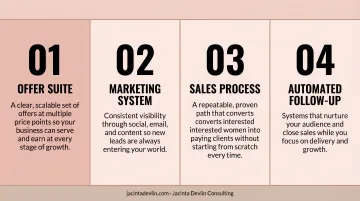
Jacinta builds this scaffolding before clients push on growth — not after things break. Sharon B. went from $4,000 in her entire first year on Amazon to $20,000+ per month consistently once the right infrastructure was in place.
Navigating a Major Business Transition
Major pivots carry real strategic risk. An outside perspective can prevent costly mistakes whether you're:
- Moving from direct sales to a personal brand
- Launching a boutique or new product line
- Going from corporate employment to full-time entrepreneurship
- Adding a new income stream to an existing business
Christina R. quit her full-time corporate job within six months of starting Jacinta's program, growing from 13K Instagram followers to 95K+ and landing five-figure brand deals with Walmart and QVC. Each of those outcomes was the result of a strategy built specifically around her transition — not a generic roadmap borrowed from someone else's business.
Clear Signs You're Ready for a Strategic Business Coach Right Now
Use these as a decision filter, regardless of what stage you're in.
You've been figuring it out alone for months — and the same problems keep surfacing. Inconsistent revenue, unclear offers, no defined sales process. It won't self-correct without outside structure.
Your decisions feel reactive. You're responding to whatever's in front of you rather than executing a deliberate plan. You feel like you're spinning your wheels instead of building momentum.
You have ideas — too many, maybe — but no framework for identifying which ones will actually move your business forward versus which are distractions.
You're done guessing. That's the real mindset signal. When a business owner is ready to stop trial-and-error and commit to a strategy built around your specific business — not a generic course template — coaching delivers its highest value. That's what individualized 1:1 coaching is designed for — a strategy built around your actual business, not a curriculum someone else used.
You have the capacity to act. The best coaching relationships produce results when the client can dedicate time to implementation. The Business Growth Program requires 3–5 hours per week of execution between calls. If your bandwidth is currently at zero, create space first.
When You Should Wait Before Hiring a Business Coach
Not every stage is the right stage. Here's when to hold off:
Still testing what you're selling and who you're selling it to? The most important work right now is market validation — not strategy. A sophisticated plan built on an unsteady foundation will still fall over.
Needing motivation, not strategy. A coach isn't a cheerleader or a therapist. If you need community, confidence, or accountability, lower-cost options — peer groups, masterminds, group memberships — are a better first step.
In financial survival mode with no bandwidth to execute. Coaching requires the financial investment and the time and energy to act on strategy — if you can't do both right now, stabilize first.
If you're not ready for 1:1 coaching yet, Jacinta's Dream+Create Online Coaching Community is a structured group environment for women who want professional guidance and accountability without the 1:1 investment.
What Happens When You Wait Too Long
Every month spent guessing, repeating strategies that aren't working, or making uninformed decisions has a real dollar cost. The Federal Reserve's 2025 Small Business Credit Survey found that 57% of small employer firms cited reaching customers and growing sales as an operational challenge — and firms were more likely to report revenue decreases than increases.
That's the environment most female entrepreneurs are navigating without a strategic framework. Waiting doesn't shrink the gap — it widens it.
The client results inside Jacinta's programs make the cost of delay concrete:
- Sharon B. spent an entire year on Amazon making $4,000 total before coaching. Post-program, she generates $20,000+ per month. That's the compounding cost of delayed strategy made visible.
- Joy W. surpassed her entire previous annual income within 6 months of starting the Business Growth Program — after years of grinding at $500/month.
- Christina R. hit her six-figure income goal and quit her corporate job within 6 months of engaging a strategy built specifically around her business.
There's a compounding risk that goes beyond lost revenue. Businesses that try to scale on hustle alone often arrive needing remediation before growth is even possible. Jamie R. described herself as "literally all over the place" before coaching — running three businesses under an incoherent brand with no systems.
Before she could scale, the foundation had to be rebuilt first. The longer the wait, the more there is to undo — and the further back the starting line moves.
How to Make the Most of Your Coaching Investment
When the timing is right, these three things determine whether you get maximum return:
1. Bring an honest picture of where your business actually is — not where you hope it is. Revenue, gaps, capacity, what's working, what isn't. The more transparent you are, the more precisely your coach can build strategy around your real situation. Every program Jacinta offers is built on this principle: no cohort, no curriculum dump, no generic advice. Strategy is customized to your business model, platform mix, and revenue targets.
2. Commit to implementation, not just conversation. The ROI of coaching comes from execution. A 2024 peer-reviewed study on entrepreneur coaching found significant goal-attainment progress — with a large effect size — when early-stage entrepreneurs actively engaged in evidence-based coaching. The key word is actively. Clients who follow through on their action plans see results within the first 30–60 days.
3. Choose a coach whose background matches your actual goals. Look for someone who has built real businesses. Jacinta Devlin's programs are built from operator experience, not observation:
- Top 1% seller and million-dollar earner across a 12-year direct sales career
- National Director of Sales & Field Training at Stella & Dot
- Six-figure e-commerce business scaled to $10K+ months
- Consulting practice grown to over $1M in revenue
Coaching is her fifth business — not her first. That's what makes the strategy she builds for clients actionable, not theoretical.
All three factors compound: honest self-assessment sets the baseline, consistent execution drives progress, and the right coach shortens the path. Get all three right, and the investment pays for itself fast.
Frequently Asked Questions
How much should I pay for a business coach?
Business coaching ranges from group memberships at a few hundred dollars per month to one-on-one retainers starting at $3,500 and scaling well above that based on scope and experience. ICF's 2025 Global Coaching Study reports an average session fee of $234 for general coaching. Evaluate the ROI relative to your revenue goals — not just the sticker price.
Is it worth investing in a business coach?
The return depends heavily on choosing a coach matched to your stage and business model, and on your own commitment to implementation. A coaching fee that drives you from $2,500/month to $10,000/month pays for itself in the first month of incremental revenue.
What is the 70/30 rule in coaching?
The 70/30 rule is a commonly cited coaching heuristic suggesting the client does approximately 70% of the talking and work while the coach guides and facilitates the remaining 30%. It's not an official ICF standard, but it reflects the core principle: coaching is an active investment, not a passive one — your effort drives the outcome.
How do I know if I'm actually ready for a business coach?
The clearest readiness markers are having a validated product/service (or a clear, specific concept), the capacity to commit 3–5 hours per week to implementation, and the mindset shift from seeking motivation to seeking strategy. If you can say yes to those three things, you're ready.
How long does it take to see results from a strategic business coach?
Most clients gain directional clarity within the first few sessions, with meaningful revenue shifts appearing within 30–60 days for those who execute consistently. Hitting $5K–$10K months typically takes 6–12 months of sustained implementation.
What's the difference between a business coach and a business strategist?
General business coaching tends to focus inward — mindset, confidence, goal clarity. Strategic consulting focuses outward — business model, revenue systems, market positioning, and execution infrastructure. The most effective support blends both: strategic direction delivered through a coaching relationship that keeps you accountable to the plan.