
Introduction
There are over 13.6 million active ecommerce stores globally, according to Store Leads — and that number doesn't account for coaches, consultants, social sellers, and service providers competing for the same digital attention. Most of them won't stand out. Not because their offer isn't good, but because no one knows who they are.
That's a branding problem. More precisely, it's a strategy problem dressed up as a visibility problem.
Your brand is the reason someone chooses you over the next person with a similar offer. It's the first impression that forms — research shows website visual appeal can be assessed in as little as 50 milliseconds — and the reason customers come back without being re-sold every time.
This article breaks down five proven branding strategies built for online business owners: coaches, social sellers, boutique owners, affiliate marketers, and women building income on their own terms. Each strategy is practical, tested, and designed to drive real recognition, loyalty, and revenue — no corporate playbook required.
Key Takeaways
- Branding is the full experience your audience has with you — your voice, visuals, values, and consistency across every touchpoint
- Personal brand identity is the #1 differentiator for online business owners, especially solopreneurs
- Visual consistency across platforms builds recognition faster than any single campaign
- Content-driven social selling and community building generate stronger long-term brand equity than paid campaigns alone
- Start with brand identity: it determines your messaging, visuals, and every strategy that follows
What Makes Branding Essential for Online Businesses Today
Having an online presence means you exist. Having a real brand means people already want to buy from you before you've said a word.
That distinction matters more than most online business owners realize. Without a physical storefront, without in-person relationship-building, your brand has to do all the work. Every touchpoint — a social post, an email, a website visit — is either building credibility or losing it.
Trust drives purchase decisions more than price. According to Edelman's research across 16,000 consumers in eight markets, 81% said trusting a brand to do what is right is a deciding or major purchase factor. That trust doesn't come from a logo. It comes from consistent, intentional brand-building across every digital touchpoint.
A professional brand signals:
- Builds credibility before a prospect ever reaches your sales page
- Supports premium pricing by positioning you above the discount tier
- Attracts your ideal customer and filters out the wrong ones naturally
A DIY brand that looks inconsistent sends the opposite message. It quietly erodes willingness to pay, drags down conversion on premium offers, and keeps brand partners from taking you seriously. Intentional branding is what closes that gap.
The Top 5 Proven Branding Strategies for Online Businesses
Each of these five strategies drives recognition, loyalty, and consistent revenue — and works whether you're launching or scaling.
Strategy 1: Build an Authentic Personal Brand Identity
For most online business owners — coaches, consultants, social sellers, boutique owners — you are the brand. Your story, values, and perspective are what make people follow and buy. Authenticity isn't a soft concept here. It's the strategy.
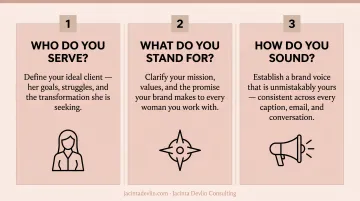
Before any visual design, content plan, or platform strategy, you need to answer three foundational questions:
- What is my mission? Why does this business exist beyond making money?
- What do I stand for? The values that shape every decision, every post, every offer
- Who is my ideal customer? The specific person you're building this for — not "women aged 25-45" but a real, detailed human being
What brand identity actually looks like in practice:
- A brand voice — how you consistently sound in captions, emails, and video
- A positioning statement — one sentence on who you help and how
- A values framework — the thread that runs through every piece of content you create
The most common mistake women entrepreneurs make? Skipping this foundation and jumping straight to tactics. Content ends up scattered. The audience never quite knows what you stand for. Posting volume goes up but conversions stay flat.
This is the exact pattern Jacinta Devlin addresses with clients in her Business Growth Program and Business Launch Program. Client Jamie Ralliford described being "literally all over the place" with a personal brand spread across three separate businesses before working with Jacinta to consolidate everything into one cohesive identity. That clarity became the foundation for consistent, converting content.
For clients who want to move faster, working with a business strategist to lock in mission, values, and positioning before touching tactics is what separates a scattered online presence from one that actually converts.
Strategy 2: Create a Consistent Visual Identity Across Every Platform
Consistency is what turns a visitor into a recognizer. People need to encounter your brand repeatedly before it registers — and inconsistency resets that process every single time.
A consistent visual identity isn't about being a designer. It's about making deliberate decisions and repeating them.
The minimum visual brand asset set for an online business:
| Asset | Why It Matters |
|---|---|
| Primary logo + submarks | Flexible use across platforms, email, and content |
| 2-3 brand colors | Instant visual recognition across all touchpoints |
| Typography system | Heading, body, and accent fonts used consistently |
| Photography/graphic style | Cohesive aesthetic that signals professionalism |
| Brand style guide | Keeps everything on-brand as your business grows |
A vendor study by Lucidpress/Marq found consistent branding can increase revenue by up to 33%. While that figure comes from a vendor-sponsored study (take it directionally, not as a guaranteed outcome), the underlying principle holds: when your brand looks the same everywhere, people trust it more.
Jacinta's Done-For-You Marketing Systems service builds this complete asset set for clients — including a full brand style guide designed for contractor handoff, so the brand stays consistent as the business scales. For client Michele & McKaylee of MckMich Collective, professional brand creation — logo, colors, vision, and mission — was the foundation that allowed them to launch at a level that secured brand partnerships and early sales within their first months.
A brand that looks DIY at the logo and color-palette level signals "amateur" to your audience. That signal silently reduces conversion rates on premium offers. The visual layer isn't vanity — it's revenue infrastructure.
Strategy 3: Leverage Social Selling and Content-Driven Branding
Content-driven branding means consistently showing up with posts, videos, stories, and emails that educate, entertain, or inspire your ideal customer — not just promotional content. Every post, story, comment, and DM reply is a branding touchpoint. How you show up — not just how often — shapes audience perception as much as any formal campaign.
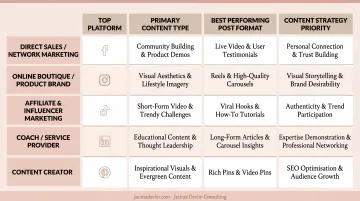
Platform priorities by business type:
- Social sellers and boutique owners: Instagram Reels and Stories for reach, Facebook Groups for community and conversion, TikTok Shop for direct product sales
- Coaches and service providers: LinkedIn for professional credibility, email marketing for conversion (email converts at rates 10-40x higher than social), YouTube for deep trust-building
- Affiliate marketers: Instagram for brand-building, Pinterest for discovery, Amazon and LTK storefronts for monetization
The data backs this up. Pew Research found that 36% of women social media users had purchased something after seeing a creator or influencer post — among women aged 18-29, that number climbs to 50%.
The biggest mistake here: posting randomly without a content strategy tied to brand identity. Frequent content without brand alignment builds an audience that doesn't convert. Brand-aligned content — even at lower posting frequency — builds a following that actually buys.
Jacinta's core philosophy on this: "You almost certainly do not have a social media problem. You have a strategy problem dressed up as a social media problem."
Strategy 4: Build a Community and Use Social Proof
Community is a branding strategy, not just a marketing tactic. When customers feel like they belong to something beyond a transaction, they become advocates — loyal to the brand, not just a one-time buyer.
Practical ways to build community as an online business owner:
- Launch a free Facebook Group around your niche (not your business name — your audience's interest)
- Show up consistently in comments, replies, and conversations
- Create a members-only space for your paying customers
- Run regular live content that invites participation, not just consumption
Social proof amplifies every branding effort. Testimonials, before-and-after stories, client shoutouts, and user-generated content signal to potential customers that your brand delivers on its promises. Nielsen found that 88% of global respondents trust recommendations from people they know more than any other channel.
Jacinta's client results demonstrate what this looks like at scale. Sharon Bean grew from $4,000 in her first year on Amazon to consistently earning $20,000+ per month after working with Jacinta — and grew two Facebook Groups to 30,000+ and 37,000+ members in just four months. Christina R. (now @mybalancedstyle) rebranded, grew her Facebook Group from zero to 36,000+ members, scaled her Instagram to 95,000+ followers, and achieved a six-figure income within six months.
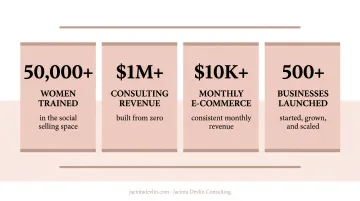
These aren't just client wins — they're demonstrations of what happens when brand clarity, community, and social proof work together.
Brands with engaged communities spend less on customer acquisition over time. Word-of-mouth and organic referrals take over — and for social sellers, coaches, and online retailers, that's the most sustainable way to grow.
Strategy 5: Tell Your Brand Story to Create Emotional Connection
People don't connect with products or services. They connect with stories. Sharing your origin story, your journey, and your mission creates an emotional bond that no ad campaign can replicate — because no ad budget can buy authenticity.
The key elements of a compelling brand story:
- Your origin — the moment, frustration, or turning point that led you here
- Your values — who you work with, how you price, what you refuse to compromise on
- Your impact — the transformation you've helped others achieve, in specific and human terms
The most powerful brand stories aren't polished. They're honest. That honesty is what builds trust.
Jacinta Devlin's own story models this perfectly. At 21, as a broke college student working two jobs, she attended a direct sales jewelry party and decided to become a rep — thinking it sounded like a way to pair accessories, drink wine, and make extra cash. That single decision turned into a 12-year career that made her a Top 1% seller and million-dollar earner. That story doesn't sound like a corporate bio. It sounds like a real person — and that's exactly why it connects.
When Jacinta coaches clients on brand storytelling, she's drawing on research that supports the principle. Harvard Business Review documented cases where brands focusing on emotional connection saw significantly stronger customer acquisition and revenue growth compared to those focused only on satisfaction metrics — you can read the full research here.
Your brand story isn't a one-time About page exercise. It threads through every caption, every email, every video, and every conversation you have with your audience.
How to Choose the Right Strategy for Your Business Stage
Not every strategy needs to be implemented at once. Where you start depends on where you are.
If you're just launching: Start with personal brand identity and brand story. Everything else — visual identity, content, community — builds on that strategic foundation. Visual before positioning is backwards, and it shows.
If you're generating revenue but hitting a ceiling: The foundation is probably there, but one of these gaps is slowing growth:
- Inconsistent visual identity that doesn't match your actual offer quality
- Content that posts frequently but isn't brand-aligned
- No community or social proof strategy in place
A quick self-audit:
| Question | Action if the Answer is "No" |
|---|---|
| Is your brand identity clear? | Start with mission, values, and positioning |
| Is your visual presence consistent across platforms? | Build or rebuild your visual identity |
| Do you have a content strategy tied to your brand? | Define content pillars before posting more |
| Are you actively building community? | Launch a Facebook Group or private community |
| Are you collecting and sharing social proof? | Start requesting testimonials immediately |
The gap you identify is where to focus first. Pick one, go deep, and move to the next when it's solid — that's how real momentum builds.
Conclusion
The online businesses that grow consistently are not always the ones with the biggest ad budgets. They're the ones with the clearest brand, the most consistent presence, and the deepest connection to their audience. Branding is the long game. Done right, it compounds — in trust, in recognition, and in revenue.
Jacinta Devlin Consulting builds individualized strategy around your specific business — not a template someone else used. Whether you're launching from zero or scaling past a revenue ceiling, the work starts with a real conversation.
Book your complimentary 15-minute Growth Chat at calendly.com/devlinconsulting/15-minute-consultation. Jacinta reviews every application personally and will tell you directly whether her programs are the right fit.
Frequently Asked Questions
What are the 4 branding strategies?
The four commonly referenced branding strategies are product branding, personal branding, corporate branding, and service branding. For online business owners — especially coaches, social sellers, and solopreneurs — personal branding combined with service or product branding tends to deliver the strongest results.
What are the 5 C's of branding?
The 5 C's of branding are Clarity, Consistency, Content, Connection, and Community. Together, they cover the full arc of online brand-building — from how you position yourself to how you turn followers into a loyal audience that buys from you repeatedly.
What are the 7 C's of branding?
The 7 C's framework adds Credibility and Conversion to those five. Those two additions are what bridge brand-building and actual revenue — a brand that attracts attention is only valuable if it also earns trust and drives people to buy.
How do I build a brand for my online business from scratch?
Start by defining your brand identity: your mission, core values, and who you're building for. Once that foundation is set, establish your visual identity, then build your content and community presence. Strategy before tactics — always.
What is the difference between personal branding and business branding?
Personal branding centers on the individual: their story, expertise, and how they show up. Business branding focuses on the company as its own entity. For solo online business owners, coaches, and social sellers, the two are often intentionally intertwined — you are the face and the reason people buy.