
The problem isn't effort. It's the absence of a system.
According to Constant Contact's 2024 Small Business Now research, 73% of small businesses lack confidence in the effectiveness of their marketing strategy, and 56% spend less than one hour per week on it. That gap between effort and outcome isn't unique to spas — but it shows up sharply in service businesses where the owner is already stretched across client care, operations, and admin.
This guide covers a practical marketing framework built specifically for women who own spa and wellness businesses — from digital foundations to social media, client retention, and local strategy. Not a list of tactics. A system you can actually build on.
Key Takeaways
- Running a spa without a defined marketing strategy means relying on luck instead of systems.
- Your ideal client, revenue goal, and chosen channels must align before layering on more tactics.
- Social media converts best when it's built around booking — not just beautiful content.
- Retention marketing is almost always more profitable than chasing new clients.
- Two channels done consistently outperform ten channels done halfway.
Why Most Spa and Wellness Marketing Doesn't Work
Most spa owners don't have a marketing problem — they have a strategy problem.
The common trap: post on Instagram, run a seasonal discount, collect emails that never get sent, try a Google ad, post again. Six tactics in motion, none of them connected to a clear goal or measured against a result. The outcome is burnout and inconsistent bookings — not growth.
The Constant Contact data reflects this: when 56% of small business owners spend less than an hour per week on marketing, it's not because they don't care — it's because they're executing tactics reactively instead of running a system that works without constant attention.
Activity Is Not Strategy
The difference between activity and strategy is a target. Activity is posting three times a week. Strategy is knowing exactly which client you're posting for, what you want her to do after she sees it, and how you'll track whether it's working.
Most spa marketing fails not because the tactics are wrong, but because there's no defined audience, no revenue goal, and no connected system behind the execution. Even good ideas produce little return when they're scattered.
The Framework This Guide Is Built Around
Those three gaps — no defined audience, no revenue goal, no connected system — are exactly what this framework addresses. In this order:
- Define your audience and revenue goal — before choosing any channel
- Choose one to two channels — and build them properly
- Build retention — so every client you earn keeps coming back
Most spas that plateau are missing step one entirely. The ones that scale have all three running at the same time.
Start With Strategy: Define Your Audience and Revenue Goals
Know Who You Are Actually Marketing To
Most spa owners can describe their ideal client as "women who want to relax and feel good." That's too vague to make a single useful marketing decision from.
A useful client profile goes deeper — into psychographics. What does she value? What's she anxious about? What outcome is she actually hoping for when she books a treatment?
She might be a burned-out professional who needs a standing monthly appointment to function. A new mom who treats her skin care routine as non-negotiable self-care. A bride-to-be building a pre-wedding wellness ritual.
The more specific the picture, the sharper every downstream decision becomes.
Vague: "Women aged 25–55 who like spa services."
Specific: "Women in their mid-30s to mid-40s, professionals or work-from-home mothers, who follow skin care accounts on Instagram, spend $150–$300/month on personal care, and want results-driven treatments — not just relaxation."
The specific version tells you which platforms to use, what content to create, what promotions will land, and what language belongs in your emails and ads. The vague version tells you nothing actionable.
Set a Revenue Goal That Guides Your Marketing
Marketing without a revenue target is guessing. Work backward instead.
Say your goal is a consistent $8,000/month and your average booking value is $120. Here's how the math breaks down:
- 67 bookings/month needed to hit $8,000
- 40 returning clients (60% retention) — focus on loyalty and rebooking
- 27 new clients/month — these come from your active marketing effort
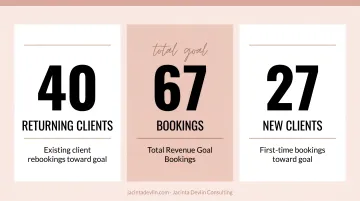
That last number tells you how much marketing activity you actually need — and what kind.
For small service businesses, allocating 7–8% of revenue to marketing is a reasonable starting point — B2C service businesses often run higher. The key is committing a real budget rather than treating marketing as free time that gets cut when bookings drop.
Choose Two Channels and Commit
For solo operators or small teams, spreading across five platforms means five things done poorly. Focus is a competitive advantage.
Pick one outbound channel — where you go find clients, like Instagram or local partnerships. Then pick one inbound channel — where clients find you, like Google search or email. Master those two before adding anything else.
This is where working with a strategist accelerates results. Jacinta Devlin's coaching approach does exactly this — no copy-paste playbook, no generic framework. Every strategy is built around your specific business model, audience, and revenue goals. That matters when you're already stretched thin.
Digital Marketing Essentials for Spa and Wellness Owners
Build a Website and Google Presence That Convert
Your website is your most important marketing asset — not a luxury, a baseline. At minimum it needs:
- Full service menu with clear pricing
- A visible, easy booking option (not buried three clicks deep)
- High-quality photos of your space and treatments
- Staff bios that build trust before a first visit
The mobile experience matters more than the desktop version. Google's research found that 76% of people who search for something nearby on a smartphone visit that business within a day — and 28% of those searches result in a purchase. If your site is slow, hard to navigate, or has no booking option on mobile, you're losing those clients before they call.
Your Google Business Profile is equally non-negotiable. Local searches like "spa near me" or "massage in [city]" come from people ready to book — and a complete profile is what puts you in front of them. Set it up fully:
- Accurate hours and location
- High-quality photos of your space
- A services list and booking link
- Responses to every review
Use Email Marketing to Drive Repeat Bookings
Email is the highest-ROI channel for service businesses. Litmus reports the average return at $36 for every $1 spent — and unlike social media, email reaches clients directly without an algorithm deciding who sees it.
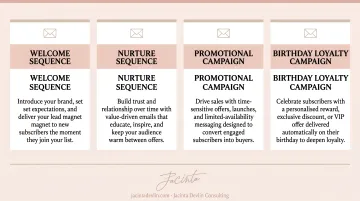
For spa owners, four email types do most of the work:
- Send a welcome sequence immediately after a first booking — introduce your space, set expectations, and link to rebooking
- Trigger a win-back at 60+ days of no visit — offer a reason to return (not necessarily a discount; sometimes a reminder is enough)
- Run seasonal promotions tied to a specific offer with a clear booking deadline
- Use birthday and anniversary emails — they get high open rates and consistently drive loyalty
Keep every email to one clear call to action. Most spa emails fail because they try to say too much. Say one thing, link to booking, and send.
Jacinta Devlin builds complete email sequences for service businesses — welcome flows to post-visit loyalty automations — on platforms like Flodesk, Klaviyo, and Kit. It's the channel most spa owners have but aren't using.
When and How to Use Paid Advertising
Once your website, Google profile, and email are producing results, paid ads become a genuine accelerator. Before that foundation exists, they're not a fix — they're a faster way to spend money on a leaky system.
When you're ready, Google Local Service Ads and Facebook/Instagram ads both work for spas because they're local, visual, and direct. A few rules:
- Send ads to a booking page, not your homepage
- Target a tight local radius — there's no reason to pay for impressions 40 miles away
- Start with a small test budget and track which ads produce actual bookings, not just clicks
- Run ads for specific services, not general awareness
When the organic foundation is working, paid ads scale what's already converting.
Social Media Marketing That Actually Converts
Choose the Right Platforms for Your Spa
Instagram and Facebook are the strongest platforms for spa and wellness businesses — they're visual, local-friendly, and both support booking integrations. Instagram's "Book Now" action button connects directly to booking partners. Facebook's Appointments tool lets clients schedule from your page.
Pinterest earns a spot in your strategy for organic discovery: the platform's own trend data showed beauty and wellness content searches growing by triple digits year over year. It won't replace Instagram for conversion, but it builds visibility with clients who are actively researching services.
Resist the pull to be everywhere. Be where your ideal client actually spends her time — then show up there consistently.
Create Content That Moves People Toward Booking
Growing followers and filling a calendar are two different goals. Most spa accounts are optimizing for the first one — and wondering why the second isn't happening.
The highest-converting content types for spas:
- Before-and-after treatment results (with client consent) — shows outcomes, not just ambiance
- Short video walkthroughs of treatment rooms, service processes, or product introductions
- Staff introductions — clients book people they feel they know
- Client testimonials in video or quote format — peer trust drives bookings faster than promotion
A practical weekly content rhythm:
- 2x per week: Anchor posts — treatment results, transformations, direct booking prompts
- 1x per week: Educational content — skincare tips, service FAQs, treatment explainers
- 1x per week: Community content — behind-the-scenes, personal moments, values-driven posts
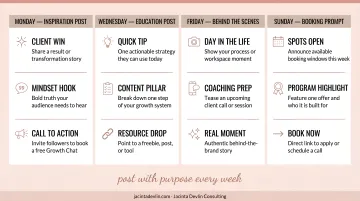
Every post should include a clear booking call to action. Consistency with direction beats high-frequency posting with no goal.
Leverage Influencer and Community Partnerships Online
Local lifestyle influencers — even those with 2,000–8,000 highly engaged local followers — can introduce your spa to exactly the client you're trying to reach.
To find them: search city-specific hashtags on Instagram, check who local women in your target demographic follow, and look for accounts that regularly feature local restaurants, boutiques, and experiences.
The exchange is usually simple: a complimentary service for genuine content posted to their audience. Keep it friction-free with these basics:
- Skip the scripts — authentic posts from someone their followers trust outperform most paid ads
- Make the booking process easy and communicate clearly about timing
- Follow up after the visit to confirm content is coming
- Repost their content with permission to extend its reach
Authentic partnership content works because it feels like a recommendation, not an ad.
Turn Happy Clients Into Your Most Powerful Marketers
Happy clients are already your best marketing asset. The question is whether you have a system that activates them.
Referral programs are one of the fastest paths to new bookings without an ad budget. Referred clients tend to book more and stay longer — Nielsen research found 90% of consumers trust recommendations from people they know, and a Wharton study found referred customers carry 16% higher lifetime value on average than non-referred clients.
A simple referral structure:
- Reward both the referring client and the new client (credit, discount, or complimentary add-on)
- Make the referral action easy — a shareable link, a referral card at checkout
- Track it so no reward is missed (missed rewards kill referral programs fast)
Review generation deserves its own habit. BrightLocal's 2026 Local Consumer Review Survey found 97% of US adults read reviews for local businesses, and 31% only consider businesses with a 4.5-star rating or higher. The same survey found that 83% of consumers who were asked to leave a review in 2026 did so — meaning you don't need a complicated system, you need to ask.
Put these three habits in place:
- Ask immediately after service, while the experience is fresh
- Send a follow-up message with a direct Google review link
- Respond to every review — positive and negative — publicly
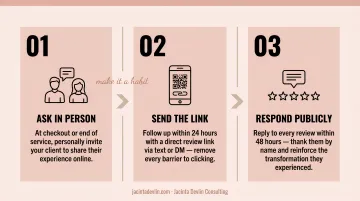
BrightLocal also found 80% of consumers are more likely to use a business that responds to all reviews. That response habit costs nothing and compounds over time.
Once you've built a loyal base of clients who refer and review, the next move is keeping them committed long-term. Memberships and packages stabilize your income and create predictable recurring revenue.
A monthly wellness membership (one treatment per month at a fixed rate) gives clients guaranteed savings and gives you guaranteed bookings. Prepaid treatment bundles work the same way. For spa owners stuck in unpredictable booking cycles, even a simple 10-client membership at $99/month adds $1,000 in guaranteed monthly revenue before a single walk-in books.
Local and Community Marketing That Builds Loyal Clientele
Strategic local partnerships go beyond swapping flyers. The goal is structured cross-referral agreements with complementary businesses — where both sides actively recommend each other to their clients. Strong partners to target include:
- Yoga studios and fitness centers
- Bridal boutiques and wedding planners
- Wellness practitioners (acupuncturists, nutritionists, therapists)
- Hair salons and beauty professionals
When you reach out, be specific about the mutual value and propose a concrete arrangement. "I'd love to put together a post-wedding self-care package for your clients — and I'll refer my clients to you for bridal appointments" is a more productive opening than a generic "let's collaborate."
Local events — open houses, mini-treatment days, wellness workshops — let potential clients experience your space before committing to a full booking. One quarterly event can generate months of social content, strengthen relationships with existing clients, and produce direct word-of-mouth. Promote through email, social, and local community Facebook groups.
Finally, your own visibility as a business owner is a marketing asset. Sponsoring local causes, joining women's business networks, or speaking at community events builds the kind of trust that advertising cannot replicate. For women-owned spas, the owner's values and community presence are a differentiation most competitors overlook entirely — and that gap is yours to fill.
Frequently Asked Questions
How do I market my spa business?
Start by defining your ideal client specifically, then build a strong online presence — mobile-optimized website and complete Google Business Profile. Choose one to two marketing channels to focus on first, build a retention system through email and referrals, and add more tactics only after those are producing consistent results.
What are the 5 C's of marketing strategy?
The 5 C's are Company, Customers, Competitors, Collaborators, and Context (or Climate). For spa owners, working through these before committing to tactics helps clarify where to focus — particularly understanding what competitors are doing and where local partnerships make sense.
What are the 5 main marketing strategies?
The five core strategies are content marketing, social media marketing, email marketing, SEO/local search, and paid advertising. Spa owners don't need all five at once — starting with the two that align with your audience and revenue goal is more effective than running all five at once.
What social media platforms work best for spa and wellness marketing?
Instagram and Facebook are the strongest platforms for spas — both are visual, support local discovery, and offer booking integrations. Platform choice should always follow where your ideal client actually spends time, not where everyone else in your industry is posting.
How do I get more clients for my spa business?
The three fastest levers: optimize your Google Business Profile for local search, activate a client referral program with a simple reward structure, and run a win-back email campaign for clients who haven't booked in 60+ days. None of these require ad spend — just consistent execution.
Do I need a big marketing budget to grow my spa?
No. The most effective starting strategies — Google Business Profile, email marketing, referrals, and social media — are low or no cost. A 7–8% of revenue marketing budget can be introduced once those free channels are producing results and you're ready to amplify what's working.