Introduction
Most local marketing advice reads like it was written for a nameless, faceless small business. It skips right past the fact that women entrepreneurs have something most marketing guides never account for: a built-in edge in the one currency that drives local buying decisions — trust.
According to the 2025 American Express Shop Small Impact Study, 76% of consumers agree small businesses are essential to their community, and 89% of Millennials and Gen Z said they were likely to Shop Small. These buyers aren't just looking for a product. They're looking for a business they can connect with — and women entrepreneurs tend to build exactly that kind of brand.
This guide covers the strategies that actually move the needle for women-owned businesses: optimizing your Google Business Profile, building community partnerships, using local SEO to get found, and turning loyal customers into your most effective marketing channel. Whether you're just starting to build local visibility or looking to sharpen what's already working, you'll find actionable steps here you can use right away.
Key Takeaways
- Google Business Profile is the highest-ROI free tool for local visibility — claim and optimize yours before anything else
- Your founding story is a local marketing asset that corporate competitors simply cannot replicate
- "Women-owned" is a searchable differentiator — display it, certify it, and use it
- Organic tactics first: community, referrals, and social media before any paid ad spend
- No storefront? No problem — coaches, social sellers, and online boutiques can all build a strong local following
Why Local Marketing Works Differently for Women-Owned Businesses
Local marketing runs on trust — and trust is where women entrepreneurs have a built-in edge.
American Express research shows that 81% of Millennials and Gen Z discovered a new small business through social media, and 75% said community recommendations on social media influenced their decision to shop locally. These buyers are actively seeking businesses with a human face and a personal story behind them — which describes most women-owned businesses by default.
What "Local" Looks Like Across Different Business Types
"Local" means something different depending on your model:
- Physical boutique: Foot traffic and neighborhood visibility come first. Google Business Profile and in-person events drive the most value.
- Coaching or service business: You're serving clients within a metro area or region, often virtually. Local SEO and community networking build your pipeline without a storefront.
- Direct sales or social selling: Your warmest market is your immediate network and community — that's where local momentum starts before you scale nationally.
- Online boutique or affiliate business: The goal is a loyal regional customer base that feels personally connected to you and the brand.
The tactics shift by model, but the underlying strategy — show up where your community already is — stays consistent.
Start With Your Digital Foundation: Local SEO and Google Business Profile
Claim and Optimize Your Google Business Profile
Google Business Profile (GBP) is the most powerful free tool available for local visibility — and only 35% of small businesses have one. If you haven't claimed yours, that's your first move.
A fully optimized profile includes:
- Accurate business name, address, and phone number (consistent with your website)
- Correct service categories — be specific, not generic
- Business hours kept current, including holiday hours
- Photos of your products, space, or team
- A compelling business description that includes your location and what makes you different
Once the basics are in place, use the Posts feature to share promotions, events, and updates at least once a week. This signals to Google that your business is active, which directly affects local search ranking. Google's own guidance confirms that relevance, distance, and prominence determine local results — and an active, complete profile covers all three.
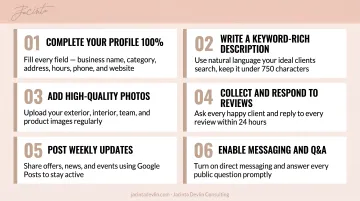
Reviews are also non-negotiable for local ranking. The 2026 BrightLocal Local Consumer Review Survey found that 47% of consumers won't use a business with fewer than 20 reviews, and 74% prioritize reviews written within the last three months.
Ask happy customers for reviews by sending a direct link — then respond to every review, positive or negative, in your own voice. A response like "Thank you for your feedback!" tells potential customers nothing. A specific, warm reply that references the actual interaction is what builds trust.
Apply Local SEO to Your Website
Your GBP and your website need to work together — search engines cross-reference both. Local SEO on your site doesn't require a developer. The fundamentals are straightforward:
- Use location-specific phrases naturally throughout your website copy, page titles, and meta descriptions. A women's clothing boutique in Boston should use "women's clothing boutique in Boston" — not just "women's clothing."
- Add a dedicated location page or "About Our Community" page if you serve a specific city or region. This signals relevance to both search engines and the humans reading it.
- Keep your name, address, and phone number consistent across your website and GBP — discrepancies confuse search engines.
In the Jacinta Devlin Consulting 12-Week Business Launch Program, SEO fundamentals are built directly into each client's website build — so organic discoverability is part of the foundation, not something patched in after the fact.
Own Your Story: Use Your Personal Brand as a Local Marketing Tool
Tell Your Founding Story to Connect Locally
Customers don't just buy products. They buy from people they know, like, and trust. A compelling founding story creates emotional connection that no chain store or corporate competitor can replicate, and most women entrepreneurs never fully use it.
Jacinta Devlin's own career is a clear example. She started at 21 as a broke college student who walked into a direct sales jewelry party for extra cash. That single decision led to a 12-year career as a Top 1% earner and million-dollar producer at lia sophia and Park Lane Jewelry, then a National Director of Sales & Field Training role at Stella & Dot, and eventually a consulting business serving thousands of women. That story appears across her website, speaking bio, and client conversations. It builds credibility not because it's polished, but because it's specific and real.
Where to place your story:
- About page: your full founding narrative lives here — make it specific, not polished
- Instagram bio and Highlights: a two-sentence version that immediately answers "who is this person?"
- Email welcome sequence: introduce yourself in the first email before you pitch anything
- Community events and speaking opportunities: in-person storytelling builds trust faster than almost any digital tactic
- Local press pitches: a genuine human story plus a women-owned angle is exactly what local journalists want
An imperfect story told honestly converts better than a slick brand statement that sounds like it was written by committee.
Highlight Your Women-Owned Status as a Differentiator
"Women-owned" isn't just a descriptor. It's a marketing asset. Buyers actively seek out women-owned businesses to support, especially in local markets where purchasing feels personal.
Practical steps:
- Display a women-owned badge on your website, email signature, and storefront
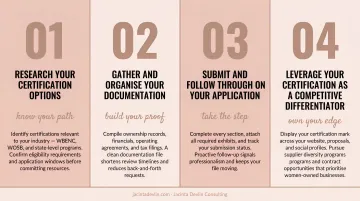
- Apply for WBENC certification (Women's Business Enterprise National Council) for added credibility, searchability, and access to buyers who specifically seek certified women-owned businesses
- Explore the SBA's WOSB program if federal contracting is on your radar (note: WOSB benefits apply to federal contracts, not private-sector sales)
- Tag your business as women-owned in your Google Business Profile and social bios
The women-owned label only carries weight when it's backed by a consistent brand identity. Your story, your positioning, and how you show up visually all need to say the same thing — otherwise the badge is just a badge.
Use Social Media and Social Selling to Reach Local Buyers
Choose the Right Platforms for Your Local Audience
Trying to maintain a presence on every platform is a fast path to burnout and scattered results. The better move is choosing one or two platforms where your local audience actually is:
- Facebook: Best for community-based discovery, local groups, and event promotion. Joining groups where your ideal local customers already gather — neighborhood groups, local buy/sell groups, women's business communities — is free and effective.
- Instagram: Strong for visual brands, lifestyle businesses, and boutiques. Location tags and local hashtags increase discoverability without ad spend.
- TikTok: Effective for reaching younger local demographics and driving discovery through short-form content.
Optimize your social profiles for local discovery by including your city or region in your bio, tagging your location in posts, and using hyper-local hashtags alongside industry hashtags.
Turn Followers Into Local Buyers Through Social Selling
Social selling is about building real relationships through consistent, personal engagement — and then converting that trust into a sale.
High-converting social selling behaviors include:
- Respond to comments in your own voice, not with copy-paste replies
- Start DM conversations that feel personal, not scripted
- Share behind-the-scenes content that shows the human running the business
- Go live regularly — live formats consistently outperform static posts for trust-building
Jacinta Devlin's coaching covers live shopping scripts, DM-to-sale conversion flows, and Story sales sequences — built around the insight that most women entrepreneurs already excel at relationship-building. What moves the needle is pairing those skills with a repeatable strategy.
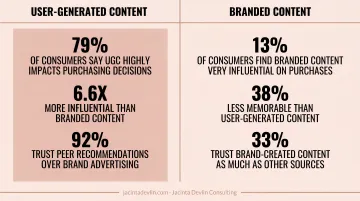
When local customers tag your business, share their photos publicly, or use a branded hashtag, they create social proof that no ad budget can buy. 79% of consumers say user-generated content highly impacts their purchasing decisions, compared to just 12% for branded content. Actively invite customers to tag you. Repost it. Make them part of your visible community.
Build Local Roots: Community Events, Partnerships, and Referrals
Showing up in the community — not just online — is one of the fastest ways to build local trust. And most of the best tactics here cost nothing.
Low-cost event and partnership ideas:
- A boutique partnering with a local salon for a "shop and style" pop-up
- A coach hosting a free workshop at a local co-working space or library
- Two complementary women-owned businesses co-hosting an Instagram Live for each other's audiences
- Sponsoring a table at a local women's business event or farmers market
These tactics put your brand in front of warm, local audiences who already trust the venue or the partner they showed up for. That trust transfers to you the moment you're in the room.
On referral programs: Word-of-mouth is the most trusted channel in local marketing — 88% of global consumers trust recommendations from people they know more than any other channel. A simple referral program doesn't require complicated software:
- Decide on the reward — a discount, a small gift, or store credit for the referring customer
- Tell your existing customers directly (email, DM, in person at checkout)
- Track referrals manually or with a simple form until your volume justifies a tool
Research also shows that referred customers carry higher long-term value than non-referred customers — meaning your referral investment adds up over time, well beyond that first sale.
Local PR and media: Those same authentic connections that fuel referrals also open doors in your local media landscape. Reach out to local bloggers, community newsletters, and podcasts with your story. The women-owned angle, combined with a real founding narrative, is genuinely newsworthy at the local level.
A feature in a neighborhood newsletter or a 20-minute spot on a local podcast can drive more qualified awareness than months of social content.
How to Budget for Local Marketing Without Wasting Money
The honest answer on marketing budgets: it depends on your stage, your business model, and your revenue — but there are useful benchmarks to work from.
According to SCORE, the average company puts around 11% of revenue to marketing, though that figure varies widely. For early-stage businesses, SCORE estimates initial monthly marketing expenses at $50 to $385, covering basics like social media, email, and a website presence.
Stage-based guidance:
| Stage | Priority | Budget Focus |
|---|---|---|
| Just starting | Free tactics only | GBP, organic social, referrals, networking |
| Early growth | Low-cost + selective paid | Email marketing, local events, occasional boosted posts |
| Scaling | Add paid local ads | Google Local Service Ads, Facebook geo-targeted ads |
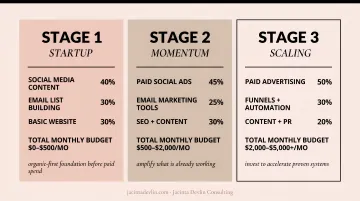
The principle is simple: build organic foundations first, then amplify with paid. Running paid ads before you have a clear brand story, an optimized GBP, and organic social momentum means paying to reach people who have no reason to trust you. That money is almost always wasted.
Metrics worth tracking from day one:
- Inbound inquiries and contact form submissions from your Google Business Profile (especially relevant if you serve local clients in person)
- Website traffic from local search terms
- Where new customers heard about you (ask directly at checkout or in a welcome email)
- Referral source tracking — which partnerships and programs send paying customers
Use that data to make decisions. If one channel consistently sends you paying customers, invest more time and money there before you experiment elsewhere. Your metrics tell you where your budget belongs — don't guess.
Frequently Asked Questions
How much should a small business pay for marketing?
Most frameworks suggest 7–11% of revenue for established businesses, but women-owned businesses just starting out should focus on free tactics first — Google Business Profile, organic social, and referral relationships. Paid channels make more sense once you have a brand story and organic audience already working.
What is the most effective local marketing strategy for small businesses?
Google Business Profile optimization and a referral program are the two highest-ROI starting points for most local businesses. Social media — particularly Instagram and Facebook — is a close third for women entrepreneurs focused on building a local following.
How do I market my women-owned business locally without a big budget?
Start with your GBP, join local community groups on Facebook, and share your brand story authentically across your platforms. Building referral relationships with complementary local businesses costs nothing and often drives your most ready-to-buy customers.
Can local marketing strategies work if I don't have a physical storefront?
Yes. Service-based businesses, coaches, social sellers, and online boutiques all build strong local customer bases using local SEO, geo-targeted social content, and community networking. A physical address is not a requirement for local visibility.
How do I get my women-owned business to show up on Google locally?
Two steps: claim and fully complete your Google Business Profile, and add location-specific keywords to your website copy and page titles. Consistent NAP (name, address, phone) information across both is essential.
How does storytelling help with local marketing?
An authentic founding story gives local customers a reason to choose you over a larger competitor. Share it consistently across your website, social, and in-person touchpoints — that repeated exposure builds the trust that turns a first-time visitor into a repeat buyer.