Introduction
Women-owned businesses now represent 39.2% of all U.S. firms — nearly 14.5 million businesses generating $3.3 trillion in annual revenue, according to the National Women's Business Council. The opportunity is real. So is the competition for attention.
Most ecommerce advice is built for brands with dedicated marketing teams and six-figure ad budgets. That leaves out a lot of women.
It wasn't written for the woman launching a boutique from her kitchen table, the direct seller moving her business online, or the creator building an affiliate storefront while working full-time.
This guide delivers 12 strategies organized by where you are in your growth journey — from building brand trust to scaling with systems. Each one is built for where you're starting from.
Key Takeaways
- Brand, community, and personal story are conversion advantages that larger brands cannot buy their way into.
- Traffic without conversion infrastructure is wasted money — build the store before scaling the spend.
- SEO, social commerce, and paid ads compound when used together, not as standalone bets.
- Customer retention is cheaper and more profitable than constantly chasing new buyers.
- Sustainable growth requires systems and a strategy built around your specific business — not a generic template borrowed from someone else's results.
Why Women-Owned Ecommerce Businesses Need a Strategy Built for Them
Most women entering ecommerce arrive with genuine selling ability — the kind built through direct sales, social selling, physical retail, or content creation. What they typically lack is the digital infrastructure to make that ability scale.
The pattern is consistent: strong relationships, loyal customers, real product knowledge — but no email list, no automated funnels, no content strategy that converts. They're posting reactively, launching softly, and relying entirely on platforms they don't own.
"An Instagram account is rented land. An email list is owned land — and your conversion rates are typically 10–40x higher." — Jacinta Devlin
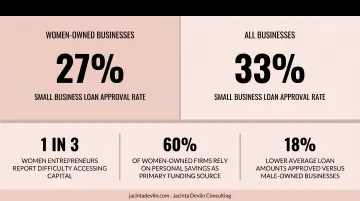
Women-owned businesses also face a documented resource gap. EPOP/NORC research shows only 24% of women-owned businesses receive the full loan amount they apply for, compared to 41% of men-owned businesses. That gap makes smart, high-leverage strategy even more critical — there's less margin for wasted spend.
The distinct strengths women entrepreneurs bring to ecommerce are exactly what large competitors can't replicate: community trust, relationship-driven selling, and an authentic personal brand. The 12 strategies below are built to put those advantages to work.
Strategies 1–3: Build a Brand That People Trust and Remember
Before any traffic or conversion strategy delivers results, the brand foundation has to hold. For women entrepreneurs, brand trust is often the deciding factor — across every category from boutiques to affiliate shops to service businesses.
Strategy 1: Lead With Your Personal Brand
In 2026, buyers want to know who they're buying from. The founder's story, values, and face aren't a distraction from the product — they're part of the product.
Stackla research of 2,042 consumers found 83% believe retailers need to provide more authentic shopping experiences, and user-generated content was rated 8.7x more impactful on purchase decisions than influencer content.
What leading with personal brand looks like in practice:
- Origin story content — why you started, what you believe, what problem you solve
- Behind-the-scenes posts — product sourcing, packing orders, your workspace
- Consistent visual identity — same colors, fonts, and tone across your website, Instagram, and emails
- Brand voice that travels — a customer should feel the same personality whether they're on your homepage or reading a Tuesday newsletter
Jacinta's client Christina R. rebranded her entire online presence to @mybalancedstyle — consistent identity across every channel — and grew from 13,000 to 95,000+ Instagram followers while building a business that now generates hundreds of thousands per month across Amazon and LTK.
Strategy 2: Create Content That Sells Without Feeling Salesy
Educational and inspirational content builds the trust that eventually converts — especially for women entrepreneurs whose audiences expect authenticity over pitches.
Content types that work for ecommerce:
- Tutorial and "how I style this" videos
- Before/after or transformation content
- Product demo Reels and TikToks
- UGC reposts from happy customers
- Blog posts targeting buyer-intent keywords (which also build SEO over time)
The burnout-prevention move is batching and repurposing. A single product shoot produces a Reel, a TikTok, static feed posts, Pinterest Idea Pins, email newsletter visuals, and blog images. One content day becomes six weeks of assets.
Jacinta's VIP Content Days do exactly this — on-location shoots that give clients months of on-brand material in a single session. Michele & McKaylee (MckMich Collective) described it as giving them "months of high-quality content to use" from one day.
Strategy 3: Build a Community, Not Just a Following
When customers feel connected to your brand, they don't just buy — they refer friends, share purchases unprompted, and stay loyal when a competitor runs a sale. A following watches. A community acts.
Research from Georgia Tech's Scheller College of Business found that customers who joined a firm-sponsored online community increased their purchase value by approximately 19% after joining.
Sharon B. put this into practice by building two private Facebook Groups — one grew to 30,000+ members, the other hit 37,000+ in just four months. Her Amazon sales went from $4,000 in her first year to $20,000+ per month consistently. The group wasn't built around her products; it was built around a shared identity her audience wanted to belong to.
Other community-building tactics that convert:
- Email lists — owned, not subject to platform reach drops, and consistently higher-converting than social media posts
- Live shopping events — TikTok and Instagram Live sessions that replicate the energy of in-person selling
- DM-to-sales automation — systems that let relationship-building conversations scale without manually following up on every inquiry
Community members don't just buy more — they refer others. Nielsen research puts 92% of consumers trusting recommendations from friends and family above all other forms of advertising.
Strategies 4–6: Drive Traffic and Get Discovered
A strong brand means nothing if the right people can't find it. These three strategies build your traffic across organic, social, and paid channels — and they work best when you run all three together.
Strategy 4: Own Your SEO From Day One
SEO is the most cost-effective long-term traffic driver available to a small ecommerce business. PowerReviews found that 89% of consumers turn to a search engine when researching products online, and BrightEdge reports organic search accounts for 53.3% of trackable web traffic.
For women-owned ecommerce businesses, the specific opportunity is long-tail keywords — niche, low-competition search phrases like "women-owned sustainable jewelry brand" or "small batch soy candles Boston" that large retailers can't target effectively.
Core ecommerce SEO actions:
- Keyword-rich product titles and descriptions (written for humans, not just crawlers)
- Alt text on every product image
- Blog content targeting buyer-intent questions your customer is already searching
- Fast, mobile-first site speed (Google's ranking algorithm rewards it)
SEO takes 3–6 months to compound, but the traffic it generates doesn't disappear when you stop paying for it. That staying power is exactly what makes it worth building before you scale paid ads.
Strategy 5: Show Up Where Your Buyers Are With Social Commerce
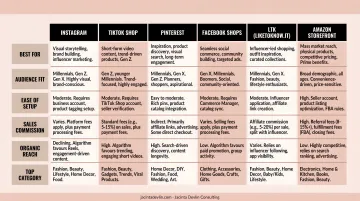
Social commerce is not optional in 2026. eMarketer projects U.S. social commerce sales will surpass $100 billion for the first time this year — and it's the primary discovery channel for many female consumers.
The platforms that matter most for women-owned ecommerce:
| Platform | Why It Matters |
|---|---|
| TikTok Shop | In-feed shoppable videos and LIVE shopping reduce friction from discovery to purchase |
| Instagram Shopping | Checkout directly in-app; shoppable posts integrated into content |
| 631M monthly users; 96% of top searches are unbranded — meaning your niche can rank | |
| LTK (LikeToKnow.it) | Drives $6B+ in annual consumer sales; Jacinta runs her own StyledByJacinta LTK storefront |
A basic social commerce setup requires three things:
- Linked product catalogs on every platform you sell through
- Shoppable posts embedded in your regular content
- Affiliate or creator partnerships that extend your reach organically
Jacinta built her own six-figure storefront on both LTK and Amazon, then coached Jennie S. through both platform approvals in her first year — reaching $5k+ monthly sales.
Strategy 6: Use Paid Ads Strategically, Not Desperately
The most common mistake is spending on ads before the brand foundation and conversion infrastructure are solid. Expensive traffic sent to a weak store doesn't fix a weak store. It just accelerates the loss.
When paid ads make sense:
- Retargeting warm audiences who visited your store but didn't buy
- Scaling a proven product/service with known conversion rates
- Seasonal campaigns with clear ROI targets
Platforms that perform for women-owned ecommerce:
- Meta (Facebook/Instagram) — Meta's Advantage+ Shopping Campaigns report a $4.52 average ROAS with a 19% cost-per-action improvement
- Pinterest — 69% of weekly users say Pinterest ads feel relevant, 30% higher than other platforms
- TikTok Spark Ads — Lets you amplify organic content you already know resonates
Three ways to cut wasted spend before you scale:
- Use UGC in your creative — real photos and reviews outperform studio shots
- Build lookalike audiences from your existing buyers, not cold interest targeting
- Set a minimum ROAS target and don't increase budget until you hit it
Strategies 7–9: Turn Browsers Into Buyers and Keep Them Coming Back
Getting traffic is only part of the equation. What actually builds a sustainable ecommerce business is what happens after someone lands on your store — whether they buy, come back, and bring others with them.
Strategy 7: Optimize Your Store for Conversion
The average ecommerce cart abandonment rate is 70.22%, according to Baymard Institute. Most of that abandonment is preventable with the right store setup.
Core elements of a high-converting women-owned ecommerce store:
- Clear product photography — Lifestyle shots that show the product in context, not just on a white background
- Transformation-focused descriptions — Speak to how the product makes the customer feel, not just its specs
- Mobile-first design — The majority of your buyers are on their phones
- Social proof front and center — Reviews, UGC, and customer photos visible on product pages
- Simple checkout flow — Every extra click is a dropout opportunity
- Multiple payment options — Shop Pay, Afterpay, Klarna reduce abandonment for price-sensitive shoppers
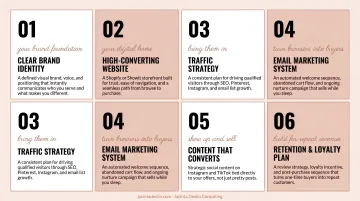
Ethical conversion levers (that don't feel manipulative): low-stock alerts when true, personalized "customers also bought" recommendations, and time-limited seasonal offers with genuine deadlines.
Jacinta's team builds Shopify stores with abandoned cart automation built in from day one — so boutique clients stop losing sales from the 70% who leave without completing checkout.
Strategy 8: Build a Loyalty and Referral Program
For women-owned brands, loyalty programs do double duty: they increase repeat purchase rate and generate word-of-mouth referrals from customers who genuinely love what you sell.
HBR cites Bain & Company research showing a 5% increase in customer retention can increase profits by 25% to 95%. Separately, LoyaltyLion research found 85% of consumers say a loyalty program directly influences their decision to repurchase from the same brand.
An effective loyalty structure includes:
- Points for purchases with bonus points for referrals and social shares
- VIP tiers that give top customers early access, free shipping, or exclusive products
- Referral incentives — Give the referrer a discount, give the new customer a welcome product/service
Referred customers aren't just cheaper to acquire. Wharton research across nearly 10,000 accounts found they were also more profitable and more loyal than customers who came in through other channels.
Strategy 9: Automate Your Post-Purchase Experience
Most brands go silent after the order ships. Narvar research shows 53% of shoppers view the post-purchase period as the most emotional part of the shopping experience — and silence is a wasted opportunity to deepen that connection.
Klaviyo data shows post-purchase email flows generate nearly 41% of total email revenue from just 5.3% of sends, with revenue per email almost 18x higher than campaign emails.
A post-purchase automation sequence for a small ecommerce business:
- Order confirmation — Immediate; set the brand tone, build excitement
- Shipping update — Reduce anxiety, reinforce trust
- How to use / styling tips — Maximize satisfaction, reduce returns
- Review request — Capture social proof while the experience is fresh
- Cross-sell or replenishment reminder — Introduce complementary products or refill prompts
- Loyalty product/service — Incentivize the second purchase
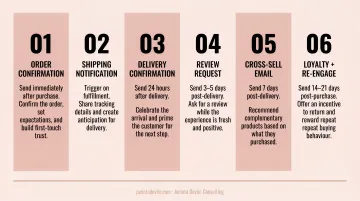
Jacinta's team builds these sequences on Flodesk (her personally recommended platform), Klaviyo, and Kit — all integrated directly with Shopify for boutique clients.
Strategies 10–12: Scale Smarter With Systems and Strategic Moves
These final three strategies are for women-owned businesses that are already generating sales and are ready to grow without working harder.
Strategy 10: Expand Your Sales Channels Intentionally
Multichannel customers have 15–35% higher average transaction value than single-channel shoppers and 30% higher lifetime value, according to Shopify data. But there's a critical distinction between intentional channel expansion and chaotic channel sprawl.
The framework for deciding which second channel to add:
- Where does your customer already discover products? Go there, not somewhere new.
- Can you fulfill orders from that channel profitably? Margin and operational capacity matter.
- Does the channel align with your content style? A boutique owner active on TikTok has a natural path to TikTok Shop. An LTK creator has a natural path to Amazon.
Etsy's marketplace has 89.6 million active buyers as of December 2024. Amazon reports that U.S.-based independent sellers averaged more than $290,000 in annual sales in 2024. Wholesale is a third option for product brands ready for retail partnerships.
Expand one channel at a time. Master it before adding the next — then the data from that channel tells you exactly where to go next.
Strategy 11: Use Data to Make Decisions, Not Guesses
Many small business owners scale what isn't working because they're not measuring what matters. The six metrics every women-owned ecommerce business should track:
| Metric | What It Tells You |
|---|---|
| Conversion rate | How well your store turns visitors into buyers (average Shopify store: 1.4%) |
| Average order value (AOV) | Revenue efficiency per transaction |
| Customer acquisition cost (CAC) | What you're paying to earn each new customer |
| Customer lifetime value (CLV) | Total revenue a customer generates over time |
| Repeat purchase rate | Loyalty and retention health |
| Email open/click rates | Engagement with your owned audience |
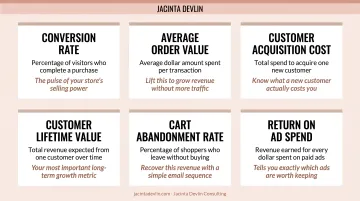
You don't need custom software. Shopify's built-in dashboard, Google Analytics, and your email platform's reporting (Klaviyo, Flodesk, Kit) give you enough data to make sharper decisions — cutting what's draining budget and doubling down on what's converting.
Strategy 12: Get Expert Help Before You Hit Your Ceiling
The most common growth ceiling in women-owned ecommerce looks like this: the founder is doing everything herself, the revenue is inconsistent, and working harder isn't moving the number. Generic courses and downloaded templates built for someone else's business won't break it. A real strategy built around your specific business will.
Jacinta Devlin has seen this pattern thousands of times. She's also broken through it — scaling her own ecommerce brand to consistent $10,000+ months, building her consulting business to over $1 million, and coaching women from their first dollar to $25 million in revenue.
Her clients' results speak to what strategy specificity produces:
- Lisa K. (Fleur de Lis Boutique FL) — $1,250 on launch day → $100,000+ in year one
- Sharon B. (Amazon affiliate) — $4,000 in year one → $20,000+ per month consistently
- Christina R. (@mybalancedstyle) — rebranded, grew to 95,000+ Instagram followers, quit her corporate job in 6 months
- Joy W. — $500/month → consistent $5,000+ months, surpassed her previous annual income in 6 months
If you're ready to stop guessing and build something that grows, book a free 15-minute Growth Chat with Jacinta. Every engagement starts there — and every program is built around your business, not a template.
Frequently Asked Questions
What ecommerce platform is best for women-owned small businesses starting out?
Shopify is the top choice for product-based businesses and boutiques — it handles inventory, checkout, and automation well. Showit or Squarespace work better for personal brands and service providers. Pick one that matches your business model and master it before expanding to additional channels.
How long does it take to see real growth from these ecommerce strategies?
SEO and community-building typically take 3–6 months to compound, while social commerce and paid retargeting can move faster. What matters most is consistent execution — clients working a structured plan with Jacinta typically see meaningful momentum within the first 30–60 days.
How can a women-owned ecommerce business compete with bigger brands that have larger budgets?
Small brands win on authenticity, niche specificity, and community — areas where large brands are structurally weak. A founder-led Instagram, real customer UGC, and hyper-targeted content routinely outperform generic big-budget campaigns — because no corporation can manufacture the trust a real founder builds.
What metrics should I track first as a women-owned ecommerce business owner?
Start with four: conversion rate, average order value, repeat purchase rate, and email list growth. Together, these show whether your store is converting, whether customers are coming back, and whether your owned marketing channel is actually growing — without burying a small team in data.
Can social media alone drive consistent ecommerce sales?
Social media drives awareness and community, but it's not a stable standalone sales engine — algorithm changes and platform risk make it unreliable as a sole revenue source. Pair it with an owned email list and a store built to convert, and social becomes the top of a funnel with a reliable close.
Do I need to show up on every social platform to grow my ecommerce business?
No. Depth beats breadth. It's better to dominate one or two platforms where your ideal customer already spends time than to spread thin across five. Start with the platform that naturally fits your content style and your customer's habits — then expand only after you've built real traction there.