
But the opportunity and the execution are two different things. Plenty of women launch skincare businesses with genuine passion and solid products, then stall within the first year — usually because they skipped the foundational work, underpriced from the start, or never built the systems that turn a hustle into a business.
This guide covers both sides: how to start with the right foundation, and how to grow once you've launched.
Key Takeaways
- A skincare business can be product-based, service-based, or hybrid — your model shapes everything from startup costs to compliance requirements
- Validated demand matters more than a full product line at launch
- FDA compliance and legal setup are non-negotiable but easier to navigate than most founders expect
- Branding, social media, and email marketing are what separate brands that grow from brands that stall
- Scaling requires systems — not just more effort
What to Know Before You Start a Skincare Business
Skincare businesses require more upfront research than most product categories. A few honest realities before you commit:
- Regulation is your responsibility from day one. Skincare products are regulated as cosmetics by the FDA. No pre-approval is required, but you own product safety and compliant labeling. The Modernization of Cosmetics Regulation Act (MoCRA) also introduced new registration and reporting requirements that took effect in 2024. Skipping this research early is one of the most common reasons indie brands stall.
- Timelines are longer than most founders expect. The early phase is about building infrastructure, not just making sales. Budget at least 3–6 months before you see consistent revenue traction.
- Know what you're actually building. There's a real difference between a skincare business for supplemental income and one you intend to scale into a brand with long-term equity. Both are valid — but they require different strategies, investment levels, and expectations from day one.
According to Beauty Independent, the most common stall points for indie beauty brands include insufficient funding, lack of a clear path to profitability, and the need to demonstrate proven performance before attracting investment. Getting clear on these three realities before you launch is what separates the brands that gain traction from the ones that stall at month six.
Why Start a Skincare Business in 2026?
The market timing is genuinely strong — but for specific, structural reasons.
The Numbers Support Long-Term Entry
The US skincare market is projected to grow at 7.5% CAGR from 2026 to 2033, reaching $62.87 billion. These numbers reflect category durability, not a short-term trend cycle. McKinsey reports skincare holds 44% of global beauty market share, with a projected 6% growth rate through 2028.
More relevant for indie founders: NIQ data reported by Beauty Independent shows indie facial skincare grew 23.2% compared to just 3.1% for conglomerates — and indie brands now hold roughly 41% of facial skincare category sales. Smaller brands are outpacing the conglomerates that once dominated the category.
The Channels Have Never Been More Accessible
The channel landscape has also shifted in favor of smaller brands:
- Social commerce is mainstream — TikTok Shop has proven particularly effective for skincare discovery and purchase, with brands like Medicube and Dr. Melaxin leading category sales during peak periods
- Amazon is growing fast — Jungle Scout reports 33% YoY unit sales growth in eye skincare and 29% in body skincare on Amazon alone
- Indie brands have consumer trust — ingredient-conscious buyers are actively seeking out smaller brands; ecommerce accounts for roughly 70% of indie beauty sales versus 48% for total beauty
Fit Matters More Than Timing
That channel access matters — but only if you show up consistently. The best time to start is when the market is ready and you have a clear audience, a defined product/service, and a plan you can actually execute. Market conditions open the door. Your preparation is what gets you through it.
How to Start Your Skincare Business — Step by Step
Most early-stage mistakes in skincare come from three places: skipping validation, underpricing, or launching before the legal and operational foundations are in place. This section is about avoiding those traps.
Step 1 — Define Your Niche, Audience, and Product Concept
Start narrow. A brand positioned for "everyone with skin" converts nobody. A brand built for acne-prone women in their 30s who want clean, minimal routines? That converts.
Mintel's US facial skincare data shows growth is concentrated in acne treatments, lip care, and targeted solutions — not broad moisturizers. Specificity is the strategy.
Choose your product model:
- Private label — Existing formulas you brand and sell; lower cost, faster to market, less R&D responsibility
- Custom formulation — Developed with a lab; higher cost and timelines, but differentiated
- Small batch / handmade — DIY production; highly controllable but harder to scale
- Service-based — Esthetician treatments; requires licensing, but lower product liability
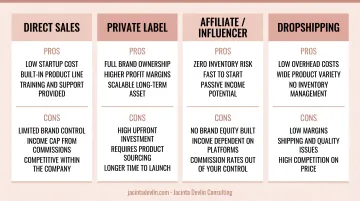
Each model carries different capital requirements, regulatory responsibility, and scaling potential. Know which one you're building before moving forward.
Step 2 — Validate Demand and Build a Business Plan
Enthusiasm is not demand. Social media engagement is not buying intent. Before investing in inventory or branding, confirm that real buyers exist and are willing to pay.
Practical validation methods:
- Pre-sell a small batch to a warm audience before producing at scale
- Run social polls asking about willingness to pay for a specific product concept
- Test a landing page with email capture before spending on inventory
- Sell a small test batch at a local market or pop-up to get live purchase data
Your business plan needs to include: startup and operating costs, pricing strategy with real margin math, a break-even timeline, your target customer profile, and your initial sales channel. One channel, done well, is more valuable than five done poorly.
Beauty Independent notes a repeat purchase benchmark worth tracking early: around 35% is considered strong, and even 15–25% can signal positive product-market fit in the early stages.
Step 3 — Price for Profitability
Starting low to "build a customer base" is one of the most damaging moves early-stage founders make. It trains customers to expect low prices, compresses your margin, and makes sustainable growth nearly impossible.
Build your price from the bottom up:
- Calculate your full cost of goods (product + packaging + labeling)
- Add platform or marketplace fees
- Add shipping costs
- Add a realistic marketing and acquisition cost
- Layer in your target profit margin
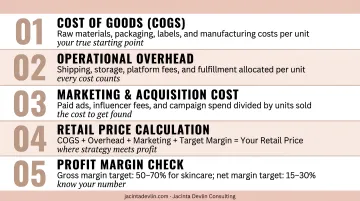
Public beauty companies show gross margins ranging from 33% to nearly 74% depending on product mix. Your margins as an indie brand will reflect your cost structure — the key is knowing those numbers before you set a price, not after.
Revenue model options:
| Model | Cash Flow | Scaling Potential |
|---|---|---|
| One-time product sales | Variable | Moderate — requires constant acquisition |
| Subscription bundles | Predictable | High — builds recurring revenue |
| Service packages | Steady | Limited by capacity |
| Wholesale | Volume-dependent | High — but margin compression |
Step 4 — Handle Legal Setup, Compliance, and FDA Basics
This step is not optional. Address it early and it's far more manageable than most founders assume.
Foundational legal setup:
- Register your business (LLC is common for product-based founders)
- Obtain an EIN
- Open a dedicated business bank account
- Secure product liability insurance
FDA compliance basics:
The FDA does not require pre-approval for cosmetic products — but you are fully responsible for product safety and accurate labeling. The Modernization of Cosmetics Regulation Act (MoCRA) introduced new requirements that include:
- Facility registration with the FDA (required for manufacturers and processors, renewed every two years)
- Product listing with ingredient disclosure, updated annually
- Safety substantiation records
- Serious adverse event reporting within 15 business days
- FDA mandatory recall authority
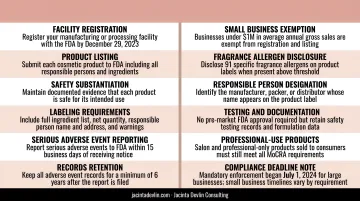
Enforcement of facility registration and product listing began after July 1, 2024. If you haven't reviewed MoCRA requirements yet, start now.
Labeling basics — every product must include an identity statement, net quantity of contents, business name and address, and a full ingredient list in descending order of concentration.
Federal requirements are just the baseline — state rules add another layer. California requires a cosmetic manufacturing registration (current fee: $1,009). Florida allows certain home-based cosmetic production under an exemption. Check your state's specific requirements before you start producing.
Step 5 — Build Your Brand Identity and Online Presence
In a saturated skincare market, trust is the currency. Your brand identity is how you build it before a customer ever tries a product.
Brand identity goes beyond a logo. It includes your tone, visual language, the values you stand for, and the specific promise you make to your customer. A DIY-looking brand directly lowers willingness to pay and kills conversion — even when the product is excellent.
Digital infrastructure to build from day one:
- A website or e-commerce store (Shopify is the standard for physical product brands)
- An email list — not optional; social media is rented reach, your email list is owned
- One social platform where your customer actually spends time (Instagram, TikTok, and Pinterest are the primary discovery channels for skincare)
Choose one primary sales channel and build it properly before expanding. DTC Shopify store, Amazon, Etsy, and TikTok Shop are all viable — but splitting attention too early spreads your resources thin and delays traction on all of them.
If you want the brand development, Shopify build, email setup, and full launch plan handled for you, Devlin Consulting's 12-Week Business Launch Program does exactly that. Jacinta Devlin leads the strategy directly — covering brand identity, email marketing automation, sales funnels, and a sequenced launch plan from day one.
Step 6 — Launch, Track, and Stabilize Before You Scale
A focused launch beats a flashy one. Bring a limited product selection to a warm, prepared audience with clear messaging and a way to collect real feedback fast.
Metrics to monitor in your first 90 days:
- Conversion rate — are visitors buying?
- Repeat purchase rate — are buyers coming back? (15–25% is an encouraging early benchmark)
- Cost per acquisition — what are you actually spending to get a customer?
- Customer feedback — what are people saying about the product, packaging, and experience?
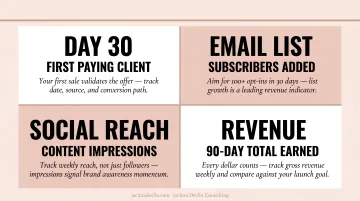
Fix gaps before you add products, platforms, or paid ad spend. Scaling a broken system doesn't fix the system — it amplifies the problems.
How to Grow Your Skincare Business
Sustainable skincare growth comes from building systems that generate revenue consistently — whether or not you're actively selling that day.
Build Revenue That Doesn't Require Constant Manual Effort
When every dollar of revenue requires manual effort from you personally, your income caps at your available hours. The fix is automation — systems that sell, follow up, and retain customers while you focus elsewhere.
High-leverage repeat revenue strategies:
- Email automations — abandoned cart sequences, post-purchase flows, and loyalty sequences convert one-time buyers into repeat customers without manual outreach. Yotpo reports beauty brands see a 66.3% increase in revenue per redeeming customer within 90 days of joining a loyalty program
- Subscription bundles — predictable recurring revenue with higher lifetime customer value
- Product bundling — increases average order value at the point of sale
- Email list building — every social platform can change its algorithm; your email list cannot be taken from you
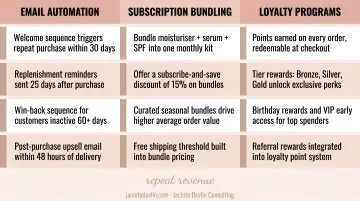
Devlin Consulting builds these exact systems — abandoned cart automation, post-purchase sequences, welcome flows, and loyalty campaigns — on platforms including Flodesk, Klaviyo, and Kit, integrated directly with Shopify for product-based brands.
Use Content to Build Trust at Scale
Educational content, ingredient breakdowns, before-and-after results, and founder story content are the primary conversion tools in skincare. Buyers in this category research before they purchase — and the brands that show up consistently with credible, useful content win the sale.
Content formats with strong skincare ROI:
- Product demonstration Reels and TikToks
- Ingredient education carousels
- Skin concern Q&A content
- Routine videos featuring your products in context
- Real customer results (with permission)
Micro-influencers in the skincare and wellness space consistently deliver stronger conversion rates than macro or celebrity partnerships for indie brands — particularly because their audiences are built on trust, not reach.
Those tactics will carry you through early growth. But at a certain point, execution alone stops moving the number — and that's when strategy becomes the constraint.
Recognize When You've Hit a Strategy Ceiling
The most common growth ceiling for women-owned skincare businesses isn't product quality or market demand. It's the absence of a repeatable scaling strategy. Working harder stops producing proportional results once the fundamentals aren't in place.
For women who have already launched and are stuck — inconsistent revenue, unclear next steps, no repeatable growth system — the Business Growth Program at Devlin Consulting is designed specifically for this stage. It delivers weekly 1:1 strategy calls with Jacinta Devlin directly, a personalized growth plan built around your specific business model, and accountability systems between calls.
Jacinta has personal brand-partner experience with Sephora and Lifeline Skin Care, and has coached product-based business owners to consistent $10K+ months. Amanda O. went from a $2,500/month goal to consistent $10,000+ months; Lisa K.'s boutique generated over $100,000 in year one.
The entry point is a free 15-minute discovery call — no commitment, no template pitch, just a direct conversation about your specific business.
Conclusion
Starting a skincare business in 2026 is achievable — the market is growing, the channels are accessible, and consumer appetite for indie brands is real. The brands that last are built on clarity, validated demand, and the discipline to treat the business like a business from day one.
Launching is only the beginning. Consistent income comes from building repeatable systems around your marketing, your offers, and your customer experience — and adjusting each one as you grow. If you're a woman building a product brand and want a strategy tailored to your specific business (not a generic template), that's exactly the work Jacinta Devlin Consulting does. You can start with a free 15-minute Growth Chat to see if it's the right fit.
Frequently Asked Questions
Do you need FDA approval to sell skincare?
No. The FDA does not require pre-approval for cosmetic skincare products in the US. However, you are responsible for product safety and compliant labeling. MoCRA (effective 2024) introduced additional requirements including facility registration, product listing, and safety substantiation records that all sellers should review.
How much money do I need to start a skincare business?
Startup costs vary widely by model. A private-label or small-batch approach can launch for a few thousand dollars; a fully custom-formulated line with professional branding and initial inventory can run $10,000–$30,000 or more. The key is building a detailed business plan that maps your real costs before spending anything.
Is a skincare business profitable?
It can be — skincare has strong margin potential and high repeat purchase behavior. But profitability depends on pricing correctly from the start, controlling production costs, and building consistent customer retention. Sales volume alone doesn't create a profitable business.
How do I find the right niche for my skincare business?
The right niche sits at the intersection of a specific customer problem, a gap in the current market, and something you can speak to authentically. Starting too broad is one of the most common early mistakes — specificity increases conversion, not limits it.
Can I start a skincare business from home?
Yes, many skincare businesses start home-based. But local zoning laws, state cosmetic manufacturing regulations, and FDA compliance requirements still apply regardless of where products are made or stored. Check your state's specific rules before producing.
How long does it take to start making money with a skincare business?
Most skincare businesses take 6–12 months to reach consistent revenue, with the first 90 days focused on validation, launch, and stabilization. Those who skip the validation phase or launch without a defined audience typically take far longer to see real returns.