
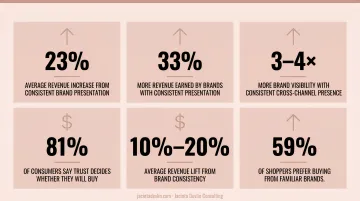
Brand creative direction is the strategic layer that most women entrepreneurs skip when they're building their brand — and it's exactly where businesses stall. According to Lucidpress research on brand consistency, companies with consistent branding can see up to a 33% increase in revenue. Yet the same study found that 81% of companies still deal with off-brand content.
Jacinta Devlin built million-dollar sales teams, scaled her own ecommerce brand to consistent $10k+ months, and has coached 500+ women entrepreneurs through her consulting practice. The pattern she sees repeatedly: women with beautiful branding assets but no cohesive creative direction — and businesses that plateau because of it.
This guide breaks down exactly what brand creative direction is, what it needs to include, and how to build one that makes your brand recognizable and ready to grow.
Key Takeaways
- Brand creative direction is a strategic framework, not just a mood board or logo package
- Every visual, verbal, and content decision should trace back to your audience and positioning
- Document your creative direction before you bring in any collaborator, VA, or designer
- Inconsistent branding directly suppresses conversion rates and customer trust
- Build your creative direction before your content — or your visuals will look good and sell nothing
What Is Brand Creative Direction (And Why It Matters for Your Business Growth)
Brand creative direction is the strategic decision-making framework that determines how your brand looks, sounds, and feels across every touchpoint: Instagram posts, email campaigns, packaging, and everything in between. It ensures everything communicates the same message, to the same audience, in the same way.
This is different from brand identity. Your brand identity is the toolkit: logo, colors, fonts. Creative direction is the strategy for using that toolkit: what it communicates, when it appears, and how every piece connects to the same story.
Why This Is a Business Problem, Not Just a Branding Problem
Here's what happens without it:
- Every content decision becomes guesswork
- Your brand looks inconsistent across platforms
- Potential customers lose confidence before they ever click "buy"
- Collaborators, VAs, and designers interpret your brand differently every time
Research from Ipsos found that 87% of consumers globally factor company reputation into purchase decisions, and that trust explains 78% of variance in willingness to pay a premium. Your creative direction is what builds — or destroys — that trust at every touchpoint.
Jacinta frames it directly in her brand development work: "The way your brand looks and the way it communicates are not vanity decisions — they are direct revenue drivers." A brand that looks inconsistent or DIY directly reduces willingness-to-pay, lowers conversion rates on premium offers, and closes doors to partnerships.
That's the pattern behind most businesses that plateau. They're posting, creating, showing up — doing plenty of activity. What's missing is the strategic architecture underneath: the creative direction that turns scattered effort into a recognizable, trustworthy brand.
The Essential Elements Every Brand Creative Direction Should Include
A complete brand creative direction document gives any team member, designer, or content creator a clear reference point. Here's what it must contain.
Brand Mission, Values, and Positioning Statement
Every creative decision should trace back to three things: what you do and why (mission), what you stand for (values), and who you serve and how you're different (positioning).
Document:
- A one-sentence brand mission
- 3–5 core values with brief notes on how each shows up in the brand
- A positioning statement naming your specific audience, your promise, and your differentiator
Without this foundation, creative decisions default to trends and gut instinct. These three elements give every visual and verbal choice a consistent filter to run through.
Target Audience Profile
Creative direction only works when it's built around a specific person. Go beyond demographics. Document:
- Values and aspirations
- Lifestyle and daily habits
- How she consumes content and what she trusts
- What makes her stop scrolling
Every creative choice — color, tone, imagery, language — should be made with this specific woman in mind, not a generic idea of your market. McKinsey found that 78% of consumers said personalized content made them more likely to repurchase — and 76% get frustrated when brands don't feel relevant to them. Your audience profile is what makes personalization possible.
Color, tone, imagery style, language — all of it flows from this profile.
Brand Voice and Tone Guidelines
Voice is the consistent personality of your brand: bold, warm, authoritative, playful. Tone is how that voice shifts slightly by context — more conversational on Instagram, more professional in a proposal.
Both need to be explicitly defined. Include:
- 3–5 voice descriptors with "we are / we are not" examples (this prevents misinterpretation by collaborators)
- Tone guidance for email vs. social media vs. sales copy
- Words and phrases that are on-brand versus off-brand
Visual Identity System
This covers the full visual language your brand uses:
- Primary and secondary color palette with exact hex codes
- Typography system: heading, body, and accent fonts
- Logo usage rules covering each version and approved contexts
- Imagery and photography style: lighting, mood, subject matter, editing approach
The imagery section is the most commonly overlooked. Every photo or graphic used across your brand should feel like it belongs to the same world. Include reference images or a mini mood board to anchor this. The mood board is one input that informs the visual language — not the final deliverable.
Typography matters more than most people realize. Monotype research on typeface and consumer response found that typeface choice can boost positive consumer response by up to 13%, including measurable improvements in perceived relevance, memorability, and trustworthiness.
Brand Story and Narrative Framework
Brand story is not a biography. It's the emotionally resonant narrative that connects your origin, your mission, and your customer's transformation — the one that makes your audience say, "This is for me."
Document:
- The core brand narrative arc (where the brand came from, what it stands for, where it's taking the customer)
- The customer's before-and-after story (the problem she has, the transformation the brand creates)
- Signature phrases or storytelling angles that belong to your brand's unique voice
Content Style and Application Guidelines
A creative direction document is only useful if it tells people how to apply it. This section bridges strategy and execution.
Cover:
- Approved content formats and styles per platform
- Graphic template guidelines (branded vs. unbranded content ratios)
- Caption tone and length guidance
- A simple "does this feel on-brand?" checklist for anyone creating content
Without a checklist, every collaborator applies the brand through their own lens — and consistency erodes faster than you'd expect.
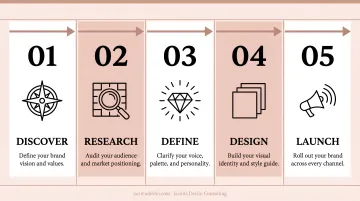
How to Build Your Brand Creative Direction Step by Step
This process takes focused effort — but following the right sequence makes the difference between a brand that looks good and one that actually converts.
Start with strategy, not visuals. Define your audience profile, mission, positioning, and what makes you distinctly different before touching any design element. Skipping this step is why so many brands end up with beautiful visuals that don't sell.
Audit what you already have. Review your existing content across all platforms and honestly assess what's consistent, what's off-brand, and what's missing. Those gaps are exactly what your creative direction needs to fill.
Build your visual language and mood board. Gather reference images that capture the feeling you want your brand to evoke, then use them to finalize your color palette, typography, and imagery style. Canva works well here and keeps the process accessible.
Write your brand voice and story guidelines. Document your voice descriptors, tone variations, core narrative, and example copy in a format collaborators can actually use — not a 40-page manual nobody opens.
Test it across touchpoints. Apply your creative direction to a week of content across your key platforms and ask whether it feels cohesive, connects with your audience, and accurately represents your brand promise. The first pass will reveal gaps — that's expected and normal.
Working through this process with a strategist who understands both brand and growth can compress the timeline and help you avoid the expensive creative restarts that come from building visuals before strategy. Jacinta's Business Growth Program is built around your specific business so you can move faster with a clear plan from day one.
How Creative Direction Shapes Your Social Media and Content Strategy
For women building businesses online, social media is often where the brand lives. Which means creative direction is the infrastructure every piece of content runs on — not a branding nice-to-have you get to eventually.
A defined creative direction tells you:
- Which content formats feel on-brand for your specific business
- How your photos and graphics should look across your feed
- What your captions sound like and how long they run
- How campaigns connect back to one unified brand story
The result is a presence people recognize instantly, because everything you post belongs to the same world.
The 30-Second Post Filter
Before publishing anything, ask three questions: Does this look like my brand? Does this sound like my brand? Does this serve my audience's needs? If the answer to any is no, revise before you hit post. This check takes 30 seconds and prevents months of brand drift.
That filter only works when you have a clear direction to check against. Jamie Ralliford, a Jacinta Devlin Consulting client who was running three separate businesses with no unified brand, described her pre-rebrand state as "literally all over the place." After consolidating her identity under a single cohesive brand direction, she gained consistent 25–30 new followers per week. Same posting frequency. Completely different results.
Common Mistakes That Undermine Your Brand Creative Direction
Mistake 1: Chasing trends instead of building something ownable. What's popular on Pinterest this month will look dated by next quarter. Your creative direction should be timeless and distinctly yours — built around your audience and positioning, not whatever aesthetic is trending right now.
Mistake 2: Treating it as a one-time project. Creative direction is a living document. Review it annually. Revise it when something significant shifts — new product line, rebrand, new target audience, new market. The core stays stable; the application evolves with your business.
Mistake 3: Keeping it in your head instead of writing it down. Even solo entrepreneurs need a documented creative direction. Without it, every content decision costs unnecessary time and mental energy. The moment you bring in a VA, designer, or collaborator, the brand starts to drift — because there's no shared reference point.
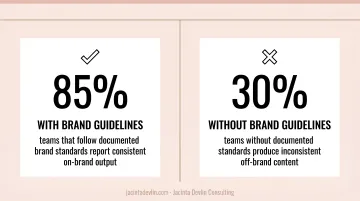
That last mistake is more common than you'd think at any business size. Marq reports that 85% of organizations have brand guidelines, but only 30% consistently enforce them. That gap is where most brand inconsistency happens. Build the document, keep it somewhere your whole team can find it, and use it as the filter for every content decision.
Frequently Asked Questions
What is the difference between creative direction and brand identity?
Brand identity is the visual toolkit — logo, colors, fonts. Creative direction is the strategic vision that guides how those assets are used, what they communicate, and how they show up consistently across every touchpoint. Without creative direction, even a polished brand identity produces inconsistent results.
Can I create a brand creative direction on my own, or do I need to hire someone?
Yes — the framework in this guide gives you everything you need. It does require honest self-assessment and the ability to see your brand from your customer's perspective, not your own. If you're in a scaling phase, working with a strategist like Jacinta can prevent costly restarts and get you there faster.
How often should I update my brand's creative direction?
Review it annually and revise it whenever a major shift occurs — new offer, rebrand, or new audience. The foundational elements stay stable; the application evolves as your business grows.
What is a mood board and do I really need one?
A mood board is a visual collage of images, textures, colors, and typography that captures the feeling and aesthetic of your brand. It's a useful tool within the creative direction process, but it is not the creative direction itself. Treat it as one reference input, not the final deliverable.
How does creative direction affect my social media content?
It removes the guesswork from every content decision. A defined creative direction tells you exactly how photos should look, how captions should sound, and what types of content belong to your brand — resulting in a feed that builds recognition and trust over time.
How do I know if my brand currently lacks creative direction?
Watch for these signs:
- Content looks inconsistent across platforms
- Your Instagram doesn't match your website
- You spend too much time deciding what to post
- Customers can't immediately tell what your brand is about or who it's for
If any of those sound familiar, it's time to build one.