

Introduction
The candle industry is bigger than most people realize. According to Grand View Research, the global candle market is projected to reach $20.09 billion by 2030, growing at a 5.7% CAGR — and the National Candle Association estimates US retail candle sales already sit at approximately $3.14 billion annually.
That scale explains why so many women — stay-at-home parents, side-hustlers, creative professionals — are drawn to starting a candle business:
- Low startup costs with home-based production
- A tangible product with strong gifting demand year-round
- Multiple ways to sell: Etsy, your own website, craft fairs, and wholesale
But attractive market numbers don't automatically translate into a profitable business. Many candle businesses launch with enthusiasm and stall within the first year — not because the market isn't there, but because they skipped foundational steps.
This guide covers both sides: how to start a candle business the right way, and how to grow it past the early-stage plateau into consistent revenue.
Key Takeaways
- The global candle market is projected at $20+ billion by 2030, with strong gifting, home décor, and wellness demand
- A home-based candle operation can launch for under $1,000, but profitability depends on pricing, positioning, and marketing from day one
- Most candle businesses take months or longer to break even; patience and a real strategy are non-negotiable
- Scaling past early sales means shifting from maker-mode to business-owner mode — systems, marketing, and channel diversification
- Niche clarity and brand identity matter far more than production volume
What to Know Before Starting a Candle Business
Many people start a candle business drawn in by how simple the product looks: wax, fragrance, a container. The reality involves two distinct skill sets that are easy to underestimate — and demanding when learned at the same time.
Getting a candle ready to sell — not just made, but actually safe and consistent — requires repeated testing across burn performance, flame height, container temperature, wick behavior, and scent throw. Most beginners underestimate how many batches that takes.
Then there's everything else: pricing, branding, legal setup, marketing, customer acquisition, and channel management. Each of these is its own learning curve.
Trying to master both at once without a structured plan is the most common path to early burnout.
The Timeline Reality
The SBA is direct on this point: some businesses take months or years before breaking even, and many lose money in the early period. SBA data on small business survival shows only 67.9% of new employer establishments survive their first two years — and that's across all industries, not just handmade products.
Those numbers matter for candle businesses specifically. The goal in the first 6–12 months should be product mastery, demand validation, and audience building — not replacing a full-time income. Founders who set that expectation early are far more likely to still be operating at month 18.
Why Start a Candle Business?
The numbers back this up.
The National Candle Association reports that candles are used in 7 out of 10 US households, and 76% of candle purchasers view candles as an appropriate gift for holidays, housewarmings, birthdays, and thank-you occasions. That's not a niche product with a fragile demand base — it's a category with deep, recurring consumer behavior.
Structural Advantages
- Low entry cost — a home-based operation can launch for under $1,000
- Home-based production — no commercial facility required at startup
- Multiple sales channels — Etsy, your own Shopify store, craft fairs, wholesale, TikTok Shop
- High margin potential — CandleScience notes wholesale prices are typically half of retail, with the maker's cost needing to sit well below that to preserve margin
- Room to differentiate — scent, packaging, brand story, and niche (eco-friendly, aromatherapy, decorative, pet-friendly) all set you apart from generic competitors
Those advantages matter — but so does the landscape you're entering.
The Competitive Reality
The candle market is saturated at the commodity level. Anyone can make a generic soy candle and list it on Etsy for $12. The opportunity isn't in volume or low price — it's in building a specific brand that earns customer loyalty from a defined audience. A candle that speaks to a particular lifestyle, value set, or aesthetic can command much higher prices and build repeat buyers in a way that a generic product never will.
How to Start a Candle Business – Step by Step
Most early-stage problems trace back to skipping steps — selling before the product is tested, pricing below cost, or launching without any audience. Work through these in order.
Step 1: Master the Craft and Test Your Product
Before a single candle is listed for sale, the product must be thoroughly tested for both safety and quality.
Safety requirements are non-negotiable:
- ASTM F2058 (active standard) covers fire safety labeling on candle units of sale — this applies before you sell a single unit
- CPSC guidance identifies federal lead-wick requirements (16 CFR 1500.17) and references ASTM F2058, F2179, and F2417 as relevant standards
- Labels must include fire safety warnings visible at point of sale
Quality testing matters just as much:
- Burn performance across multiple wicks and containers
- Flame height and container temperature (safety and aesthetics)
- Cold and hot scent throw
- Visual aesthetics across different ambient temperatures
The practical approach: make a large number of practice candles and give most of them away. Ask for honest feedback on scent, burn quality, and packaging — not just "I love it." Real feedback from real people before you've spent money on branding or inventory is worth more than any market research.
Step 2: Define Your Niche, Customer, and Market Position
The candle market has three broad segments, and your choice shapes every downstream decision:
| Segment | Price Range | Where They Sell | Buyer Profile |
|---|---|---|---|
| Mass-market | Low | Big box, Amazon | Price-driven, convenience-focused |
| Mid-market | Mid | Etsy, own website, boutiques | Quality-aware, lifestyle-oriented |
| Prestige/Luxury | High | Own site, high-end retail | Brand-driven, experience-focused |
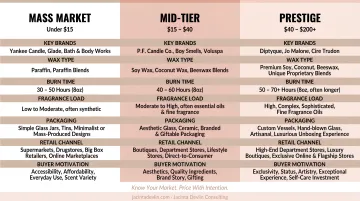
A candle business that tries to appeal to everyone typically wins no one. Pick a lane, then go deeper within it.
Niche options worth considering:
- Soy-based eco candles (sustainability-focused buyers)
- Aromatherapy candles (wellness audience)
- Decorative/aesthetic candles (home décor and gift market)
- Memory or location-scented candles (novelty gifting)
- Pet-friendly, non-toxic formulas (pet owner households)
Once you've chosen a niche, define the specific person buying your candle: their lifestyle, what they value, and what they're willing to pay. That customer profile should inform every future decision, from packaging to marketing channel.
Step 3: Validate Demand and Set Profitable Pricing
Validation means someone actually pays for your product — not just that they said they liked it. Before scaling production, test with:
- Small batch sales at a local craft fair or market
- A soft launch on Etsy with 5–10 SKUs
- Selling to friends-of-friends (not just friends, who won't tell you the truth about price)
Pricing formula:
Materials + Labor + Packaging + Overhead + Margin = Minimum Viable Price
CandleScience notes that wholesale prices are typically about half the retail price, and recommends wholesale pricing at 2–3x total production cost. If you can't hit that math, something in your cost structure needs to change before you scale.
The most common early mistake: underpricing to attract customers and getting stuck there. Raising prices on existing customers later is harder than launching at the right price from the start.
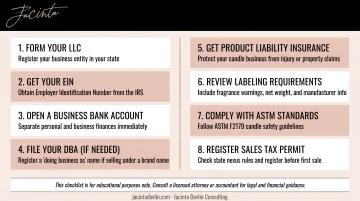
Step 4: Handle Legal Setup, Insurance, and Compliance
Once you've validated demand and priced correctly, protecting what you're building becomes the next priority. Get the legal foundations in place before you take your first real order.
Legal foundations:
- Choose a business structure — a sole proprietorship is the simplest, but offers no personal liability protection. An LLC separates personal and business assets and is worth the setup cost given candle-related risks
- Obtain an EIN (free from the IRS)
- Open a separate business bank account
- Check local zoning and permit requirements for home-based manufacturing
Insurance: CandleScience recommends general liability, product liability, business property, and business interruption coverage for candle makers. Product liability specifically covers claims from products after they're sold — and with fire, heat, and container risks inherent to candles, this isn't optional.
Labeling: ASTM F2058 compliance is required before you sell. This is a pre-launch requirement, not an afterthought.
Step 5: Build Your Brand and Sales Presence
A candle brand is the reason a customer chooses your product over the one sitting next to it on the shelf or page. It's the story, aesthetic, values, and voice that create preference.
Brand fundamentals:
- Name (check domain availability and social handles before committing)
- Visual identity: color palette, label design, photography style
- Brand story: why you make this product and who it's for
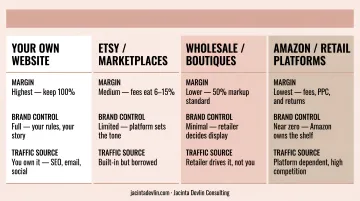
Sales channel decisions:
- Own ecommerce website (Shopify): Keeps the highest margin and full brand control, but you build your own traffic from scratch
- Etsy: Existing search traffic shortens time to first sale, but you're competing on the same page as hundreds of similar products
- Craft fairs and markets: Face-to-face selling builds customer trust fast and generates immediate cash flow while you're still refining your product
- Wholesale: Moves volume, but only works if your pricing structure survives a 50% retailer cut without going underwater
Start with one or two channels and do them well before expanding. Trying to manage four sales channels at launch means none of them get the attention needed to gain traction.
Step 6: Launch, Market, and Build an Audience
The most effective marketing channels for candle businesses:
- Instagram and TikTok: Short-form video showing the pour process, scent comparisons, packaging reveals. TikTok Shop reported 70% year-over-year sales growth for small US businesses in 2025, with over one-third of monthly TikTok Shop purchases going to small businesses
- Pinterest: Strong home décor and gifting audience — high purchase intent, longer content shelf life
- Email list: The one channel you own. Unlike social media accounts, your email list can't be taken away by an algorithm change
Build your audience before launch, not after. Even 200–300 engaged followers before you open the store creates early sales momentum that a cold launch never achieves.
Consistency beats volume. Post regularly, engage with comments, leverage seasonal peaks — the National Candle Association confirms approximately 35% of candle sales occur during the Christmas/holiday season. Planning content and inventory around Q4 isn't optional for a candle business.
How to Grow Your Candle Business After Launch
Getting your first sales is a different challenge than building consistent monthly revenue. The shift from "just started" to "growing steadily" requires moving out of pure maker mode and into business strategy mode.
Increase Average Order Value and Repeat Purchases
- Bundles: Candle sets, gift boxes with accessories (matches, snuffers, trays)
- Complementary products: Wax melts, room sprays, candle care kits
- Subscription programs: A scent-of-the-month model creates predictable revenue and builds customer lifetime value — Keap Candles documented increased LTV using flexible subscription tiers
- Limited-edition seasonal releases: Drive urgency, justify premium pricing, create excitement around new launches
Wholesale and Retail Partnerships
Wholesale expands your reach without requiring you to find every customer individually. Approach local boutiques, gift shops, and home décor stores with samples, a wholesale price sheet, and a clear brand story.
Faire, which serves over 700,000 independent retailers, is a practical starting point for getting in front of buyers without cold-calling. The math matters here: this is why getting retail pricing right before you scale is so critical. If your retail price doesn't leave room for a 50% wholesale discount and still cover your costs, wholesale will shrink your margins rather than grow your business.
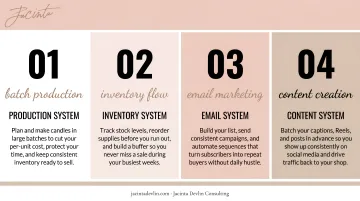
Build Systems Before Scaling Production
Without systems, growth stalls because the owner becomes the bottleneck. Before scaling:
- Batch production planning — so you're not making candles reactively
- Inventory tracking — know your sell-through rates before reordering materials
- Email automation — welcome sequences, abandoned cart recovery, post-purchase review requests
- Content calendar — consistent social posting without reinventing the wheel weekly
When to Get Outside Help
Systems get you organized — but sometimes the ceiling isn't operational. For women making sales but stuck below consistent $10K+ months, the gap usually sits in one of three places: pricing structure, marketing systems, or channel strategy.
Generic blog advice can only go so far when the problem is specific to your business.
Jacinta Devlin works directly with product-based businesses — including candle brands — building the Shopify storefronts, email automations, and marketing systems that turn sporadic sales into consistent monthly revenue. Her Business Launch Program and Business Growth Program are built for this exact stage.
The starting point is a free 15-minute Growth Chat where Jacinta reviews your current revenue, goals, and obstacles and recommends which approach fits your stage. Book directly at calendly.com/devlinconsulting/15-minute-consultation.
Conclusion
Starting a candle business is genuinely accessible — low startup costs, home-based production, strong and recurring consumer demand. The businesses that actually grow, though, are the ones that treat it like a real business from day one: testing the product thoroughly, pricing for profit, building a brand identity, and marketing consistently before the first sale.
Speed matters less than clarity. Knowing exactly who you're selling to, what makes your candle worth choosing over another, and how you'll reach that customer systematically — those are the decisions that determine whether this stays a side project or becomes a real income stream.
That clarity is exactly what Jacinta Devlin Consulting helps women entrepreneurs build. If you're ready to move forward with a strategy built around your specific business — not generic advice — book a free 15-minute Growth Chat to get started.
Frequently Asked Questions
How profitable is a candle business?
Candle businesses can achieve strong gross margins — CandleScience recommends wholesale pricing at 2–3x production cost, with wholesale prices sitting at roughly half of retail. Actual profitability comes down to pricing discipline, production efficiency, and customer acquisition cost.
How much does it cost to start a candle business?
A small home-based operation can launch for under $1,000, covering initial materials, basic equipment, packaging, and an ecommerce platform. Costs scale as production volume and marketing spend increase.
Do I need a license or permit to sell candles from home?
No federal candle-making license is required, but check local zoning and business permit requirements for home-based production. Forming an LLC is worth the cost given fire-related liability risks, and product liability insurance is essential before you start selling.
How do I price my candles to make a real profit?
Start with: materials + labor + packaging + overhead + desired margin = minimum viable price. Set your retail price first, then work backward to ensure wholesale (roughly half of retail) still covers your costs with margin intact. Underpricing to win early customers is the most common mistake candle makers make — and the hardest one to undo.
What is the best place to sell candles online?
Your own Shopify store offers the highest margin and full brand control. Etsy provides built-in traffic but lower differentiation and platform fees. TikTok Shop is increasingly effective for product discovery. Start with one channel, execute it well, then expand.
How long does it take to grow a candle business into consistent income?
Most candle businesses take at least 6–12 months to stabilize, with consistent monthly revenue taking longer — the SBA notes many businesses don't break even for a year or more. How early you build an audience and how consistently you market will determine where you land on that timeline.