The problem isn't your products or your content — it's the absence of a system that moves people from "I love this" to "I just bought this." That system is a sales funnel, and for fashion brands, it looks nothing like the templates designed for software companies or online coaches.
Fashion buying is emotionally driven and identity-based. Your customer isn't solving a problem — she's expressing who she is, or who she wants to become. Getting this distinction wrong is exactly why most fashion funnels fail to convert even when the content looks great.
This guide breaks down how to build a sales funnel specifically for fashion brands — from first discovery to loyal repeat buyer.
Key Takeaways
- A fashion sales funnel has four stages: Attract, Engage, Convert, and Retain — each needs a different strategy
- Fashion buyers rarely follow a linear path — your funnel must create desire fast and remove friction faster
- Retention is the most overlooked stage — loyalty members spend 1.8x more and buy 1.9x more often than non-members
- Brand aesthetic and a clear ICP are the foundation everything else is built on
- Social brings people in; email closes and retains them
Why Fashion Sales Funnels Are Different
Standard funnel logic goes: identify a problem, offer a solution, close the sale. Fashion doesn't work that way.
A woman browsing Instagram at 9pm isn't searching for a solution. She's looking for herself — a version of her style, her lifestyle, her identity. That shift from problem-solving to aspiration-chasing changes everything about how you build your funnel.
The "See It, Like It, Buy It" Effect
TikTok's retail path-to-purchase research found that 35% of users immediately buy after discovering a product, and 49% use TikTok to discover something new. On Instagram, Meta's fashion shopping data shows that 60% of users were tempted to buy a fashion item they didn't intend to purchase, and more than 50% discovered fashion inspiration in the prior three months.
This compressed discovery-to-purchase journey is unique to fashion. A shopper can go from zero awareness to checkout in minutes — if the emotional and visual triggers are strong enough.
Most generic funnel templates slow this process down. A fashion funnel should accelerate it.
Platforms Are Part of the Funnel
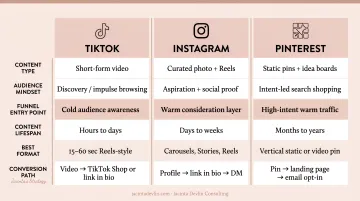
Instagram, TikTok, and Pinterest aren't just marketing channels: they're the top of your funnel. The moment a shopper interacts with your content, she's already in it. Your funnel design has to account for the impulse-driven behavior these platforms create — not treat them as passive traffic sources.
Each platform creates its own entry point:
- TikTok: A product demo or "outfit of the day" video sparks immediate buy intent
- Instagram: A saved post or Reel view starts a consideration window that email can close
- Pinterest: A pinned outfit signals purchase intent days or weeks before a search even happens
What You Need Before You Build
Before you map a single funnel stage, three things need to be in place:
- Know your ideal customer — not "women who like fashion," but a specific woman with a specific style identity, budget, and shopping behavior. Every content decision flows from her.
- A consistent brand aesthetic — your Instagram, website, and emails must look and feel like the same brand. Visual inconsistency creates subconscious friction that kills conversions.
- A hero product or collection to anchor your funnel. Pick one high-desire, lower-risk item that makes it easy for someone to buy from you the first time.
One of those three prerequisites deserves extra attention before you build anything else.
Build Your Email List From Day One
Social media reach is rented. Your email list is owned. Litmus reports email generates $36 for every $1 spent — making it the highest-ROI channel in fashion marketing.
Lead magnets that work for fashion brands:
- A style guide or lookbook PDF
- A "build your capsule wardrobe" checklist
- A first-purchase discount
- Early access to a new collection drop
Jacinta Devlin scaled her own clothing boutique, Jacinta The Label, to consistent $10,000+ months — and she's direct with boutique clients: the email list is the backbone of your marketing, not an afterthought.
Her 12-week Business Launch Program builds the full email architecture — from opt-in to post-purchase sequence — as a core deliverable. She's seen what happens when fashion brands skip this step: every new collection launch starts from zero.
How to Build Your Fashion Sales Funnel Step by Step
Step 1: Attract — Drive Discovery With Visual Content
The top of your funnel is almost entirely visual and social. Your goal is to get in front of the right people consistently — not to sell yet.
The three primary awareness channels for fashion brands:
- Instagram/TikTok — styling videos, outfit inspiration, behind-the-scenes, try-ons
- Pinterest — evergreen visual discovery; saved products are 7x more likely to be purchased, and shoppable Pin engagement among Gen Z rose 86% year over year
- SEO content — style guides and trend posts that drive organic search traffic
Don't just post products. Create identity content — the kind that makes your ideal customer think "this brand gets my style." Content types that work for awareness:
- Outfit-of-the-day posts showing real styling choices
- "Style this piece three ways" videos
- Trend roundups tied to your aesthetic
- Behind-the-scenes of buying trips or collection builds
Paid ads (Meta, TikTok) can amplify this stage — but not until organic content is working and you have a product page that converts. Paid traffic sent to a weak destination is wasted money.
Step 2: Engage — Capture Attention Before the Algorithm Takes It Back
Once someone discovers your brand, the goal is to move them into an owned channel — primarily your email list.
How to capture emails:
- Offer a lead magnet tied to style (a lookbook, style quiz, or exclusive discount)
- Use a simple opt-in landing page — Flodesk is the platform Jacinta recommends and uses herself for boutique clients
- Drive DMs to email capture using automation tools like LinkDM
What an effective fashion welcome sequence looks like:
Most brands treat this as a promotional blast. It shouldn't be. A welcome sequence is a 5–7 email series that introduces your brand story, your aesthetic, and the person behind it. For boutique and social selling brands especially, the founder's story is a conversion asset.
Your subscribers want to know:
- Why you started this brand
- What your style stands for
- Why you carry what you carry
Those answers build the kind of trust that turns a new subscriber into a buyer — and a buyer into a repeat customer.
Step 3: Convert — Remove Every Barrier Between Interest and Purchase
Conversion in fashion isn't just persuasion — it's confidence engineering. Your customer needs to feel certain before she clicks "buy."
The key conversion levers:
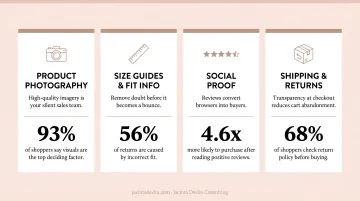
- Multi-angle product photography — front, back, side, on-model, flat lay
- Honest sizing information — Coresight found that 53% of apparel decision-makers cite size and fit as the top reason for returns; size guides are conversion copy, not support content
- Transparent shipping and returns — Baymard's research shows 39% of shoppers abandon carts because of unexpected extra costs
- Social proof — reviews, UGC photos, and styling testimonials
Abandoned cart recovery is non-negotiable. Klaviyo's apparel-specific data shows abandoned cart emails average 51.43% open rates and 3.42% conversion — meaning a significant portion of your lost sales are recoverable with a 2–3 email sequence. That sequence should include the product photo, a size reassurance note, and clear shipping information.
Retargeting ads that show shoppers exactly what they viewed complete the recovery loop for those who don't open email. When someone does buy, that's your highest-trust moment. What happens next determines whether she comes back.
Step 4: Retain — Turn Buyers Into Loyal Repeat Customers
Most fashion brands go quiet after the sale. That's exactly where profitability gets left on the table.
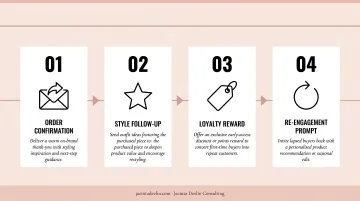
Yotpo's loyalty benchmark data shows that apparel loyalty members spend 1.8x more and purchase 1.9x more frequently than non-members. Klaviyo reports post-purchase emails see open rates nearly 17% higher than average automations. Your highest-trust moment with a customer is immediately after she buys.
Your post-purchase sequence should include:
- A thank-you email that feels personal, not automated
- Styling suggestions for the item purchased
- A next-purchase incentive (not necessarily a discount — early access works)
- A review or UGC request 7–10 days after delivery
Loyalty-building strategies for fashion and social selling brands:
- Instagram Close Friends lists for VIP early access to new drops
- Private Facebook groups where your best customers get first look at new inventory
- Referral programs that reward customers for bringing in friends
Jacinta has coached boutique clients to build Facebook communities from scratch to tens of thousands of members — the same relationship-based selling philosophy she applied during her 12-year direct sales career, scaled to digital. Brands that build community create customers who stay. Brands that skip it are always starting over.
Key Variables That Affect Your Funnel's Performance
Two brands can follow the same steps and get very different results. These four variables explain why.
Ideal Customer Clarity
Every piece of content, every email subject line, every product description should be written for one specific person. When you try to speak to everyone, you resonate with no one.
Knowing your customer's specific style identity, income level, what occasions she dresses for, and who she follows on Instagram directly shapes which funnel content converts versus which gets ignored.
Email Sequence Quality
Most fashion buyers need multiple touchpoints before purchasing. A single post or email rarely closes the sale. Brands that convert well have a planned email cadence: welcome series, weekly or bi-weekly content emails, promotional sends, and post-purchase sequences.
A curated style story that features shoppable products will outperform a generic "20% off this weekend" email every time.
Visual Brand Consistency
Shoppers decide in seconds whether a brand feels like "them." When your ad, website, and welcome email all look and feel cohesive, that consistency builds trust before she reads a single word. Inconsistency across those touchpoints creates friction that kills conversions — even when the product is exactly right.
Offer and Timing Strategy
What you offer at each funnel stage matters as much as how you offer it.
A cold audience needs a low-risk entry — free shipping, a small first-purchase discount, or a style guide. A warm retargeted audience responds to urgency and exclusivity.
Blanket discount codes train shoppers to wait for sales, which erodes both margins and brand positioning. McKinsey's State of Fashion research warns against over-reliance on promotions as a growth strategy.
Value-driven offers — early access, capsule wardrobe guides, free shipping thresholds — convert without conditioning your customers to expect a discount every time.
Common Mistakes Fashion Brands Make in Their Funnels
Most fashion brands don't have a traffic problem — they have a funnel problem. These four mistakes show up constantly, and each one quietly drains revenue.
- Skipping the engagement stage — posting content and running promotions without building an email list means no owned audience; every collection launch starts from zero
- Using the same content at every stage — conversion-focused product posts at the top of the funnel won't build awareness, and awareness content at the bottom won't close sales
- Not following up after the sale — the period right after purchase is your highest-trust moment, and most brands leave it completely untouched
- Leading with the wrong product — high-price or high-consideration items at the top of the funnel slow everything down; the entry point should be a low-risk, high-desire product that gets someone to buy for the first time
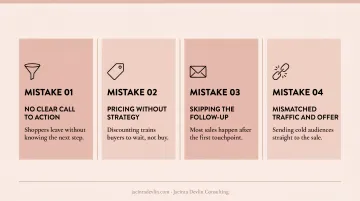
Fix these four, and you'll see the difference in your next launch.
Frequently Asked Questions
What is the funnel for clothing brands?
A clothing brand funnel is a structured path that moves a potential customer from first discovering the brand through interest, purchase, and ideally repeat buying. Unlike standard funnels, fashion funnels are driven by visual identity and aspiration rather than problem-solution logic. The goal is emotional connection first, conversion second.
How long does it take to see results from a fashion sales funnel?
Early results like email list growth and engagement lift can appear within 30–60 days of consistent implementation. A fully optimized funnel with reliable repeat revenue typically takes 3–6 months of content, email nurturing, and iteration to mature.
What social media platforms work best for fashion brand funnels?
Instagram and TikTok are the strongest top-of-funnel discovery platforms due to their visual nature and compressed path to purchase. Pinterest drives evergreen discovery especially for women's fashion. Email converts the warm audience built through social into actual buyers.
Do I need a big advertising budget to build a fashion sales funnel?
No. Organic social content and email marketing can build an effective funnel with little to no ad spend. Paid ads amplify what's already working. That said, don't run paid traffic until you have a clear brand identity, an email capture system, and a product page that already converts organic visitors.
How do I get customers to open and click my fashion brand emails?
Subject lines should speak to style and identity, not just announce a sale. Email content should feel like a curated style resource rather than a promotional blast. Consistency matters most — subscribers who receive valuable content regularly are far more likely to open purchase-focused emails.