

Introduction
Post a gorgeous gallery. Get three comments, two likes, one DM asking about pricing — then silence. So you post again. This is "luck marketing," and most photographers run their entire business this way without realizing it.
Here's the real problem: when you're deep in a shooting season, marketing stops. You're editing until midnight, delivering galleries, juggling client emails. Then six months later, the calendar goes quiet and the panic sets in.
Photographers who consistently outbook their peers aren't working harder — they have a system that keeps attracting clients in the background, even during their busiest weeks. That system is a sales funnel.
This guide walks through exactly how to build one: from defining your ideal client to driving traffic, nurturing leads, and converting inquiries into bookings — without the feast-or-famine cycle.
Key Takeaways
- A sales funnel moves potential clients from first discovery to booking through a deliberate, repeatable process
- Unlike a general website, a funnel guides every visitor toward one specific decision
- The core components are a lead magnet, landing page, email nurture sequence, and a clear offer
- Both paid and organic traffic feed the top of the funnel — diversification matters
- A funnel needs ongoing monitoring and refinement to keep performing
What Is a Sales Funnel for Photographers?
A sales funnel is a step-by-step system that takes a stranger who stumbled across your work and guides them — through intentional touchpoints — toward becoming a paying client.
The name comes from the shape of the process itself. Many people enter at the top (they see your work somewhere online). Fewer make it to the middle (they start researching you seriously). A smaller, highly qualified group converts at the bottom (they inquire and book). That filtering isn't a failure — it's the point. You want the people who reach your inbox to already trust you.
Website vs. Funnel: What's the Difference?
Most photographers have a website. Far fewer have a funnel — and that gap is where bookings get lost:
| Website | Sales Funnel |
|---|---|
| Presents information passively | Guides visitors through deliberate steps |
| Visitors decide where to go next | One clear path, one clear next action |
| Designed to inform | Designed to move toward a decision |
| Loses most visitors with no follow-up | Captures contact info and stays in their world |
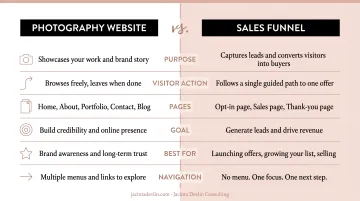
A website is necessary, but it's just the starting point. The funnel is what turns a curious visitor into someone who books.
Why Photographers Need a Sales Funnel
The photography market is competitive. IBISWorld reports over 250,000 photography businesses operating in the US in 2025, a number that keeps growing. In a saturated market, potential clients research extensively before reaching out — browsing portfolios, reading reviews, comparing pricing pages across multiple photographers before sending a single inquiry.
Without a funnel, most of those people disappear. Professional services websites average only a 6.1% conversion rate, according to Ruler Analytics' 2026 benchmark study of 110M+ sessions. That means roughly 94 out of every 100 visitors leave without taking action.
The Real Cost of No Follow-Up System
When there's no structure to capture and nurture those visitors:
- You rely on one-off posts, referrals, and directory listings
- Bookings become unpredictable — busy season followed by empty months
- Every new client starts from scratch, with no existing trust built
- You're always chasing the next inquiry instead of attracting it
A properly built funnel solves this by working while you're on a shoot, editing a gallery, or taking a weekend off. Research by the Professional Photographers of America confirms that cost and trust — built across multiple touchpoints including websites, social media, and reviews — drive booking decisions. A funnel builds that trust consistently, so by the time a client reaches out, the decision to book is already nearly made.
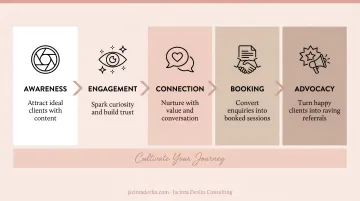
The 5 Stages of a Photography Sales Funnel
Stage 1: Awareness
A potential client first encounters your work — through Instagram, a Google search, a blog post, a venue recommendation, or a directory listing. Your job here is visibility and a strong enough first impression to make them want to learn more. The goal isn't a sale; it's a second click.
Stage 2: Interest
Now they're actively exploring. They browse your portfolio, read your about page, follow you on Instagram. This is where most photographers lose people — there's no way to capture their information before they move on to the next option.
The fix: give them a reason to hand over their email address. A lead magnet (more on this below) keeps you in their world even after they close your website.
Stage 3: Evaluation
The potential client is seriously considering booking and comparing you to two or three other photographers. At this stage, what they're looking for includes:
- Clear pricing information (or a guide that addresses costs)
- Genuine client testimonials and reviews
- A professional, easy-to-navigate experience
- Evidence that you understand their specific situation
Each of these signals matters more than most photographers realize. BrightLocal reports that 97% of consumers read reviews for local businesses, and 31% will only book a business with a 4.5-star rating or higher. Your trust signals at this stage can win or lose the booking.
Stage 4: Conversion
The inquiry arrives — and this is where a lot of bookings are quietly lost. A client who was ready to sign can disappear just as fast if the response is slow or the process feels clunky. When an inquiry comes in:
- Reply within a few hours, not a few days
- Have a clear, professional consultation process ready
- Make the next step (a call, a contract, a booking link) immediately obvious
Stage 5: Advocacy
The funnel doesn't end at the contract. When clients love their experience, they become referral sources who feed new people back into the top of your funnel. A few practical ways to activate this stage:
- Send a follow-up email after gallery delivery with a direct ask for a Google review
- Create a simple referral incentive (a print credit for every successful referral)
- Build a post-delivery email sequence that stays in touch seasonally
How to Build a Photography Sales Funnel — Step by Step
Most photographers overcomplicate this. A basic funnel that's live and working beats a perfect funnel that never gets launched. Start simple, then improve.
Step 1: Define Your Ideal Client and Niche
This comes first because a funnel built around a vague audience converts no one. Get specific:
- Who are they? Wedding couples, new parents, high school seniors, or families?
- What's their budget range? A luxury funnel aimed at budget shoppers won't convert.
- Where do they spend time online? Pinterest for wedding planners, Facebook groups for parents.
- What emotional outcome do they want? Heirloom prints, preserved memories, or confidence in front of a camera.
A clear client profile makes every other step easier: your lead magnet, ad targeting, email content, and offer packaging all follow from it.
Step 2: Create a Lead Magnet That Solves One Problem
A lead magnet is a free, valuable resource offered in exchange for an email address. The rule: it must solve a real problem the potential client is already trying to figure out.
Photography-specific lead magnet ideas:
- Wedding day timeline checklist (for couples stressed about pacing)
- "What to Wear for Your Family Session" style guide
- Newborn preparation checklist (for first-time parents who have no idea what to expect)
- Pricing clarity guide (for couples who don't know what photography costs)
- Senior portrait location guide for your area
A disconnected freebie — like a photography technique guide aimed at photographers — attracts the wrong list entirely.
Step 3: Build a Simple Landing Page
Your landing page has one job: convert visitors into email subscribers. Three non-negotiable elements:
- A headline that clearly states what the freebie is and who it's for ("Free Wedding Day Timeline for Couples Planning Their 2025 Wedding")
- An opt-in form or CTA button — keep it simple, first name and email only
- A brief description of what they'll get and why it matters to them
Remove the navigation bar. Remove links to other pages. This page has one exit: either they opt in, or they leave. A/B testing the headline and CTA button over time can meaningfully lift your opt-in rate — MailerLite's analysis of 41,000+ signup forms found an average opt-in conversion rate of 22% across all form types.
Step 4: Set Up an Email Nurture Sequence
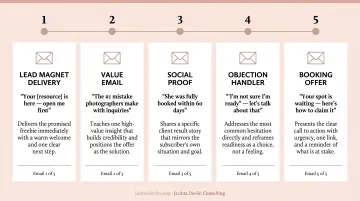
Before your email sequence ever sells anything, it builds trust. Here's the structure that works:
- Email 1 — Delivery + Introduction: Deliver the lead magnet, introduce yourself personally (not just professionally)
- Email 2 — Your Story and Why: Share what drives your work — the philosophy behind your photography
- Email 3 — Client Experience: Walk through what it's actually like to work with you; share a client story
- Email 4 — Social Proof: Testimonials, reviews, or a gallery reveal that demonstrates results
- Email 5 — The Offer: Invite them to inquire, with a clear next step
Email is the most reliable channel for this kind of nurture because it doesn't depend on algorithms. Litmus reports that email marketing drives an average ROI of $36 for every $1 spent, compared to Instagram's average organic reach of just 3.5% per post.
. The offer is your service plus context, clarity, deliverables, timeline, and added value. A couple comparing photographers doesn't just compare price; they compare what they understand themselves to be getting.
Consider a tiered structure:
- Entry-level: Mini session or engagement session (lower commitment, lower risk)
- Core: Your standard wedding or portrait package with clear deliverables
- Premium: Full-day coverage, albums, fine art prints, second shooter
A potential client who downloads your free wedding timeline guide isn't ready to book the $5,000 package immediately. Having a progression of offers creates a natural journey — and increases overall revenue per client over time.
How to Drive Traffic Into Your Funnel and Track What's Working
Getting people into your funnel is the only way to turn a well-built system into actual bookings.
Starting with Paid Traffic
For early data quickly, start with one paid traffic channel — Facebook or Instagram ads targeting your specific ideal client (engaged couples in your metro area, new parents in your ZIP code range). The average cost per lead on Facebook runs around $27.66 across industries in 2025, per WordStream's benchmark data. Your actual CPL will vary, but paid traffic gives you results in days rather than months.
Building Organic Traffic Over Time
Build organic traffic assets alongside paid efforts — these grow in value the longer they run:
- SEO-optimized blog posts (venue guides, session prep tips, real wedding features)
- Pinterest — effective for wedding and family photographers
- Consistent social media with content that drives people toward your lead magnet
Ahrefs reports that SEO typically takes 3-6 months to show meaningful results, so organic traffic is a long game. Start it alongside paid efforts, not instead of them.
Monitoring Funnel Health
Track these four metrics consistently:
- Landing page opt-in rate — below 15% means the headline or offer needs work
- Email open rate — industry benchmarks hover around 35%; lower suggests subject line issues
- Email click rate — tracks how many people take the next step after opening
- Inquiry-to-booking conversion rate — a low rate here often points to a consultation process problem, not a traffic problem
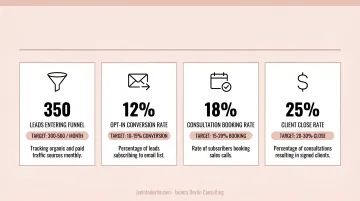
Fixing a leaky funnel is more effective than driving more traffic into a broken system. Find where people are dropping off, and fix that stage first. Once your funnel is converting consistently, the next priority is protecting that lead flow.
Don't Rely on a Single Source
Platform algorithm changes, rising ad costs, and seasonal shifts all affect lead flow. Instagram organic reach dropped 12% year-over-year as of 2025. Photographers who diversify across two or three channels hold up far better when one source dips. Consider building from:
- Paid ads (Facebook or Instagram)
- SEO and blog content
- Referral systems
Depending entirely on one platform is the fastest way to watch a full calendar go quiet overnight.
Conclusion
A sales funnel isn't a complicated technical project. It's a structured system built around how clients naturally make decisions — and the photographers who build one stop chasing clients and start attracting them consistently.
When you're ready to build a funnel that fits your photography business specifically, Jacinta Devlin at Devlin Consulting works with women entrepreneurs to design customized funnel and marketing systems built around your offers, your clients, and how you actually sell. The starting point is a free 15-minute Growth Chat where Jacinta will assess your business and tell you honestly whether and how she can help.
Frequently Asked Questions
What is the difference between a sales funnel and a photography website?
A website presents your portfolio and information passively, leaving visitors to decide what to do next. A sales funnel guides those same visitors through a deliberate sequence — lead magnet, email sequence, offer — designed to build trust and move them toward booking. Ideally, both work together.
Do I need expensive software to build a sales funnel as a photographer?
No. Photographers can start with affordable tools — a simple email platform like Flodesk or MailerLite, a basic landing page builder, and an email automation sequence. Start simple, execute consistently, and upgrade tools as revenue grows.
What is the best lead magnet idea for a photographer?
A wedding day timeline, a "what to wear" style guide, or a pricing breakdown for couples unfamiliar with photography costs all perform well. Each addresses a real anxiety clients have before they ever reach out — which is exactly what a strong lead magnet does.
How many emails should be in a photographer's nurture sequence?
Five to six emails is typically enough. Open with your lead magnet delivery and a warm introduction, build trust through storytelling and client results in the middle, then close with a direct invitation to inquire or book.
How long does it take to see results from a photography sales funnel?
Paid traffic can generate leads within days. Email nurture and organic content traffic typically take weeks to months to build momentum. Most photographers see meaningful results within 60 to 90 days of consistent effort.
Can I build a sales funnel if I don't have a big social media following?
A large following isn't required. A funnel works with any amount of targeted traffic. A small ad budget or a few well-placed referrals can drive enough traffic to start producing real inquiries.