

Introduction
You share an idea in a meeting. Silence. Maybe a polite nod. Then, three minutes later, a male colleague says essentially the same thing — and suddenly it's the best idea anyone's heard all week.
If that scene is familiar, you're not imagining it. This is a documented, systemic experience that women across industries encounter regularly. It's a structural dynamic — one with a name, and research to back it up.
This post breaks down the real barriers women face when speaking up in professional settings, explains the psychology behind why women can't win either way, and offers concrete strategies to make your voice heard and your ideas stick. Whether you're in a corporate boardroom or leading a call as a business owner, these tools are for you.
TL;DR
- 45% of women business leaders say it's difficult for women to speak up in meetings — this is systemic, not personal.
- Women face a double bind: speaking too much gets labeled "aggressive," speaking too little makes them invisible.
- Imposter syndrome affects 75% of executive women — and the meeting room dynamics described here are a direct driver.
- Practical tactics — prepping before meetings, reclaiming interrupted ideas, and building ally networks — produce real, measurable change.
- Virtual meetings compound the problem, but the same strategies apply with small adjustments.
Why Speaking Up Is So Hard: The Core Barriers
The first thing to understand is scale. According to a 2020 Catalyst workplace study, 45% of women business leaders said it's difficult for women to speak up in meetings — and 1 in 5 women reported feeling ignored or overlooked by coworkers during video calls. That's not a handful of isolated bad experiences — it's a documented, repeating pattern.
The Language That Names It
Three terms have emerged to describe what many women already know from experience:
- Manterrupting — an unnecessary interruption of a woman by a man, coined by journalist Jessica Bennett in TIME magazine
- Mansplaining — explaining something to a woman in a condescending way, as if she couldn't possibly already know it (the phenomenon traced back to Rebecca Solnit's 2008 essay Men Explain Things to Me)
- Bropropriating — when a woman's idea is dismissed, then repeated by a male colleague who receives credit for it
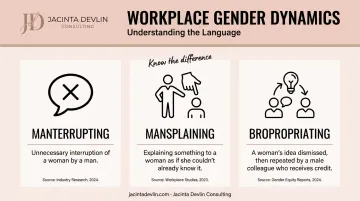
Naming these behaviors matters because it gives women a shared, research-backed language for experiences they've often been told to dismiss or downplay.
The Perception Gap
Research supports what many women have observed: men consistently talk more in mixed-gender meetings, yet women are perceived as dominating the conversation when they speak significantly less. Peer-reviewed work confirms this bias can be reproduced experimentally — meaning it exists independent of actual talk time, creating a distorted baseline before a woman has said a single word.
The Exhaustion Factor
Women also choose silence for a practical reason: contributing takes more energy than it should. Every comment often requires extra labor — proving expertise, anticipating dismissal, and bracing for the idea to either be ignored or credited to someone else. Over time, that extra overhead quietly discourages women from speaking at all.
There's also the fear of getting it wrong in either direction — speak too much and risk being labeled aggressive, speak too little and become invisible. Either way, the cost falls on the woman.
The Double Bind: Damned If You Do, Dismissed If You Don't
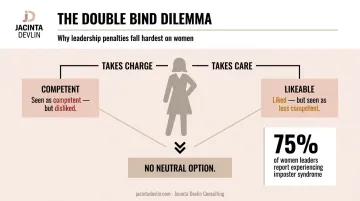
Catalyst's landmark research on women in leadership identified a structural trap that's difficult to escape: women leaders are simultaneously perceived as talking too much AND not speaking up enough. When they "take charge," they're viewed as competent but disliked. When they "take care," they're liked but viewed as less competent.
There's no neutral option. That's the double bind.
How It Fuels Imposter Syndrome
The double bind doesn't just affect how others perceive women — it shapes how women perceive themselves. A 2020 KPMG study of 750 high-performing executive women found that 75% had experienced imposter syndrome at some point in their careers. 81% said they put more pressure on themselves not to fail, and 74% felt their male counterparts don't experience self-doubt as often.
When a woman is penalized for speaking too much and for speaking too little, it's rational to start questioning whether her voice belongs in the room at all. That's not a character flaw — it's a predictable response to an impossible standard.
Bropropriating and Credibility
The idea-credit problem is measurable. McKinsey and LeanIn.Org's 2022 Women in the Workplace report found that 37% of women leaders had a coworker take credit for their idea, compared to 27% of men leaders. That gap compounds over time — each incident chipping away at confidence and willingness to contribute.
Communication Style Is Misread as Weakness
Linguist Deborah Tannen's research distinguishes between "report talk" (speaking to demonstrate expertise and establish authority) and "rapport talk" (speaking to share information collaboratively). Men more often default to report talk in professional settings. Women more often use rapport talk — and that style is frequently misread as a lack of conviction rather than a difference in approach.
These dynamics don't hit every woman equally. For women of color, non-native speakers, and those in junior positions, the double bind runs deeper — compounding layers of scrutiny stack on top of each other when multiple marginalized identities overlap.
Practical Strategies to Speak Up and Be Heard
Knowing the problem is one thing. Having tools to work within — and around — it is another. These strategies are specific and actionable.
Before the Meeting
- Choose one agenda item where you'll speak early, not when it feels "safe." Early contributions carry more weight and establish your presence.
- Prep your opening line. Rehearse something that signals authority: "I've been thinking about this specifically — here's what I'd propose."
- Lead with the headline. State your main point first. If you get interrupted, your core message has already landed.
During the Meeting
Drop the hedges. Phrases like "I'm not sure if this is right, but..." or "This might be a silly idea..." immediately undercut what follows. Speak in statements.
Small adjustments to voice and pacing make a real difference:
- Slow down rather than rush — pace signals confidence
- Use pauses after key points instead of filling silence immediately
- Drop upward inflection at the end of statements (it makes assertions sound like questions)
Make your ideas "sticky": Give them a name or label. "The 3-tier framework I mentioned" is easier for others to cite and attribute back to you than a vague idea that enters the collective consciousness unnamed.
After the Meeting
Follow up in writing. A brief email — "Recapping the key points I raised today..." — creates a paper trail and puts your name on your contributions. It's a simple habit that compounds over time.
The Ally Strategy
Having someone in the room say "let her finish her point" is one of the most effective interruption-stoppers available. Before high-stakes meetings, identify a trusted colleague and ask them explicitly to back you up if you're talked over.
The Obama White House documented this tactic directly: women staffers used "amplification" — repeating a woman's key point and crediting her by name — to ensure ideas didn't get absorbed without attribution. It worked then, and it works now.
How to Handle Interruptions and Reclaim Your Ideas
In the Moment
When interrupted, the most important thing is to respond calmly and without apology. Apologizing signals the interruption was acceptable. It wasn't.
Phrases that work:
- "I'd like to finish my thought."
- "I'm not done yet — let me complete this."
- "Good point — let me finish mine and then I'd love to hear yours."
Deliver these evenly, not defensively. Research on backlash (Williams and Tiedens' 2016 meta-analysis of 71 studies) confirms that explicit dominance creates social penalties for women — calm, firm assertiveness lands better than an aggressive response.
Circling Back When You've Lost Your Turn
If the moment passes before you can respond, come back to it: "As I was starting to say earlier..." This reasserts your presence without confrontation.
A separate problem entirely is when a colleague repeats your idea and receives credit for it. That requires a different response.
Reclaiming Bropropriated Ideas
When your idea gets claimed by someone else, stay calm and specific — not emotional. A clean way to handle it: "I'm glad Peter is building on the idea I raised — here's how I'd extend it further."
This works because it restates your ownership factually rather than defensively, then moves the conversation forward. The more you practice it, the more natural it feels — and the harder it becomes to ignore.
The Virtual Meeting Problem
Virtual environments have added a new layer to an existing problem. The same Catalyst 2020 study found 1 in 5 women felt ignored or overlooked specifically during video calls — and it's easy to see why. Fewer social cues, harder to hold the floor, easier to be accidentally (or not so accidentally) talked over. The mute button creates a natural barrier to spontaneous contribution.
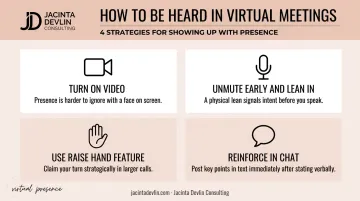
Specific strategies for virtual settings:
- Turn on video when possible. Presence is harder to ignore when there's a face.
- Unmute early and lean in before speaking to signal intent — the physical cue matters even on screen.
- Use the raise hand feature strategically in larger calls rather than waiting for a natural pause that may never come.
- Reinforce key points in the chat immediately after stating them verbally. Your contribution now exists in two places — audio and text — making it harder to overlook.
Meeting leaders carry responsibility here too. Inclusive virtual facilitation means actively calling on quieter voices, enforcing no-interruption norms, and checking in with team members who seem sidelined. If you're in a position to advocate for these norms on your own calls or with clients, use it.
Building the Confidence to Own Your Voice
Confidence isn't a fixed trait. It's a skill built through repetition.
The practical approach: set a specific, small goal for each meeting — contribute at least one idea, ask two questions. Not because you need permission to speak, but because building the habit of participation gradually reduces the hesitation that holds most women back.
A more significant mindset shift is moving from "I want to be liked" to "I want to be respected." These aren't the same thing, and when likability is the primary goal, women self-censor constantly. When the goal is contribution, the fear of stepping on toes loses some of its grip.
Seventy-two percent of the executive women in KPMG's study said they sought advice from a mentor or trusted advisor when doubting their ability to take on new responsibilities. Having someone in your corner who understands the specific dynamics women navigate — not just general business challenges — matters.
That same principle applies beyond the boardroom. For women entrepreneurs working to close more clients, lead their teams, and pitch with authority, working with a coach who understands these specific dynamics accelerates the process considerably.
Jacinta Devlin's individualized coaching programs and the Dream+Create Online Coaching Community are built specifically for ambitious women who are ready to grow their revenue and lead their businesses with confidence. A free 15-minute consultation is the first step to finding out if it's the right fit.
Frequently Asked Questions
How do you handle people who talk over you at work?
Use calm, firm phrases like "I'd like to finish my thought" in the moment, without apologizing. Before important meetings, enlist a trusted colleague to back you up if you're interrupted. Over time, raise the pattern with meeting leaders to establish clearer norms around turn-taking.
What is imposter syndrome for women in the workplace?
Imposter syndrome is the persistent internal feeling that you don't deserve your success or truly belong in the room. It's disproportionately common among women — 75% of executive women report experiencing it — largely because double-bind dynamics make self-doubt a predictable response to an unsupportive environment.
Why are women interrupted more than men in meetings?
Research consistently shows that interruptions increase when the conversation partner is female, regardless of who's doing the interrupting. This reflects deeply ingrained patterns around who is granted authority and airtime in professional spaces, patterns that operate largely below the level of conscious awareness.
What is bropropriating and how can women respond to it?
Bropropriating is when a woman's idea is dismissed, then repeated by a male colleague who receives the credit for it. The most effective response is calm and specific: "I'm glad [name] is building on what I raised— here's how I'd take it further."
How can women speak up more confidently in meetings?
Prep one specific talking point before the meeting and lead with the headline. Drop hedging language, which undercuts everything that follows. Treat each meeting as a practice opportunity rather than a high-stakes performance. The habit of contributing builds confidence faster than waiting to feel ready first.
Do virtual meetings make it harder for women to speak up?
Yes. Virtual environments reduce social cues and psychological safety, making it easier to be overlooked or talked over. Practical fixes: turn on video, unmute early to signal intent, and use the chat to reinforce verbal contributions.