
Sound familiar? The missing piece is almost always the same: a clearly defined personal brand.
Here's the thing — personal branding isn't reserved for celebrities or creators with millions of followers. In the digital economy, your personal brand is your most valuable business asset. According to Sprout Social's 2024 research, 49% of consumers make purchases because of influencer posts — daily, weekly, or monthly. People buy from people they trust. Full stop.
This guide walks through five actionable steps to build a personal brand that attracts the right audience, earns real trust, and opens income opportunities — from brand partnerships to affiliate programs to loyal customers who buy because they believe in you.
TL;DR
- Your personal brand combines your story, values, expertise, and personality into something memorable and worth trusting
- Niche clarity and audience definition come before content creation; they're the foundation everything else builds on
- Authentic storytelling and consistent content pillars beat polished, impersonal content
- Consistent presence on the right platforms builds "know, like, trust" — turning your audience into paying clients
- A strong personal brand directly unlocks income: brand partnerships, affiliate programs, social selling, and beyond
What Is a Personal Brand (and Why It Matters for Women Entrepreneurs)
Your personal brand is the intentional, strategic practice of defining and expressing your unique value — the sum total of your story, expertise, personality, and values as others experience them. It shows up in how you communicate, what you stand for, and how people feel after interacting with you. Your logo and Instagram aesthetic are just the surface.
Harvard Business School defines a strong personal brand as one that is accurate, coherent, compelling, and differentiated — all four working together, not just the parts that feel comfortable.
Why This Matters More for Women Entrepreneurs
In the social selling, influencer, and e-commerce space, people buy from people they trust. The numbers back this up:
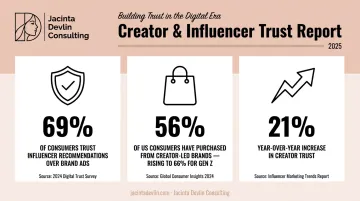
- 69% of consumers trust recommendations from friends, family, or influencers more than brand advertising, according to Nielsen
- 56% of US consumers have purchased from creator-led brands, rising to 66% of Gen Z
- Trust in creators increased 21% year over year, according to LTK's 2024 Creator Shopping Trends Report
Women make up 72% of influencers overall and 78% on Instagram and TikTok. The opportunity is real — and it rewards the women who show up with a clearly positioned brand, not just a pretty feed.
What a Strong Personal Brand Actually Unlocks
- Attracting ideal clients who already want what you offer
- Commanding higher prices because your value is clear
- Securing brand partnerships and sponsorships
- Building loyal communities that buy repeatedly
- Creating multiple income streams that don't depend on chasing each sale
Done right, personal branding becomes one of the most powerful sales tools you own — and the foundation everything else gets built on.
Step 1 – Know Your Brand: Defining Your Identity and Niche
Get Clear on Who You Are
Before you post a single piece of content, do the foundational work. Ask yourself:
- What do people always come to me for advice about?
- What could I talk about for hours without getting tired?
- What experiences have I had that others in my space haven't?
The goal here is to uncover what's already there — not manufacture something new.
The fear that stops most women at this stage: "I don't want to limit myself." But speaking to everyone means resonating with no one. Choosing a clear focus helps the right audience find you faster.
A specific niche accelerates growth. A vague one stalls it.
Define Your Target Audience
Once you know your niche, your audience definition shapes everything else — your tone, your platform choices, your topics, even your visual style. Get specific about who your ideal customer is:
- Her age range and lifestyle
- Her specific struggles and aspirations
- What she's searching for online right now
- What language she uses to describe her own problems
Write Your Personal Brand Statement
A personal brand statement is a 1-2 sentence declaration that names who you are, who you serve, and what transformation you offer. Use this framework:
"I help [specific audience] achieve [specific outcome] through [your unique approach or expertise]."
Example: "I help women entrepreneurs in the social selling space build personal brands that attract brand partnerships and generate consistent income — without starting from scratch or having a massive following."
This statement becomes the north star for every brand decision you make. Nail it now, and every piece of content, every platform choice, and every partnership opportunity becomes easier to evaluate.
Step 2 – Tell Your Story: Building a Compelling Narrative
Why Your Story Is Your Greatest Competitive Advantage
Two people can share the same advice, sell similar products, or operate in the same niche. The audience will choose the person whose story they connect with.
Research published in the Journal of Brand Management confirms that storytelling creates consumer engagement and contributes to brand trust. And Matter's consumer survey found that 39% of consumers say authenticity is the single most important influencer attribute when learning about brands — not follower count, not production quality.
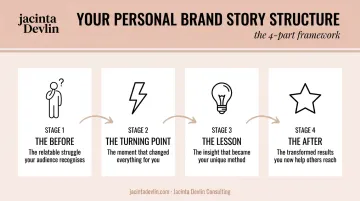
A powerful personal brand story has four parts:
- The before — where you started, including the relatable struggle
- The turning point — the challenge or decision that changed things
- The lesson — what you learned, what shifted
- The after — where you are now, with real credibility
Include specific, honest details. Include failures. The specificity is what creates emotional resonance, not the highlight reel.
Consider how Jacinta Devlin built her brand: at 21, she was a broke college student working two jobs when she walked into a direct sales jewelry party. That one decision turned into a 12-year career, a million-dollar income, and a National Director role at Stella & Dot.
From there, she launched a coaching business that's helped over 50,000 women grow theirs — with brand partnerships at Gucci, Nordstrom, and Sephora along the way. That progression, told honestly, is exactly what earns trust from the audience she serves.
Build Your Content Pillars Around Your Story
Content pillars are the 3-5 core themes you consistently return to. They connect your story, your expertise, and your audience's needs — and they make your brand feel coherent rather than scattered.
For women entrepreneurs in social selling and influencer spaces, common pillars include:
- Business strategy and social selling tips
- Personal growth and mindset
- Behind-the-scenes of your business
- Product or style content
- Values, lifestyle, and community
Your pillars also need a point of view. Neutral, safe, opinion-free content doesn't build loyal communities. Audiences connect with creators who stand for something specific. Identify 3-5 beliefs you hold about your industry or audience — these become the backbone of a brand voice that's actually memorable.
Don't overlook visual and tonal consistency. Your color palette, photography style, caption voice, and video tone all reinforce that point of view over time — and audiences who recognize your aesthetic are far more likely to trust your brand.
Step 3 – Show Up Online: Platforms and Visual Presence
Choose Your Platforms Strategically
You do not need to be everywhere. Go deep on 1-2 primary platforms before expanding, and choose based on where your specific audience spends time.
For women entrepreneurs in social selling, lifestyle, and influencer spaces:
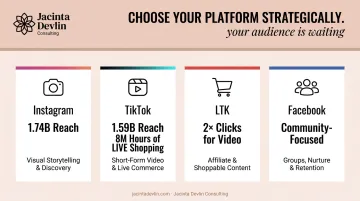
- Instagram — strong for lifestyle content, brand partnerships, and community (advertising reach of 1.74 billion users as of January 2025)
- TikTok — powerful for discovery and video-first content (advertising reach of 1.59 billion users; in 2024, brands and creators hosted over 8 million hours of LIVE shopping sessions in the US)
- LTK — purpose-built for creator-driven shopping, with video content driving over 2x clicks per post compared to static content
- Facebook Groups — underrated for community building and high-engagement niche audiences
Every profile should be optimized for brand clarity:
- Consistent username across platforms
- Professional headshot (not a product photo)
- Bio that leads with your brand statement
- Strategic link-in-bio directing to your key offer or content hub
Invest in Your Visual Brand
Visuals are often the first impression of your brand. A brand photoshoot should include:
- Outfits that reflect your brand personality
- Settings that reinforce your story and niche
- Variety in shot types: headshots, lifestyle, action/working shots
Every visual choice signals something about your brand — consistency across photos, colors, and settings is what makes a first impression stick.
Your visual brand also needs a permanent home. A personal website gives you an SEO presence, a professional base that no algorithm can take away, and one place to house your full story, testimonials, products, and contact information. For coaches, boutique owners, and influencers pursuing brand partnerships, it's non-negotiable.
Jacinta Devlin Consulting offers done-for-you services covering website development, content strategy, and full brand launches — built around your specific income goals, not a generic template. Jacinta's 15+ years in social selling and her own brand partnerships with companies like Nordstrom and Amazon inform every strategy she builds for clients.
Step 4 – Stay Consistent: Content Strategy That Builds Trust
Your content strategy has one job: move your audience through know → like → trust.
- Awareness content helps new people discover you
- Connection content reveals your personality and values
- Credibility content demonstrates your expertise and results
Most brands stall because they jump straight to selling before earning trust. Build the relationship first — the sales follow naturally.
A Practical Content Mix
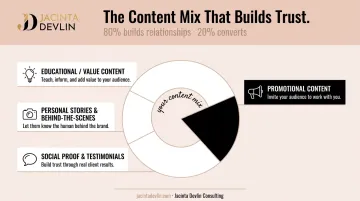
A widely recommended guideline is the 80/20 rule: roughly 80% of your content should inform, educate, or entertain — with only 20% being directly promotional. This ratio keeps your audience engaged rather than feeling sold to constantly.
Your content mix should include:
- Value-driven educational posts or tips (tied to your pillars)
- Personal stories and behind-the-scenes moments
- Social proof: results, testimonials, transformations
- Promotional content for your offers, products, or affiliate links
Consistency Over Quantity
Posting with intention 3-4 times per week on the right platform outperforms sporadic, directionless daily posting. But frequency is only half of it — how you show up matters just as much.
Responding to comments and DMs, asking questions, and staying active in your community signals credibility to your audience and visibility to the platform. The algorithms on both major short-form platforms reward this behavior:
- Instagram weighs commenting, liking, sharing, and profile visits
- TikTok factors in likes, shares, comments, and video completion rates
Consistent engagement — not just consistent posting — is what builds an audience that actually buys.
Step 5 – Turn Your Brand Into Income: Monetization Strategies
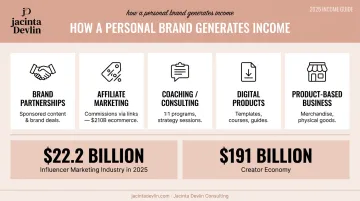
A well-built personal brand doesn't just feel good — it generates real income. The primary streams available to women entrepreneurs:
- Brand partnerships and sponsored content — paid collaborations with brands in your niche
- Affiliate marketing — commissions through LTK, Amazon storefront, and other programs (US affiliate marketing will drive more than $210 billion in ecommerce sales in 2025, per eMarketer)
- Coaching or consulting services — selling your expertise directly
- Digital products — guides, templates, courses
- Product-based businesses — your own boutique, storefront, or line
The global influencer marketing industry is projected at $22.2 billion in 2025, with the broader creator economy reaching $191 billion. The opportunity is real. But you need a clearly positioned brand to access it.
Your Media Kit Is the Bridge to Brand Deals
A media kit is your professional portfolio for brand partnership outreach. It should include:
- Audience size and platform demographics
- Engagement rates across your channels
- A summary of your brand, niche, and audience
- Past collaboration examples or brand mentions
- Your rates or services overview
Micro-influencers with highly engaged niche audiences consistently land meaningful brand deals. Engagement matters more than follower count.
HypeAuditor's data shows nano-influencers average 10.3% engagement on TikTok compared to 7.1% for mega-influencers. A smaller, targeted audience often converts better for brand partners than a massive, disengaged one.
Jacinta's clients have built exactly this kind of positioned brand. Christina Roach rebranded as @mybalancedstyle, grew from 0 to 36,000+ Facebook Group members, hit over 95,000 Instagram followers, and now sells hundreds of thousands monthly through Amazon and LTK — landing five-figure brand deals with Walmart and QVC in the process.
Sharon Bean went from $4,000 in her first year on Amazon to consistently earning $20,000+ per month. Results like these follow from a clear personal brand paired with a focused strategy — not luck.
Jacinta Devlin Consulting provides personalized coaching to help women position their brand, approach the right partnerships, and build toward those $5k–$50k+ income months with clarity rather than guesswork.
Frequently Asked Questions
What are the 7 pillars of personal branding?
The seven pillars — as outlined by Forbes Coaches Council and Berkeley Executive Education — are purpose, values, clarity, strengths, energy, legacy, and ownership. Each one works together to make your brand intentional and consistent rather than reactive.
What are the 5 A's of personal branding?
The 5 A's — Authenticity, Authority, Audience, Aesthetic, and Action — give you a practical structure for brand building. Authenticity keeps you credible, Authority establishes expertise, Audience focuses your message, Aesthetic creates visual recognition, and Action converts attention into income.
What is the 3-7-27 rule in branding?
This model suggests it takes 3 seconds to form a first impression, 7 hours of content exposure to feel familiar, and 27 interactions before real trust develops. The numbers aren't empirically verified, but the principle holds: consistent, repeated content is what moves people from strangers to buyers.
How long does it take to build a personal brand?
The foundational work — clarity, story, positioning — can happen in a matter of weeks. Building a visible, income-generating brand typically takes 6-12 months of consistent effort. The variable that matters most is consistency — showing up with intention on the right platforms, not just showing up often.
What should I post to build my personal brand on social media?
Focus on a mix tied to your content pillars: educational tips-based posts, personal stories and behind-the-scenes moments, social proof and results, and content that reflects your values and point of view. Every post should connect to who you serve and what you want to be known for.