
The businesses that actually grow through content aren't posting more. They're posting smarter — with a clear strategy tied to real revenue goals.
This guide covers a practical content creation framework built specifically for women-owned businesses: how to build a revenue-focused strategy, find the right content mix, repurpose efficiently, and show up consistently without running on empty.
TLDR
- Content only drives growth when it connects to a specific income goal — not just a posting schedule
- A balanced content mix (value, connection, and promotion) keeps your audience engaged and buying
- Repurposing one strong piece across multiple platforms multiplies reach — without multiplying effort
- Your authentic founder story is one of the most powerful — and most underused — sales tools you have
- A sustainable routine you'll actually stick to outperforms an ambitious one you abandon
Build a Content Strategy That Drives Real Revenue
Most women entrepreneurs create content based on what looks good, what's trending, or what they saw someone else post. The result? A feed full of content that performs fine aesthetically but doesn't move the needle on revenue.
The fix is working backward from your income goals.
Start With the Revenue Goal
Before you create a single piece of content, get specific about what you're trying to grow:
- An Amazon storefront
- An affiliate income stream through LTK
- A coaching program or service offering
- Brand partnerships and sponsorship deals
Once you know the income stream, you can map content to the customer journey for that specific offer. That alignment is what turns content into a revenue driver — not just an activity that keeps you busy.
Map Content to the Buying Journey
Every customer moves through three stages before purchasing. Your content needs to meet them at each one:
| Stage | Goal | Content Example |
|---|---|---|
| Awareness | Attract new eyes | Instagram Reel showing a product in use |
| Nurture | Build trust | Carousel post educating about the product's benefits |
| Convert | Drive the sale | Story post with a swipe-up link or promo code |
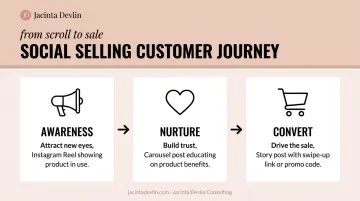
This simple three-stage funnel works whether you're selling affiliate products, filling a coaching program, or driving traffic to your Amazon storefront. Adjust your content format to each platform — the underlying funnel stays the same.
Choose 1-2 Platforms — Then Go Deep
Trying to be everywhere is the fastest route to burnout. Pick one or two platforms where your ideal customer already spends time and where your content format plays to your strengths. For visual sellers and influencers, that's typically Instagram and LTK. For product-based businesses targeting younger buyers, TikTok makes sense — eMarketer reports that 43.8% of U.S. TikTok users are active buyers, the highest rate of any social platform.
Build depth on your primary platform before expanding.
That platform depth is exactly what makes customized strategy so much more effective than a one-size-fits-all content plan. Jacinta Devlin Consulting builds revenue-tied content strategies around each client's specific income goals and platforms. Client Sharon B. went from $4,000 in an entire year on Amazon to earning $20,000+ per month after working from a plan built around her actual targets.
Master the Content Mix: What to Post and When
Most women entrepreneurs either over-promote and lose followers, or over-educate and leave revenue on the table. The fix is a deliberate content mix — one that builds trust consistently so your audience actually buys when you ask them to.
The 70/20/10 Framework
Use this ratio as your starting point:
- 70% — Value content: education, inspiration, entertainment, helpful tips
- 20% — Connection content: questions, polls, behind-the-scenes, user-generated content
- 10% — Promotional content: offers, sales, direct calls to action
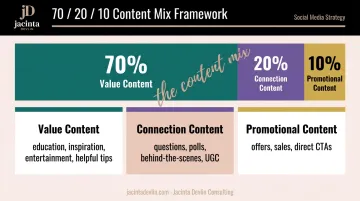
For a social seller or influencer, this means the majority of your content builds trust and relationship — and that relationship is exactly what makes the 10% convert. Once you know your ratio, the next question is: what topics do you actually post about?
Define Your Content Pillars
Content pillars are the 3-5 core topics your brand consistently speaks about. They create a clear identity, make planning easier, and ensure every post serves your brand even when topics vary.
For a boutique owner or social seller, pillars might look like:
- Style inspiration — seasonal looks, outfit ideas, and product styling that showcase your aesthetic
- Behind the scenes — how products are sourced, what's new in the shop
- Client love — reviews, transformation photos, and community shoutouts that build social proof
- Business and mindset — entrepreneurship tips, your story, lessons learned
- Promotions and sales — new arrivals, limited-time offers, and affiliate links
According to Sprout Social, most brands maintain 3 to 5 pillars. Fewer than three and your content feels narrow; more than five and you lose focus.
Format and Frequency by Platform
Different formats serve different purposes:
- Reels and TikTok — best for reach and discovery with new audiences
- Carousels — strong for saves and education; Socialinsider data shows carousels average 0.55% engagement, outperforming both Reels and single images
- Stories — real-time connection, daily touchpoints, direct sales via links
- Email — highest-quality nurture channel; use weekly for consistent relationship-building
For posting frequency, Hootsuite recommends 3-5 posts per week on Instagram and at least 1 email per week. Quality and strategic intent matter more than daily volume.
Repurpose Like a Pro: One Piece, Maximum Reach
Smart content creators don't work harder — they work smarter. Repurposing is how they stay consistent without burning out.
The most effective creators don't produce unique content for every platform. They create one strong "pillar" piece and adapt it across channels — multiplying visibility without multiplying effort.
The One-to-Many Repurposing Model
A single live video, podcast episode, or long-form post can produce:
- A short-form Reel clip (30-60 second highlight)
- A carousel that breaks down the key points
- An email newsletter to your list
- Instagram Story slides walking through the takeaways
- An LTK collection caption with linked products
- A Pinterest pin with a keyword-rich description
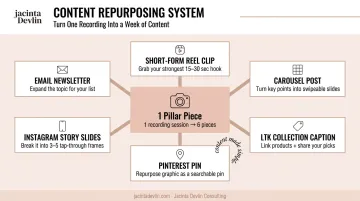
That's six pieces of content from one recording session. Adobe found that 70% of small business owners repurpose content, and 49% reported an 11-25% increase in engagement rates as a result.
What to Repurpose First
Not all content is worth repurposing. Prioritize pieces that:
- Generated strong engagement (saves, shares, comments)
- Answered a question your audience asks repeatedly
- Drove clicks or traffic to an offer
This keeps your repurposed content working for the business — not just filling the calendar.
A Simple Batching System
Block one dedicated creation day per week or per month to record, write, or capture raw content in bulk. Then schedule a separate block for repurposing and distributing.
This two-phase approach eliminates the daily scramble and cuts the decision fatigue that leads to inconsistent posting. It's the same thinking behind the done-for-you content calendars inside Jacinta Devlin Consulting's programs. Having a plan removes the friction of starting from scratch every single day.
Turn Your Brand Story Into Content That Sells
The most underused content asset in most women-owned businesses isn't a trending audio or a viral format. It's the founder's own story.
Female buyers are more likely to purchase from a brand when they feel connected to the person behind it. NielsenIQ research found that 51% of consumers view smaller brands as more authentic than large ones — and that emotional connection directly influences buying decisions.
How to Turn Your Story Into Content
You don't need a dramatic origin story to use this strategy. Practical story content types include:
- The moment or decision that led you to start — your "why I started" story
- Client transformation results with specific before/after details
- Behind-the-scenes looks at how products are sourced, what your workday actually looks like, what goes into your process
- Honest reflections on challenges, mistakes, and what you learned from them
Jacinta Devlin's own story — starting at 21 as a broke college student at a jewelry party, growing into a million-dollar earner and eventually helping over 50,000 women build their businesses — is a perfect example of how an authentic founding narrative creates connection that no promotional post can replicate.
Make Values Part of Your Everyday Content
That kind of story sets a foundation — but brand story doesn't stop at the origin post. Every piece of content communicates values through the products you feature, the language you use, the causes you support, and the clients you spotlight.
Consistently showing what you stand for builds a brand identity that compounds over time. A client transformation story posted today doesn't just convert one buyer — it builds trust with everyone watching, making your next sale easier before you ever pitch it.
Build Consistency Without Burning Out
Burnout is one of the primary reasons women entrepreneurs abandon their content strategy entirely. And it almost never comes from a lack of motivation. It comes from trying to maintain a volume that was never realistic in the first place.
Billion Dollar Boy's research found that 52% of creators have experienced burnout directly tied to their work, with 37% having actively considered leaving the profession. A separate Awin survey found 78% of influencers on their platform admitted to suffering burnout.
The fix isn't working harder — it's building a routine that actually holds up month after month.
A Sustainable Content Routine
Follow this framework to stay consistent without overextending:
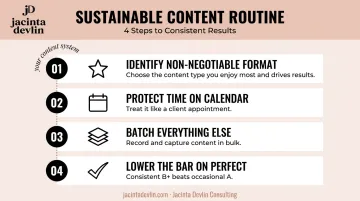
- Identify your one non-negotiable format — the content type you enjoy most and that drives the best results. For many women entrepreneurs, that's short-form video or Stories.
- Protect that time on your calendar — treat it like a client appointment, not an optional task
- Batch everything else around it — record, write, or capture content in bulk rather than daily
- Lower the bar on "perfect" — a consistent B+ is worth more than an occasional A that leaves you depleted
The goal isn't to post every day forever. The goal is to build a system you can sustain for the next two years.
That kind of structure is easier to maintain with support. The Dream+Create Online Coaching Community offers accountability, training, and a network of women building businesses alongside you. There's a free one-week trial, so you can experience the community and the strategy before committing.
Frequently Asked Questions
What is the 70/20/10 rule for content?
The 70/20/10 rule suggests roughly 70% of your content should deliver value (education, inspiration, entertainment), 20% should foster engagement and community (polls, questions, behind-the-scenes), and 10% should be directly promotional. It's a simple framework for keeping your feed valuable and your audience engaged without every post feeling like a sales push.
What are the 5 C's of content creation?
The 5 C's are Clarity, Consistency, Creativity, Credibility, and Customer-Centricity. For women-owned businesses, they mean communicating what you offer clearly, showing up reliably, leading with genuine personality, building trust through real results, and keeping your audience's needs front and center.
What is the 5-5-5 rule for social media?
The 5-5-5 rule is a practitioner engagement strategy: interact with 5 existing followers, 5 prospective new accounts, and 5 industry peers each day. The goal is to build organic community and visibility through genuine engagement rather than relying solely on posting or paid reach.
What is the 3-3-3 rule in marketing?
The 3-3-3 rule focuses on 3 core brand messages, 3 audience segments, and 3 marketing channels. For women entrepreneurs, it's a practical filter for building a content calendar that moves buyers through awareness, nurture, and conversion without spreading efforts too thin.
How often should women entrepreneurs post on social media to see results?
Consistency and content quality matter more than raw frequency. A realistic minimum is 3-5 times per week on your primary platform, with at least one email per week to your list. Posting more means little if the content isn't tied to a clear business goal.