According to QuickBooks' 2025 Women's History Month Report, **61% of women-led small businesses have adopted social media** for marketing — compared to just 49% of men-led businesses. Women entrepreneurs aren't behind on social. They're leading it.
The problem? Activity isn't the same as revenue. Most women posting consistently aren't seeing it convert to income — and Constant Contact's 2024 survey of 1,300+ small business owners found that 51% say posting on social media is their most time-consuming marketing task. That's a lot of effort with uncertain returns.
The gap isn't effort — it's strategy. This guide covers how to build social media into an actual revenue-generating tool, not just a place to post and hope.
TL;DR
- High social media activity rarely converts to income without a clear, intentional strategy behind it
- Define your audience, goals, and brand identity before creating a single post
- Focus on 1-2 platforms where your ideal customer already spends time
- Educate, inspire, and show up authentically — that's what builds the trust that drives sales
- Monetize beyond your own products through affiliate marketing, LTK, Amazon storefronts, and brand partnerships
Why Social Media Is a Competitive Advantage for Women Entrepreneurs
Women-owned businesses represent a massive and growing force in the U.S. economy. The Census Bureau reports women own 14.2 million U.S. businesses generating $2.8 trillion in receipts — and according to the NWBC, women's business ownership grew twice as fast as men's between 2019 and 2023.
Yet access to traditional growth capital remains deeply unequal. Female-founded startups still receive less than 2% of venture capital funding. That funding gap makes social media a practical equalizer: low cost, high reach, and accessible without investor backing.
The Trust Advantage Is Real
Platforms like Instagram and TikTok reward exactly the kind of content that comes naturally to many women entrepreneurs: authentic, relationship-driven, community-oriented communication. That's not a soft observation — it's backed by purchase data.
A 2024 TikTok/WARC study found:
- 78% of TikTok users are more likely to consider buying when content feels personally relevant
- 7 in 10 users purchased a brand or product they'd never bought before after seeing it on TikTok
- 45% of users define brand relevance as a brand that understands their needs
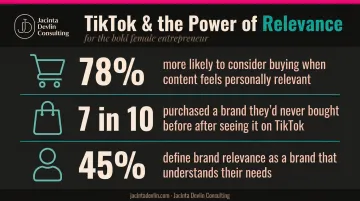
Those numbers make the case clearly: relationship-first content drives real purchasing decisions.
Social Media Is Now Business Infrastructure
That conversion power is exactly why social media has become core business infrastructure — not an optional add-on. Whether you're a coach, a boutique owner, or a product seller, building visibility through organic content is now a fundamental business skill. The question isn't whether to use it. It's how to use it strategically.
Christina Roach of @mybalancedstyle is a clear example of what's possible. Starting from zero, she grew a Facebook Group to 36,000+ members and her Instagram to over 95,000 followers. Within six months of working with Jacinta Devlin Consulting, she quit her full-time job and now generates hundreds of thousands of dollars monthly through Amazon and LTK.
Build Your Foundation Before You Start Posting
The most common mistake women entrepreneurs make on social media? Starting with content before starting with strategy.
Posting without a foundation means creating content for no one in particular, with no clear purpose, on a profile that doesn't communicate a consistent message. The result is inconsistency, burnout, and wondering why nothing is working.
The Content Marketing Institute found that 65% of the most successful content marketers have a documented strategy, compared to just 14% of the least successful. That gap is not coincidental.
Define Your Ideal Customer First
Before creating a single post, get specific about who you're talking to:
- How old is she? What does her daily life look like?
- What problem keeps her up at night?
- What does she want more of — time, money, confidence, style?
- Where does she spend time online, and what kind of content does she engage with?
The more specific your answers, the more effective every piece of content becomes. Vague targeting produces vague results — clarity about your ideal customer is what makes the right people stop scrolling.
Set Business Goals Before You Set a Posting Schedule
Different goals require completely different content approaches. Know which one you're optimizing for:
- Brand awareness — reach new audiences, increase discoverability
- Lead generation — drive email sign-ups, consultation bookings, DM inquiries
- Direct sales — convert followers into buyers of a specific product or service
- Brand partnership attraction — position yourself as a credible creator for paid collaborations
A business owner chasing all four at once will achieve none of them. Pick your primary goal for the next 90 days and build your content around it.
Establish a Consistent Brand Identity
Your brand identity has three components that work together:
- Consistent colors, fonts, and photo style that create a recognizable look across every post
- A distinct voice in your captions — whether that's warm, witty, direct, or educational
- A clear core message that communicates the transformation or outcome you deliver
Consistency across all three is what makes a profile feel trustworthy and recognizable at a glance. Jacinta Devlin's Business Launch Program covers this groundwork first — brand board, logo, colors, and messaging — so that every piece of content you create works from a solid base.
Choosing the Right Social Media Platforms for Your Business
Trying to master every platform at once is one of the fastest paths to burnout. The better approach: choose 1-2 platforms, build consistency and results there, and expand only after you've established traction.
Where the Major Platforms Fit
| Platform | Best For | Key Stat |
|---|---|---|
| Visual storytelling, personal brand, shopping | Used by 55% of women vs. 44% of men in the U.S. | |
| TikTok | Organic reach, discovery, video content | 37% of U.S. adults, up from 21% in 2021 |
| Community building, groups, warm audience engagement | Used by 71% of U.S. adults |
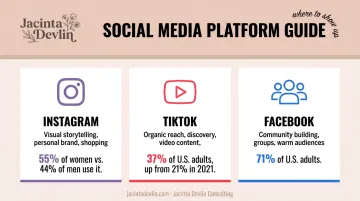
Platform usage data: Pew Research Center, 2025
Don't Overlook LTK
LTK (formerly LikeToKnowIt) is one of the most underutilized revenue tools for women entrepreneurs in lifestyle, fashion, home, and product categories. It functions as both a social platform and a direct shopping tool — creators share product links, followers shop directly through them, and creators earn commissions on every sale.
The platform's scale is significant: LTK creators in 150+ countries drive over $5 billion in annual retail sales and reach 40 million monthly shoppers. For product-forward women-owned businesses, it's a serious revenue channel worth building from the start.
Jacinta Devlin built her own LTK profile and Amazon storefront using this exact model, and her clients regularly hit $5k–$50k+ income months through affiliate and influencer programs. Sharon Bean, for example, went from earning $4,000 in her first year on Amazon to consistently generating $20,000+ monthly after working with Jacinta.
The Right Platform Is Where Your Customer Already Scrolls
Those kinds of results start with one decision: choosing the right platform for your specific audience, not what's trending or what you personally enjoy most. A boutique owner whose customers are women 35–55 will find more traction on Facebook and Instagram than TikTok. A fashion creator targeting women in their 20s should prioritize TikTok and Instagram Reels.
What to Post: A Content Strategy Framework
Random posting is just noise. A sustainable content strategy needs structure — which is where content pillars come in.
The Four Content Pillars
Content pillars are recurring content categories that keep your feed balanced and strategic:
- Education — tips, how-tos, industry knowledge, myth-busting
- Inspiration — transformation stories, motivational moments, aspirational content
- Behind-the-Scenes/Personal — founder journey, real moments, the human side of the business
- Promotional — products, services, direct calls to action
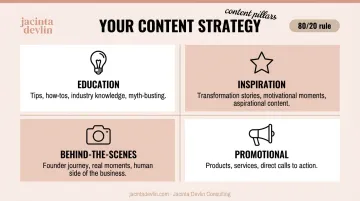
The mix prevents your feed from becoming a sales pitch while still driving toward business goals. A general starting point: approximately 80% of content provides value and builds relationship, while 20% is direct promotion.
Your Story Is Your Strongest Selling Tool
Authentic storytelling converts casual followers into loyal buyers. Sharing your "why," showing real struggles alongside wins, and letting your personality come through creates the kind of emotional connection a polished brand logo never can.
Hiding behind a curated brand persona costs you that connection. The entrepreneur behind the business is almost always the most compelling part of the story. Make it visible:
- Share the moment you decided to start your business
- Show behind-the-scenes reality, not just highlight-reel wins
- Let your voice and opinions come through in captions and video
Short-Form Video: Your Highest-ROI Content Format
Short-form video is also the best delivery vehicle for that founder story. Reels and TikTok consistently generate the highest organic reach of any content format. What works:
- Quick tips (15–30 seconds, one idea per video)
- Product demos or unboxings
- Day-in-the-life clips that show the business behind the brand
- Story-driven content — a struggle, a turning point, a result
Stay Consistent Without Burning Out
Buffer's analysis of 2M+ Instagram posts found that posting 3–5 times per week can more than double follower growth rate compared to sporadic posting. Consistency matters more than volume.
Two practical methods for staying consistent:
- Batching — dedicate one session per week to creating multiple pieces of content rather than starting from scratch daily
- Repurposing — a tutorial Reel becomes a carousel, a caption, and a Story series; one idea fuels four pieces of content
A simple content calendar — even a spreadsheet — is the most practical tool for staying on track.
How to Turn Social Media Into a Real Revenue Stream
Visibility and revenue are not the same thing. Building an audience is the first step. Converting that audience into income requires specific, deliberate mechanics.
The Tactical Elements That Bridge the Gap
- Strong calls-to-action in every post: tell people exactly what to do next (shop the link, book a call, DM you a keyword)
- A clear link-in-bio strategy: direct traffic to one high-priority destination — a product page, email sign-up, or booking link
- Social proof: testimonials, before-and-afters, and user-generated content lower the psychological barrier to buying
Affiliate Marketing and Platform Storefronts
LTK and Amazon storefronts allow women entrepreneurs to earn commissions by recommending products they already use and love. Amazon Associates offers up to 10% commission on qualifying purchases, while LTK enables creators to build shoppable content that reaches 40 million monthly shoppers.
This income stream layers on top of — rather than replacing — a primary business. For women with engaged audiences in lifestyle, fashion, wellness, or home categories, it's one of the most efficient revenue additions available.
Jacinta Devlin's clients demonstrate the upside clearly:
- Christina Roach now generates hundreds of thousands monthly through Amazon and LTK, and quit her full-time job within six months
- Jennie Stehli grew from 500 to 6,000+ Instagram followers and now earns $5k+ monthly across multiple brands
- Joy W. scaled from $500 months to consistent $5k+ monthly sales after building her social presence
The Brand Partnership Pathway
Building affiliate income also opens doors to paid brand collaborations — and those aren't reserved for accounts with massive followings. What brands actually look for:
- A clearly defined niche with a specific, consistent audience
- Genuine engagement — comments, saves, shares — not just follower count
- Authentic alignment with the brand's product or values
- Professional outreach that demonstrates you've researched the brand
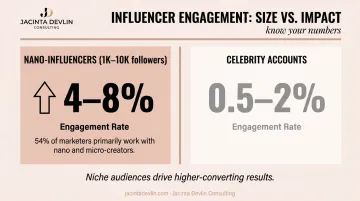
54% of marketers primarily work with nano and micro-creators (under 100,000 followers), because smaller, niche audiences drive higher-converting results than large passive ones. Nano-influencers (1,000–10,000 followers) see engagement rates of 4–8%, compared to 0.5–2% for celebrity accounts.
Measure What Actually Matters
Follower count and likes feel satisfying, but vanity metrics don't move the needle. The numbers that indicate real business impact:
- Reach and impressions — how many people are seeing your content
- Link taps and website traffic from social — are people taking action?
- Saves — a strong indicator of content value and purchase intent
- Email list growth from social — converting followers to owned audience
- Conversion rate — what percentage of social traffic becomes buyers
Check your native analytics weekly. If a post drove link taps or email sign-ups, make more content like it — that's the signal that matters.
Frequently Asked Questions
Which social media platform is best for women-owned businesses?
There's no single best platform — it depends on where your ideal customer spends time and what content you can create consistently. That said, Instagram remains the most versatile choice for most women entrepreneurs, TikTok offers the highest organic reach for video content, and LTK is the strongest option for product-based or lifestyle brands looking to generate commission income.
How often should I post on social media as a female entrepreneur?
Prioritize consistency over volume. Posting 3–5 times per week with intentional content will outperform daily posting with no strategy. Stories and short-form video can supplement feed posts to maintain daily presence without requiring full creative production every day.
How can I make money from social media beyond selling my own products?
The three primary income streams to layer on top of a core business are affiliate marketing through platforms like LTK and Amazon, brand partnerships and sponsored content, and direct product sales through shoppable social features. LTK and Amazon storefronts require minimal setup and can generate steady passive commission income for women with engaged lifestyle audiences.
What type of content performs best for women-owned businesses?
Short-form video (Reels and TikTok) delivers the highest organic reach, while educational content, personal stories, and behind-the-scenes posts drive the deepest engagement. Educational or personal video combining both formats typically performs best for reach and trust-building that converts.
Do I need a large following to get brand deals or make money on social media?
Engagement rate matters far more than follower count. An account with 5,000 highly engaged followers in a specific niche is often more attractive to brands than one with 100,000 passive followers, because niche micro-influencers drive more authentic conversions.
How do I stay consistent on social media when I'm running a business by myself?
Batch your content by filming or writing multiple posts in one dedicated session each week. Pair that with a simple content calendar and repurpose one strong piece across multiple formats so you're not starting from scratch every time.