Why Most Women Entrepreneurs Struggle to Sell Online
A great product gets you in the game. Converting your online presence into consistent revenue — that's the part most women entrepreneurs are still figuring out.
The pattern shows up constantly: post content, hear crickets, get one or two sales, repeat. There's even a name for it — "post and pray." It leaves women overwhelmed, second-guessing every decision, watching sales fail to reflect the quality of what they actually offer.
The gap is rarely talent or product quality. It's strategy — and that's a fixable problem.
Women-owned businesses are already a significant economic force — 1.3 million U.S. employer firms generating $2.1 trillion in receipts, according to 2024 Census data. And 67% of women business owners already use social media as a business tool, per a 2024 QuickBooks survey. The challenge isn't getting online — it's turning that digital activity into reliable, measurable revenue.
This article walks through a proven framework: identifying your ideal customer, building a personal brand that attracts buyers, mastering social selling, and creating multiple income streams that don't depend on any single platform.
TLDR
- Know exactly who you're selling to before investing time in any platform or content strategy
- Your personal story is your strongest sales asset — build your brand around it
- Focus social selling on one or two platforms where your ideal buyer already spends time
- Build and nurture an email list — it's the one channel you own outright and can sell through consistently
- Layer income channels across social, affiliate, and marketplaces so a slow month on one platform doesn't stall your business
Know Your Ideal Customer Before You Sell Anything
The more precisely you define your audience, the more every downstream decision — platform choice, content format, offer framing — becomes obvious rather than exhausting. Vague targeting doesn't just underperform; it actively costs you revenue.
McKinsey found that 71% of consumers expect personalized interactions, and that personalization typically drives a 10–15% revenue lift. Broad, generic messaging is the fastest way to leave that revenue on the table.
Build Your Customer Avatar
A basic customer avatar covers five areas:
- Demographics — age, location, life stage, income range
- Core desires — what they want to achieve or become
- Pain points — what's frustrating them right now
- Content habits — where they spend time online and what they consume
- Language — the exact words they use to describe their own problem
That last point is the one most entrepreneurs skip. When your copy mirrors how your customer already talks about their problem, it reads like you're inside their head — and that's what makes someone click "buy."
Identify the Problem You Solve, Not Just the Product You Sell
Customers buy outcomes and solutions. Features are secondary. The shift from product-first to problem-first positioning is one of the fastest ways to make an offer feel more compelling.
Consider a planner or productivity tool. The same product can be positioned three completely different ways depending on the audience's pain:
- For the overwhelmed mom: "Finally get your time back"
- For the freelancer: "Stop leaving money on the table — structure your income"
- For the anxious high achiever: "Go to bed at night knowing everything is handled"
Same product. Three distinct buyers. Three different emotional hooks.
Once you know your buyer's pain point, the platform question answers itself.
Map Where Your Buyer Spends Time Online
Choosing the wrong platform wastes effort regardless of content quality. Match your channel to your buyer:
| Platform | Audience Profile |
|---|---|
| Visual lifestyle buyers — fashion, beauty, home, coaching | |
| TikTok | Younger buyers, trend-driven discovery, impulse purchases |
| Facebook Groups | Community-driven buyers, deals, repeat engagement |
| LTK | Lifestyle shoppers actively looking to buy through creators |
| Professional buyers, B2B-adjacent services, expert positioning | |
| Amazon | Deal-oriented shoppers, search-intent buyers |
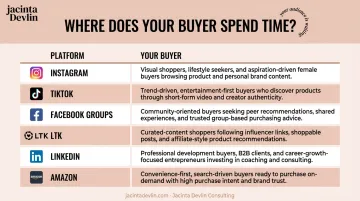
Pew Research's 2024 data shows 70% of U.S. adults use Facebook, 50% use Instagram, and 33% use TikTok — with TikTok skewing heavily toward adults under 30. Match your platform choice to where your specific buyer already spends time, not where you're most comfortable.
Build a Personal Brand That Attracts Buyers
Buyers choose people they know, like, and trust — and in an online environment, your personal brand is what creates that trust before a single conversation happens. A polished logo helps, but it's your story, voice, and consistency that actually move people from follower to buyer.
A strong personal brand has three non-negotiable components:
- A clear niche — a specific audience and problem you're known for solving
- A consistent voice and visual identity — so your audience always recognizes you across formats
- A compelling value proposition — a clear answer to "why should I follow and buy from you?"
Lead with Your Story, Not Your Pitch
Generic promotional content gets scrolled past. A real story stops the scroll.
Jacinta Devlin's own origin story is a clean example of this principle in action. She started at 21 as a broke college student working two jobs, said yes to a jewelry sales party mostly for the extra cash, and had no idea it would turn into a 12-year direct sales career. That career made her a Top 1% seller and million-dollar earner at companies like lia sophia and Park Lane Jewelry, eventually leading to her role as National Director of Sales & Field Training at Stella & Dot — and ultimately to coaching over 50,000 women in the social selling space.
What makes that story work isn't the success. It's the starting point. Buyers and clients connect with the version of you that looked exactly like them — uncertain, scrappy, figuring it out. The journey from there to here is what builds trust that no credentials list can replicate.
Share the challenges, the hard pivots, and the wins. That's what creates emotional resonance — and emotional resonance is what makes someone want to buy from you specifically.
Show Up Consistently Across Your Chosen Channels
Once your story is working, the next job is showing up long enough for it to compound. Consistency signals professionalism and builds familiarity — audiences need to see you repeatedly before they trust you enough to buy. One viral post rarely converts the way people expect. Ninety days of consistent presence almost always moves the needle.
A few practical rules:
- Pick one primary platform and master it before expanding. Genuine authority on one platform outperforms scattered presence across five.
- Keep your brand voice consistent even as formats vary — whether you're posting a Reel, a Story, or sending an email, your audience should immediately recognize it as you.
- Use a done-for-you content calendar to eliminate daily decision fatigue. Clients who work with Jacinta often describe becoming "more consistent and intentional" with posts as one of the first visible changes in their business.
Social Selling Strategies That Turn Followers Into Customers
Social selling is relationship-first selling. Instead of pushing products at your audience, you use social media to build trust over time — and that trust is what converts followers into paying customers. Hard-sell tactics underperform because buyers don't respond to pressure. They respond to feeling understood.
Social commerce is no longer a side channel. eMarketer forecasts U.S. social commerce sales will surpass $100 billion in 2026. TikTok alone reported 120% year-over-year U.S. sales growth and found that 83% of TikTok Shop shoppers discovered a new product through the platform.
Choose the Right Platforms and Own Them
Here's how the top platforms break down for women entrepreneurs:
- Instagram — lifestyle, fashion, beauty, and coaching. Strong for visual content, Stories, and creator partnerships. 50% of U.S. adults use it.
- TikTok — broad discovery, viral reach, and TikTok Shop for direct purchasing. Strongest with buyers under 35.
- Facebook Groups — community building, repeat engagement, and direct sales. Still the largest platform with 70% U.S. adult usage.
- LTK — affiliate-style selling with built-in purchase intent. LTK's creator network drives over $5 billion in annual retail sales and reaches 40 million monthly shoppers.
Pick one platform, master it, and build a real audience there. Showing up consistently on a single channel outperforms spreading thin across five — and your engagement metrics will prove it.
Engage to Convert — Not Just to Grow
Once you've chosen your platform, the next job is closing the gap between follower and buyer. That gap is engagement — and engagement doesn't happen by accident.
The shift from passive audience to paying customer usually happens through:
- Responding to comments with substance, not just emojis
- Starting DM conversations with followers who engage repeatedly
- Writing captions with questions that invite a real response
- Creating content that opens conversations rather than closes them
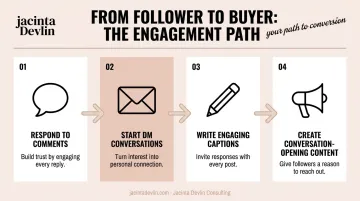
Once someone is warm, move them toward a purchase with clear, low-friction calls to action. "DM me for details," a time-limited Stories offer, or a direct link-in-bio landing page all work — the key is making the next step obvious.
Asking for the sale confidently doesn't require pressure tactics. Frame your offer as a solution to a problem you've already demonstrated you understand. When the connection is real and the offer is relevant, asking for the sale is just the logical next step.
Content and Email Marketing That Builds Long-Term Revenue
Social algorithms change constantly. An email list doesn't.
Email and content are the two most durable sales assets you can build — because you own them. A well-built email list compounds in value over time regardless of what any platform decides to do with its algorithm next quarter.
A practical content mix that works:
- Educational content — builds authority and answers your audience's real questions
- Relatable content — builds trust through shared experience and honest storytelling
- Conversion content — drives action with clear offers and calls to action
Rotate across all three. Heavy conversion content without the trust-building content that precedes it rarely converts.
Build an Email List from Day One
The mechanics are simple: create a lead magnet that solves one specific problem for your ideal customer and offer it in exchange for an email address. Formats that work include:
- A checklist or quick-reference guide
- A template or swipe file
- A discount or first-order offer
- A short video training or challenge
Jacinta applies this directly in her own business, offering freebies like "10 Affiliate Programs to Apply For No Matter How Many Followers You Have" as entry points that deliver immediate value while building her list.
From there, the work is nurturing — consistent emails that educate, entertain, or inspire action, not just promotional blasts. Litmus reports email marketing generates an average ROI of $36 for every $1 spent. That return comes from relationships built over time, not one-off campaigns.
Expand Your Income with Multi-Channel Selling
Relying on a single sales channel is a single point of failure. Algorithm changes, platform policy shifts, or a slow season can crater revenue overnight. Layering multiple income streams creates both stability and real scale.
The main online revenue channels available to women entrepreneurs today:
| Channel | What It Is | Scale Proof |
|---|---|---|
| Direct social selling | Selling via Instagram, TikTok, Facebook | Social commerce approaching $100B by 2026 |
| LTK affiliate | Commission-based product recommendations | $5B+ annual retail sales, 40M monthly shoppers |
| Amazon storefront | Product-linked storefront with affiliate commissions | 40%+ of U.S. e-commerce; 75,000+ sellers hit $1M+ annually |
| Shopify/Etsy | Owned or marketplace storefronts | $292B Shopify GMV and $12.6B Etsy GMS in 2024 |
| Brand partnerships | Paid collaborations and sponsored content | Influencer market forecast at $24B by end of 2024 |
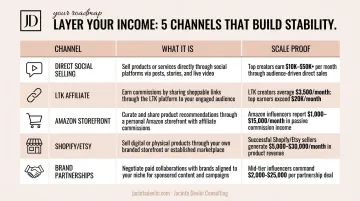
Real results are possible across all of these — but the path looks different for every business. A few examples of what that looks like in practice:
- Sharon B. went from $4,000 in her first year on Amazon to $20,000+ per month after working through Jacinta's coaching program
- Christina R. grew from under 13,000 to over 95,000 Instagram followers, now sells hundreds of thousands monthly via Amazon and LTK, and quit her full-time job within six months
- Jennie S. launched with 500 followers and reached $5,000+ per month across multiple platforms after getting approved on both Amazon and LTK
Those results come from matching the right channels to each person's strengths. Jacinta Devlin Consulting helps women entrepreneurs do exactly that — building the systems behind affiliate, influencer, and e-commerce income with clients reaching $5,000–$50,000+ months through individualized strategy.
Frequently Asked Questions
What is the 3-3-3 rule in sales?
The 3-3-3 rule is a prospecting framework often described as: contact 3 new prospects, follow up with 3 existing leads, and complete 3 value-adding activities each day. For online sellers, it translates directly to consistency — showing up daily with intentional outreach rather than waiting for inbound interest.
What are the 5 C's of sales?
One widely used version defines them as: Customer-Centricity, Communication, Closing, Consistency, and Continuous Learning. For women selling online, each C maps to a trust-building behavior — from understanding your buyer's needs to following up confidently and refining your approach over time.
What are the 5 P's of sales?
The 5 P's — Product, Price, Place, Promotion, and People — come from the extended marketing mix. Use them as a quick audit: Is your offer clear, your pricing right, and your promotion consistent? Most importantly, are you showing up as someone your buyers actually want to buy from?
How do I turn social media followers into paying customers?
Move from broadcasting to engaging: respond to comments, start DM conversations with warm followers, and use clear calls to action in every post. Make the next step obvious — a link in bio, a Stories offer, or a direct message invitation — so interested buyers know exactly where to go.
What are the best platforms for women entrepreneurs to sell online?
Instagram, TikTok, LTK, and Amazon are the strongest platforms depending on your product type and audience. Instagram and LTK work well for lifestyle and visual products; TikTok for discovery and trend-driven sales; Amazon for search-intent buyers. Choose one, master it, then expand — spreading across five platforms at once rarely works.
How can I be successful in sales as a woman?
Lead with authenticity and relationship-building. Your personal story and genuine connection to your audience are natural sales strengths — use them. Stay consistent, follow up without apologizing for it, and don't let fear of coming across as "salesy" keep you from making real offers. Confidence in selling comes from knowing your offer solves a problem your buyer is already looking to fix.