Introduction
A brand slides into your DMs. They mention a "paid partnership opportunity," and suddenly you're staring at words like deliverables, exclusivity clauses, usage rights, and NET 60 payment terms — none of which anyone explained to you. Most creators freeze up, either accepting whatever's offered or missing the opportunity entirely.
Brand deals are one of the most powerful income streams available to creators right now. But the process from first contact to final payment is rarely broken down in plain language. This guide covers the entire lifecycle: what brand deals actually are, why brands pay for them, how the process works, and what drives your earning potential.
Whether you're fielding your first inbound offer or building toward consistent five-figure deal income, knowing how the system works is what separates creators who negotiate confidently from those who leave money on the table.
TL;DR
- A brand deal is a paid (or product-based) agreement where a brand compensates a creator to promote its products or services to their audience.
- Every deal moves through the same lifecycle: outreach, negotiation, contract, content creation, publication, and payment.
- Brands pay for trust, relevance, and real purchase influence — audience size alone rarely wins deals.
- Before signing, know your deliverables, usage rights, exclusivity clauses, and payment timeline.
- Landing deals comes down to niche authority and engagement — not how many followers you have.
What Is a Brand Deal?
A brand deal is a formal agreement where a company pays or compensates a content creator to promote its products, services, or messaging to their audience — in exchange for content, visibility, and trust.
A banner ad interrupts someone. A brand deal works because a creator's audience already trusts their recommendations. That trust is what brands are actually buying.
Brand deals vary widely in structure and compensation:
- Sponsored posts — flat fee for a specific piece of content
- Affiliate/commission deals — earnings tied to tracked sales through a unique link or code
- Brand ambassadorships — long-term partnerships (typically 6–12 months) with recurring deliverables and exclusivity
- UGC (User Generated Content) deals — creator is paid to produce content the brand uses on its own channels, without the creator posting it themselves
- Gifted/product seeding — no monetary payment; brand sends product hoping for organic coverage
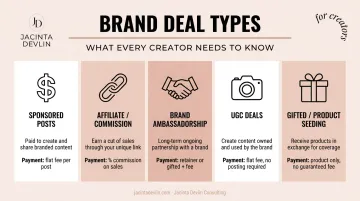
Each structure affects your income potential, workload, and contract obligations differently. Knowing the distinctions upfront helps you negotiate better terms and say yes to the right opportunities.
Why Brands Pay Creators (Not Just for Follower Count)
Brands pay creators because they can move an audience to act — to consider, care about, or buy a product — based on genuine trust. That kind of influence can't be purchased through a traditional ad buy.
What Brands Actually Evaluate
Before extending a deal offer, brands typically assess three things:
- Relevance — Does the creator's content naturally align with the brand's product category and target customer?
- Engagement — Are real people responding, commenting, saving, and sharing? Not just watching and scrolling past?
- Consistency — Does the creator post regularly enough that a campaign placement actually means something?
Follower count sits further down the list than most creators assume. That shift in priorities is exactly why smaller creators are landing more deals than ever.
Why Smaller Creators Are in High Demand
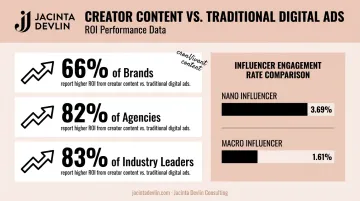
According to Aspire's 2026 analysis, 70% of marketers currently collaborate with nano or micro influencers, compared to just 7% working with macro-level creators and above. Influencer Marketing Hub's 2026 benchmark report puts it even more plainly: 44% of brands actively prefer nano-influencers and 26% prefer micro-influencers.
The engagement data supports why. Aspire reports nano influencers average 3.69% engagement — more than double the 1.61% average for macro influencers. A tight, loyal community regularly outperforms a large, disengaged audience on actual conversions.
The Business Case for Creator Partnerships
CreatorIQ's 2024 Trends Report found that 66% of brands, 82% of agencies, and 83% of industry leaders reported creator content drove more ROI than traditional digital advertising. Creators integrate products into content their audience already chooses to watch — a different dynamic than an ad someone skips.
Brand safety matters here too. Brands are entrusting creators with their reputation. A messy, inconsistent, or controversial profile is a common reason deals fall through even when follower numbers look strong.
How a Brand Deal Works: Step-by-Step
The deal lifecycle moves from first contact through negotiation, a legally binding contract, content production with brand approval, publication with proper disclosures, and finally analytics reporting and payment. Here's how each stage actually plays out.
Step 1: Initial Contact and Opportunity Evaluation
First contact happens one of two ways: a brand (or their PR agency or influencer marketing team) reaches out via email or DM, or you pitch proactively. Having a business email visible in every bio is essential — if brands can't find you, they can't pay you.
A typical inbound inquiry includes a campaign concept, rough deliverables, timeline, and sometimes a budget range. Before responding with interest, evaluate:
- Total deliverables (how many posts, which platforms, what format)
- Campaign timeline and how it fits your schedule
- Whether usage rights are organic or paid
- Any exclusivity requirements and their scope
- Whether budget is disclosed or requires negotiation
Step 2: Negotiation
Negotiation is expected — brands anticipate back-and-forth. The items typically in play:
- Rate — your flat fee or per-deliverable rate
- Exclusivity — length of the restriction and how broad the category is
- Deliverable count — number of posts, Stories, Reels, etc.
- Usage rights — organic reposting vs. paid ads, whitelisting, or dark posting each carry different pricing implications
Know your baseline rate before entering any conversation. Account for concept development, filming, editing, revision time, and the value of your audience's trust. Lumanu's 2026 survey of 400+ influencers found 51% charge an additional fee for whitelisting or paid amplification — if a brand wants to run your content as an ad, that's a separate line item.
Quote higher than your floor — adjustments are part of the process.
Step 3: Contracting
Once terms are agreed, the brand or agency produces a formal agreement. Three areas demand close attention:
- Content ownership and usage duration — avoid granting rights "in perpetuity"
- Payment timeline — NET 30 to NET 90 is common; confirm before signing
- Revision rounds — ensure unlimited revisions are not written into the contract; one to two rounds is standard
If any clause is ambiguous — especially around usage rights or payment terms — have a lawyer or experienced manager review it before you sign. One hour of review can prevent months of disputes.
Step 4: Content Creation and Approval
The typical production workflow:
- Submit a content concept for brand approval before filming
- Create the content (short-form video, static post, Stories, etc.)
- Submit a draft to the brand or agency for review
- Incorporate feedback through the agreed revision rounds
- Receive final approval before scheduling
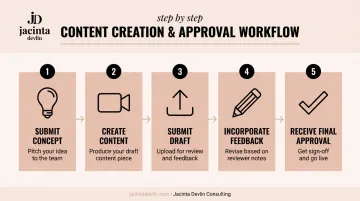
Build revision rounds into your timeline upfront and communicate that estimate to the brand at the start — it prevents last-minute pressure when approval takes longer than expected.
Step 5: Publication and Disclosures
At publication, confirm the exact go-live date with the brand and include all required disclosures. FTC guidelines require clear, conspicuous disclosure of any material connection — payment, free products, or other compensation. Acceptable formats include:
- #Ad or #Sponsored (visible above the fold)
- "Paid partnership" label (Instagram's native tool)
- Plain-language statements like "Thanks [Brand] for the free product"
Platform disclosure tools — Instagram's "Paid Partnership" label, TikTok's content disclosure setting, YouTube's paid promotion checkbox — are useful but don't replace your obligation to make it obvious. A buried hashtag at the end of a caption doesn't meet the standard.
After posting, actively engage with audience comments. It signals to the brand that you're genuinely invested in campaign performance.
Step 6: Analytics Reporting and Payment
After the content goes live:
- Screenshot and compile your analytics (reach, views, engagement rate, saves, link clicks, and affiliate conversions if applicable)
- Send a brief performance summary — not just raw numbers, but a few key insights about what performed well
- Submit your invoice per the contracted payment timeline
Most creators send raw screenshots and nothing else. A two-paragraph summary — noting your top-performing moment and any audience sentiment — shows the brand you understand their goals, not just your metrics. That's what gets you on the shortlist for the next campaign.
What Affects Your Brand Deal Value
Two creators with identical follower counts can receive wildly different offers. Understanding what drives perceived value lets you proactively influence what you earn.
Core Value Drivers
- Niche clarity — a defined, targetable audience is more valuable than a broad general one
- Engagement quality — saves, shares, and click-through rates carry more weight than likes or raw view counts
- Audience demographics — age range, location, income level, and gender alignment with the brand's target customer directly influences offer size
- Content production quality — brands are trusting you to represent them publicly
Contract Factors You Can Negotiate
Beyond the base rate, these elements affect total compensation:
- Usage rights: if a brand wants to run your content as a paid ad, negotiate a higher rate — that's a separate revenue stream
- Exclusivity windows: longer restrictions on competitor brand work should be compensated proportionally, not assumed
- Scope creep: any deliverables added after you've agreed to terms require renegotiation, full stop
The Media Kit Factor
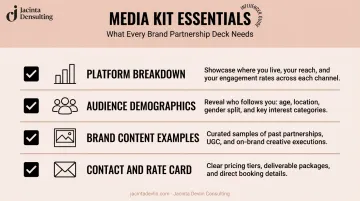
A strong media kit — one that clearly presents audience demographics, engagement rates, platform performance, and examples of previous brand content — helps brands quickly assess fit. Creators who show up with one often receive faster responses and higher initial offers. At minimum, include:
- Platform breakdown with follower counts and engagement rates
- Audience demographic data (age, location, gender)
- 2–3 examples of previous brand content
- Contact information and rate card (optional)
Knowing what to include is one thing — knowing how to position it for brands like Gucci, Nordstrom, or Amazon is another. Jacinta Devlin built her influencer career through partnerships with exactly those brands, and her coaching clients learn the same positioning strategies she used firsthand.
Common Misconceptions About Brand Deals
Not every belief creators hold about brand deals is grounded in reality. These three myths, in particular, can cost you real opportunities — or lead you into deals you'll regret.
"I need a huge following before brands will work with me." This is the most persistent myth in the space. Influencer Marketing Hub's 2026 benchmark report shows 44% of brands prefer nano-influencers. A creator with 5,000 followers and 8% engagement can be more valuable to a brand than one with 100,000 followers and 0.5% engagement. Niche relevance and genuine audience trust are the actual criteria.
"A gifted product deal is the same as a paid deal." It isn't. Gifted or seeded product has no monetary value and no legal obligation to post. It can be a useful portfolio-builder early in your creator journey, but it should never be treated as income. Be cautious about investing significant production time in unpaid campaigns unless there's a clear strategic reason.
"Any brand deal is a good deal." Some deals actively hurt you. Watch for these red flags before signing:
- Misaligned brands that undermine your audience's trust
- Unlimited revision clauses with no defined scope
- Full content ownership granted in perpetuity
- Below-market rates that set a low ceiling for future deals
The best strategy is to be selective, negotiate confidently, and walk away from deals that don't genuinely serve your audience — because every poor deal sets a precedent for the next.
Frequently Asked Questions
What exactly is a brand deal?
A brand deal is a paid or product-based agreement between a creator and a company, where the creator promotes the brand's product or service to their audience in exchange for compensation. It can range from a single sponsored post to a multi-month ambassadorship with recurring deliverables.
How much do you get paid for brand deals?
CreatorIQ's 2024 data shows 36% of brands paid creators with under 100K followers $500–$2,500 for a single Instagram post. IZEA's 2023 data puts nano-influencer averages around $1,105 per sponsored post. Rates shift based on platform, niche, engagement, and deal type — UGC and usage rights deals often pay more than standard posts.
What is a brand deal example?
A lifestyle creator with 15,000 Instagram followers partners with a skincare brand for one Instagram Reel and two Stories in exchange for a flat fee. The contract permits the brand to repost the content organically for 30 days and requires one revision round before the content goes live.
Do you need a lot of followers to get brand deals?
No. Follower count is not the primary criterion. Brands increasingly seek creators with niche audiences, strong engagement, and authentic influence. Nano and micro creators are actively sought out — 44% of brands now prefer working with nano-influencers specifically.
What should be in a brand deal contract?
Every contract should cover:
- Deliverables and platform
- Usage rights (organic vs. paid, and duration)
- Exclusivity terms
- Payment amount and timeline (NET 30/60/90)
- Revision rounds permitted
- Content ownership terms
Avoid contracts that grant perpetual ownership or include unlimited revision clauses.
How do you find brands to work with as a creator?
Four reliable channels to start:
- Influencer marketplaces: LTK, Amazon, impact.com, Collabstr, Aspire
- Cold outreach: Contact brands you already use and genuinely like
- Bio signaling: Add a business email and note that you're open to partnerships
- Relationship building: Engage consistently with brand accounts before pitching