The catch? Most women entrepreneurs treat email as an afterthought behind social media. That's a costly mistake, because your email list is the one audience you actually own. Algorithm changes can cut your social reach overnight — Meta said as much when it reduced Page content distribution back in 2018. Your email list can't be taken from you.
This guide covers everything you need to launch or level up your email marketing: proven strategies, list-building tactics, platform comparisons, and the mistakes that quietly kill results.
TL;DR
- Email marketing's $36:1 average ROI makes it the highest-return channel most entrepreneurs underuse
- An engaged list of 1,000 subscribers beats a disengaged list of 10,000 — quality is everything
- Personalization, storytelling, segmentation, and automation drive results — master all four
- Flodesk, Mailchimp, Klaviyo, and Constant Contact each suit different business types and budgets
- Never buy a list or skip segmentation — and keep every email to one clear call-to-action
Top Email Marketing Strategies for Women Entrepreneurs
Email strategy is the bridge between building an audience and generating consistent revenue. Without it, even the warmest following stays dormant. With it, subscribers become buyers, repeat customers, and eventually your loudest advocates.
Craft Subject Lines That Demand to Be Opened
Your subject line determines whether everything else you wrote gets read. Personalized subject lines — ones that include the recipient's first name — increase open rates by 26%, according to Campaign Monitor. Mailchimp recommends keeping subject lines under 9 words and 60 characters.
These four formulas are worth saving:
- Urgency-based: "Last chance: 20% off ends tonight" — use for sales, launches, and deadlines
- Curiosity-based: "You're leaving money on the table (here's why)" — use to tease a reveal or insight
- Benefit-driven: "3 scripts that close sales on Stories" — use when the value is the hook
- Personal/story-based: "The moment I almost quit (and what changed)" — use to build emotional connection
Build Your Brand Voice Through Authentic Storytelling
Women entrepreneurs carry a genuine storytelling advantage: your journey, your "why," and your behind-the-scenes moments create connection that no polished brand blast can replicate. When subscribers feel like they know you, trust follows — and trust drives sales.
Jacinta Devlin built her consulting practice on exactly this principle. Her story — from broke college student at 21 selling jewelry at a direct sales party to National Director of Sales at Stella & Dot and coach to 50,000+ women — runs through all her content and consistently resonates with her audience because it's real and specific.
Your story works the same way — but only if you know how to frame it. Working with a business coach can help you uncover and articulate your own narrative. Jacinta Devlin Consulting's 1:1 coaching programs help women develop their brand positioning and translate it into a content and email strategy that actually converts.
Segment Your List to Send the Right Message to the Right Person
Segmentation means dividing your list into groups based on interests, purchase behavior, or where someone is in the buyer journey. The results are significant: Mailchimp's analysis found that segmented campaigns had 14.31% higher open rates and 100.95% higher click rates compared to non-segmented campaigns.
Start with these three segments:
- New subscribers — welcome content, brand story, expectation-setting
- Repeat buyers — loyalty rewards, early access, VIP offers
- Inactive subscribers — re-engagement sequence before removing from the list
Automate for Consistency Without Burning Out
Every woman entrepreneur needs at least three automations running:
- Welcome sequence (3-5 emails) — introduces you, delivers the lead magnet, sets expectations, and builds trust before any offer
- Nurture sequence (4-7 emails) — educates subscribers on your offers, shares social proof, and moves them toward a purchase decision
- Re-engagement sequence (2-3 emails) — targets inactive subscribers with a compelling reason to stay, followed by a list-clean if there's no response
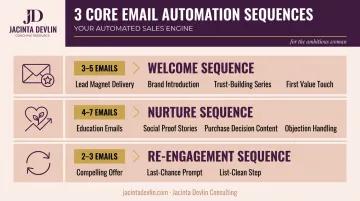
Klaviyo reports that automated flows generate nearly 41% of total email revenue from just 5.3% of total sends — which means your automations work while you're coaching a client, running an event, or offline entirely.
Always Include a Clear Call-to-Action
Every email needs one primary CTA — not three competing asks. Pick one goal per email, then write every line in service of that goal.
Strong CTAs for women entrepreneurs:
- "Shop the sale" — drives product revenue with urgency
- "Book your free call" — fills your coaching calendar
- "Download the freebie" — grows your list and delivers immediate value
Optimize for Mobile and Consistency
A strong CTA only works if it's easy to tap. HubSpot reports that 41% of email views come from mobile devices, with 75% of Gmail users reading on mobile. Short paragraphs, single-column layouts, and large tap-friendly buttons aren't optional — they're the baseline for any email that converts.
Consistency matters just as much as design. A set schedule — weekly or bi-weekly works for most — trains subscribers to expect your emails, which lifts open rates over time. One well-crafted email per week outperforms three rushed ones every time.
How to Build and Grow Your Email List from the Ground Up
Here's the mindset shift worth making early: your email list is a more valuable asset than your Instagram following or TikTok views. Social media accounts can be suspended, shadowbanned, or buried by an algorithm update. Your list belongs to you.
Lead Magnets: The Fastest List-Building Tool
A lead magnet is a free resource offered in exchange for an email address. Four ideas tailored to Jacinta's audience of social sellers, boutique owners, and affiliate marketers:
- "5 Scripts for Selling on Social Media" — perfect for direct sellers and social sellers
- "Affiliate Marketing Starter Checklist" — ideal for influencers getting started on Amazon or LTK
- "10 Affiliate Link Programs to Apply for (No Matter How Many Followers You Have)" — Jacinta uses this exact lead magnet because it addresses a real pain point for her audience
- "30+ Content Ideas That Work": practical for any entrepreneur who struggles with consistency
Jacinta's free resources also include daily affirmations and a productivity checklist — behind-the-scenes content that builds personal connection while growing the list.
Where to Promote Your Opt-In
- Website pop-ups and homepage banners
- Link-in-bio on Instagram, TikTok, and Facebook
- Stories CTAs (swipe up or "link in bio")
- Pinned posts in Facebook Groups
- In-person events and speaking engagements
Women who are already social sellers and content creators have a head start — they're sitting on warm audiences ready to convert.
List Hygiene and the 80/20 Rule
Once your list is growing, keeping it clean matters just as much as building it. Remove inactive subscribers every 90 days. A smaller, engaged list delivers better deliverability, stronger open rates, and clearer data — a disengaged list of 10,000 will underperform a focused list of 1,000 every time.
The 80/20 rule is direct: 80% of your email revenue comes from your most engaged 20% of subscribers. Instead of chasing cold contacts, invest your energy in that active segment through personalized offers, early access, and exclusive content.
What is a 1,000-subscriber list worth? It depends on your niche, offer price, and engagement. Artist Danny Gregory generates $45,000 annually from just 600 subscribers, per Kit's 2024 creator economy report. List size is a vanity metric. Relationship quality is what converts.
The Best Email Marketing Platforms for Women Entrepreneurs
The right platform depends on your business stage, list size, and comfort with tech. Pick one that fits where you are now — you can always switch later.
| Platform | Best For | Starting Price | Key Strength |
|---|---|---|---|
| Mailchimp | Beginners building their first list | Free up to 250 contacts | Intuitive, widely supported |
| Klaviyo | Boutique owners and e-commerce sellers | Free up to 250 profiles | Deep segmentation and analytics |
| Flodesk | Coaches, creators, and design-focused brands | $19/month (up to 1,000 subscribers) | Beautiful templates, flat-fee pricing |
| Constant Contact | Simple campaigns, small businesses | From $10.20/month | Easy setup, reliable support |
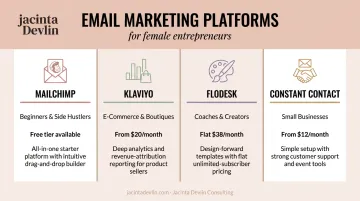
Of the four, Jacinta Devlin Consulting uses and recommends Flodesk — it's the platform she runs her own business on and points clients toward, particularly those who want design-forward emails without a steep learning curve.
Regardless of which platform you choose, make sure it covers these essentials:
- Automation workflows — so your list works for you around the clock
- List segmentation — to send the right message to the right subscribers
- Mobile-optimized templates — since most emails are opened on phones
- Campaign analytics — to track what's working and refine your approach
How to Measure and Improve Email Campaign Performance
The Four Metrics That Matter
| Metric | What It Tells You | Benchmark |
|---|---|---|
| Open rate | Subject line quality and list engagement | ~35.6% (Mailchimp, all industries) |
| Click-through rate (CTR) | Content relevance and CTA effectiveness | ~2.6% (Mailchimp average) |
| Conversion rate | Revenue impact of the email | 1–5% is typical for digital offers and coaching |
| Unsubscribe rate | List health and content fit | Under 0.5% is healthy |
Creators and coaches tend to see stronger numbers — Kit's 2024 report found a 44% average open rate and 3.7% CTR in the creator economy. If your open rates are below 30%, start with subject lines and segmentation.
A/B Testing Made Simple
Test one variable at a time. A simple test to run this week: send the same email to two equal segments with different subject lines, one benefit-driven and one curiosity-based, then track which performs better. Apply the winner to future sends and keep testing.
A few variables worth testing:
- Subject lines — benefit-driven vs. curiosity-based phrasing
- Send time — Mailchimp's data points to 10am in the recipient's time zone as optimal for newsletters
- Best days — Tuesday through Thursday consistently outperform Monday and Friday across most audiences
- CTAs — single link vs. multiple options, button text variations
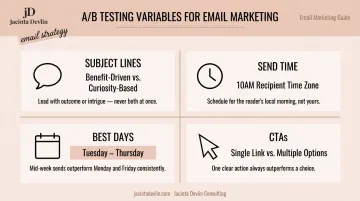
Your list may behave differently from industry averages. Run your own tests for at least two to four sends before drawing conclusions.
Email Marketing Mistakes Women Entrepreneurs Should Avoid
Buying Email Lists
Purchased lists destroy your sender reputation, route emails straight to spam, and violate CAN-SPAM and GDPR regulations. The FTC notes that violations can trigger penalties of up to $53,088 per email. Build your list organically — every time.
Sending Without a Strategy or Schedule
Sporadic emails train subscribers to ignore you. Consistency builds anticipation and trust. One thoughtful weekly email delivers more results than four rushed ones sent whenever you remember.
Treating Every Subscriber the Same
Sending the same generic message to new subscribers, loyal customers, and cold leads guarantees low engagement and high unsubscribes. Segmentation isn't optional. Done right, it's what separates email marketing that converts from email marketing that collects dust.
Conclusion
For women entrepreneurs building multiple income streams — whether through social selling, affiliate marketing, coaching, or running a boutique — email is the one marketing channel that belongs entirely to you. No algorithm can reduce your reach. No platform can deactivate your account and take your audience with it.
Start with one action today: set up your first lead magnet, choose a platform, or write your welcome sequence. Every subscriber you add from here is an asset — one that compounds over time and converts independent of whatever platform changes next.
If you want email strategy built into a full plan for scaling your business, Jacinta Devlin Consulting offers 1:1 coaching for ambitious women working toward six- and seven-figure growth. You can explore coaching options and book a free 15-minute consultation — just a real conversation about your business and where you want to take it.
Frequently Asked Questions
How much is a 1,000 email list worth?
Value depends on your niche, engagement level, offer price, and segmentation — not size alone. A highly engaged list of 1,000 subscribers in a specific niche can generate thousands of dollars monthly, while a disengaged list of 10,000 may produce very little. Relationship quality always outweighs subscriber count.
What is the 80/20 rule in email marketing?
The 80/20 rule suggests that 80% of your email revenue comes from your most engaged 20% of subscribers. Use segmentation to identify your most active subscribers and direct your highest-value offers, early access, and personalized content to that group.
How often should women entrepreneurs send marketing emails?
A consistent schedule of 1-2 emails per week is a strong starting point. Consistency matters more than frequency — subscribers who know when to expect your emails are more likely to open them. Test different cadences and watch your unsubscribe rate for feedback.
What should I write in my first email to new subscribers?
Your welcome email should introduce who you are, share a bit of your story, set expectations for your list, and include one clear CTA. Welcome emails consistently outperform standard campaigns, which is reason enough to make this the most carefully written email in your sequence.
What is a good email open rate for small businesses?
Mailchimp's benchmark across all industries sits at 35.6%. Creator-focused platforms like Kit report averages closer to 44%. Rates above these benchmarks indicate a strong list. The fastest ways to improve open rates are stronger subject lines and better segmentation.