Introduction
Networking gets a bad reputation. For many women, the word conjures images of awkward cocktail hours, rehearsed elevator pitches, and the exhausting performance of selling yourself to strangers. Strategic networking, though, is one of the most direct paths to revenue, referrals, and real business growth — and women who approach it that way outpace those who don't.
The challenge is that traditional networking environments were largely designed around how men build professional relationships. Women often navigate rooms where they're talked over, underestimated, or expected to self-promote in ways that feel culturally uncomfortable.
That friction compounds fast. Many women entrepreneurs are also managing caregiving responsibilities — averaging 18 hours per week on caregiving alongside running a business — which makes "just network more" genuinely unhelpful advice.
What works is smarter, not harder. This guide covers the specific strategies — from personal branding to social media outreach to follow-up systems and referral-building — that help women create networks that generate real opportunities.
TLDR
- Women with strong female inner circles have 2.5x better leadership and career placement outcomes than those without
- Personal brand does the heavy lifting — before you say a word, it's already speaking for you
- 61% of women-led small businesses use social media as a primary business development tool — and it shows in their results
- The follow-up separates the connectors from the closers — speed and personalization matter most
- The right community isn't just emotional support; it's referrals, accountability, and real revenue
Why Networking Looks Different for Women in Business
The Inner Circle Advantage
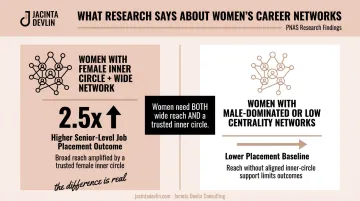
A 2019 PNAS study summarized by Harvard Business Review analyzed 728 graduate students and 4.55 million anonymized emails. The finding was stark: women with high network centrality and a female-dominated inner circle had 2.5x higher expected job placement than women with low centrality and male-dominated networks.
Men, by contrast, benefited from broad networks regardless of gender composition. Women needed both — wide reach and a trusted inner circle of other women.
The difference comes down to access — to candid advice, unfiltered feedback, and the kind of confidence-building that mixed or male-dominated networks often don't provide women at the same rate.
The Self-Promotion Problem
Research from Harvard found that women rate their own performance 33% lower than equally performing men — and separate research identified backlash avoidance as a key reason women feel uncomfortable self-promoting. Many women have been socialized to stay quiet about their wins, which makes traditional "work the room" networking feel off-brand or pushy.
The reframe that changes everything: networking is relationship-building, not self-promotion. You're finding the right people, being genuinely helpful, and letting the relationship develop from there.
The Time Constraint Is Real
Women entrepreneurs aren't networking less because they don't value it. They're doing it with less margin. Every networking action needs to count. That means choosing events selectively, showing up prepared, maintaining a consistent digital presence, and building habits that generate connections even when you're heads-down in your business.
Quality over volume isn't just a preference — for most women entrepreneurs, it's the only realistic strategy.
Build Your Personal Brand as Your Best Networking Tool
Think of your personal brand as a networking asset that works 24/7. When your bio, content, and online presence clearly communicate who you help and what results you create, people find you — before you've attended a single event or sent one outreach message.
The Foundation: What Strong Branding Actually Requires
Before you walk into any room or send any outreach message, these elements should be locked in:
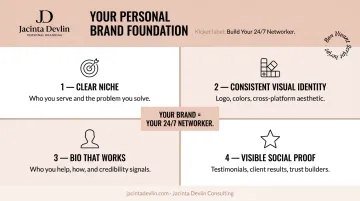
- A clear niche — who you serve and what problem you solve
- Consistent visual identity — logo, colors, and aesthetic that reads the same across platforms
- A bio that works — states who you help, how you help them, and what makes you credible
- Visible social proof — testimonials, client results, and visible wins that build trust before the conversation starts
Jacinta Devlin's 12-week Business Launch Program includes an entire module on this foundation — brand board creation, logo, positioning, and messaging — because after training over 50,000 women, she's seen firsthand that skipping this step makes every other networking effort harder.
Your Elevator Pitch: Keep It Conversational
You need a 1-2 sentence summary of who you are, what you do, and who you serve — and it needs to work as naturally in a DM as it does at a live event.
Most women write their pitch to sound impressive rather than to start a conversation. That's the shift worth making.
A better approach:
- Lead with the person you help, not your credentials
- Name a specific outcome, not a vague service category
- End with something that invites a response, not a close
Example: "I help women in direct sales build their personal brand online so they can stop cold-calling and start getting found." That's a conversation starter, not a pitch.
Show Up Consistently in Your Niche
Content is long-game networking. Every post, every comment, every story you share builds name recognition in your space. When you eventually reach out to someone or show up at an event, the conversation is already warmer, because they've already seen your work.
Nielsen research shows 92% of consumers trust recommendations from people they know above all other forms of advertising. Your consistent presence turns strangers into familiar faces before you've exchanged a single word.
Smart Networking Strategies for In-Person Events
Go Deep, Not Wide
Most networking advice tells you to "work the room." The evidence says otherwise. Research published in the Journal of Business Venturing Insights found that tie quality — the depth of a connection — more strongly predicted business results than tie quantity.
Set a goal of 2-3 real conversations per event, not 20 business cards. One well-connected, right-fit contact is worth more than a stack of names you'll never follow up with.
Prepare Like It's a Meeting, Not a Party
Before any event:
- Research the attendee or speaker list — know who you want to meet and why
- Define your goal — are you looking for a referral partner, a collaborator, a mentor, or a client?
- Prepare conversation starters that go beyond "So, what do you do?"
Better openers:
- "What's been your biggest focus in your business this year?"
- "How did you find out about this event?"
- "What are you working on right now that you're most excited about?"
These questions invite real answers and make the other person feel genuinely seen — a far stronger first impression than any rehearsed pitch.
Lead With Curiosity, Not Credentials
The best networkers ask more than they tell. When you're in a conversation, focus on being useful rather than impressive:
- Listen actively and ask follow-up questions
- Offer to make an introduction if you spot a natural fit
- Share a relevant resource or tip without being asked
- Name a connection who could help them
When you're the person who helped, you're the person remembered.
After the Event: Create a System
Don't leave it to memory. Before you leave or on the way home:
- Note who you connected with and one specific detail from the conversation
- Flag anyone who needs a follow-up and why
- Commit to reaching out within 24-48 hours while context is still fresh
How to Use Social Media to Network as a Woman Entrepreneur
Social media isn't a supplement to networking — for most women entrepreneurs, it is the networking. According to Intuit QuickBooks' 2025 report, 61% of women-led small businesses use social media for promotion, compared to 49% of men-led businesses. Women who treat it as a business tool aren't just creating content — they're building relationships that turn into clients, referral partners, and collaborators.
That distinction — relationship-building versus content broadcasting — is what separates social media that drives revenue from social media that just drives likes.
Choose Your Platform Based on Your Business Model
| Platform | Best For | Key Strategy |
|---|---|---|
| B2B services, consulting, partnerships | Thought leadership posts, connection requests with personalized notes | |
| Lifestyle brands, influencer marketing, coaching | Stories, Reels, consistent visual brand presence | |
| TikTok | Product discovery, direct sales, affiliate marketing | Short-form video; 55% of TikTok users discover new brands on the platform |
| Facebook Groups | Community building, warm audiences, direct sales | Consistent engagement, not just posting |
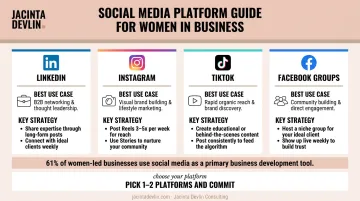
Pick 1-2 platforms and commit. Showing up consistently on two platforms beats spreading thin across five, every single time.
The Engage-Before-You-Pitch Rule
Before you DM someone to collaborate or connect, spend time in their world first. Leave a thoughtful comment on their posts. Share their content. Respond genuinely to their stories. When you finally reach out, you're not a stranger — you're someone they recognize.
This is the difference between an outreach message that gets a response and one that gets ignored.
What Makes a Great Networking DM
A high-quality outreach message:
- References something specific ("I loved your post about X — it changed how I think about Y")
- States a clear, genuine reason for connecting
- Offers value or asks a thoughtful question
- Is short — under 5 sentences
A spammy one:
- Starts with "Hey girl!" and pivots immediately to a pitch
- Feels copy-pasted because it is
- Asks for something before giving anything
These strategies work — and the results speak for themselves. Jacinta Devlin's clients have used this exact approach to scale fast: Sharon B. grew from $4k in her first year to $20,000+ per month in Amazon sales. Christina R. built a Facebook Group from zero to 36,000+ members and hit six-figure income within six months of coaching.
A coach who has built this model herself — across direct sales, influencer partnerships, and e-commerce — brings more than tactics. She brings a proven system.
The Follow-Up Formula: Turning Connections Into Clients
Most networking opportunities die in the silence after a great conversation.
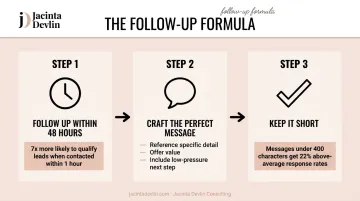
The 48-Hour Rule
Follow up while the interaction is still warm. Sales-response research is consistent on speed: companies that contact leads within an hour are nearly 7x more likely to qualify them than those who wait longer. The same principle applies to networking — the longer you wait, the more context fades.
Your follow-up message should:
- Reference something specific from your conversation (not a generic "great to meet you")
- Offer something of value — an article, an introduction, a resource relevant to what they mentioned
- Include a low-pressure next step — a follow on social, a coffee chat, a collaboration idea
Keep it short. LinkedIn's InMail research found messages under 400 characters received response rates 22% above average. Brief and personal beats long and polished.
Nurture Over Time Without the Awkwardness
One message doesn't build a relationship — consistent, low-pressure touchpoints do:
- Share a relevant article with a note like "This made me think of what you mentioned"
- Congratulate them on a visible milestone
- Tag them in something genuinely useful
These small gestures keep the connection alive without a big ask. By the time a real opportunity comes up — a referral, a collaboration, a client fit — the relationship is already warm and the conversation picks up naturally.
The Two Mistakes That Kill Follow-Up
- Going silent after one message. The connection exists only if you maintain it.
- Jumping straight to a pitch. Receiving a sales email immediately after meeting someone destroys all the trust built in the original conversation.
The goal is to stay genuinely present in someone's professional life — so when the right moment comes, reaching out feels natural, not transactional.
Finding Your Circle: Community Is Part of Your Networking Strategy
There are over 14 million women-owned businesses in the U.S., generating $2.7 trillion in revenue — yet many women entrepreneurs still try to build without a support system. The research on peer networks is clear: women who connect with the right communities build leadership skills and increase company profits faster than those who go it alone.
How to Evaluate Whether a Community Is the Right Fit
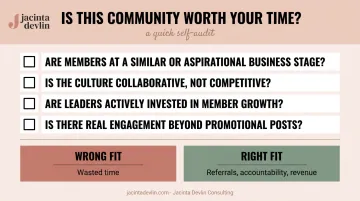
Not every group is worth your time. Ask:
- Are the members at a similar or aspirational stage of business?
- Is the culture collaborative, not competitive?
- Are the leaders actively invested in members' growth — or just collecting dues?
- Is there real engagement, or is it mostly promotional posts?
The wrong community wastes time you can't get back. The right one delivers referrals, accountability, and collaborative opportunities — often all at once.
A Community Built Specifically for This
Jacinta Devlin's Dream+Create Online Coaching Community was created for exactly this: ambitious women entrepreneurs who want network access, business strategy, and real accountability in one place. Members have formed referral partnerships, launched group collaborations, and seen real results — including doubling income within six months and landing brand partnerships with companies like Walmart and QVC.
The community offers a free one-week trial. For women who want individualized strategy on top of community access, Jacinta's 1:1 coaching programs start at $3,500 — including weekly coaching calls, a personalized growth strategy, and direct access to her 15+ years of social selling expertise.
Frequently Asked Questions
What are the 7 steps of networking?
Clarify your goal, build your brand and online presence, identify the right spaces, show up and have meaningful conversations, lead with value, follow up promptly, and nurture the relationship over time. The steps aren't linear — treat them as an ongoing cycle you return to, not a one-time sequence you complete.
How do I network as a woman in business?
Reframe networking as relationship-building rather than self-promotion. Use both online communities and in-person events, and actively seek out women-focused spaces where collaboration is the default culture.
How do I network on social media as a female entrepreneur?
Choose 1-2 platforms where your audience already spends time, and show up consistently rather than spreading yourself thin. Engage genuinely with others' content before making any ask, and use direct messages to deepen connections that started publicly, referencing something specific each time.
How do I follow up after networking without it feeling awkward?
Reference a specific detail from your original conversation — this immediately signals you were paying attention. Lead with something useful rather than a pitch, keep the tone warm, and treat it as continuing a conversation rather than starting a transaction.
How do I find networking groups for women in business?
Search Facebook Groups, LinkedIn Groups, and local business associations using terms like "women entrepreneurs" or your specific niche. Look for groups where active discussion — not just promotional posting — is the norm. Jacinta Devlin's Dream+Create community, for example, is built specifically for female entrepreneurs in social selling and digital business.
What is the difference between networking and social selling?
Networking is the relationship-building process. Social selling is using those relationships and your online presence to generate leads and revenue. For women entrepreneurs especially, the two work best together — building genuine connections first makes the selling feel natural, not transactional.