

Introduction
Network marketing has changed dramatically. The home party model that defined direct sales for decades has largely given way to Instagram Reels, TikTok content, and LTK storefronts — and women are driving that shift.
The numbers back it up. The US direct selling industry generated $34.7 billion in retail sales in 2024, with 5.4 million active sellers, according to the DSA's 2025 Growth & Outlook report.
Women make up 73% of the active US direct selling salesforce, per WFDSA's 2024 data — making this one of the most female-dominated entrepreneurial spaces in the country.
The women joining aren't a monolith. They include:
- Stay-at-home moms looking for supplemental income on their own schedule
- Corporate professionals tired of pay ceilings and rigid hours
- Side-hustlers who want a real business, not just a second job
This guide is built for all three. It covers what network marketing actually is, how to vet an opportunity before you commit, what consistent income really requires, and the traps that trip up most beginners.
TL;DR
- Network marketing is a legitimate business model — but it requires real strategy and consistency.
- Women make up 73% of the US direct selling workforce; the barrier to entry is low, with average startup costs around $106
- Choosing the right company matters more than most women realize — product quality, compensation structure, and ethics are non-negotiable filters
- Build a loyal retail customer base before focusing on team recruitment; this habit separates sustainable earners from early dropouts.
- External coaching — beyond your upline — is often the missing piece between stalling out and scaling consistently.
What Is Network Marketing for Women?
Network marketing is a business model where independent distributors earn income in two ways: by selling products or services directly to customers, and by recruiting others onto their team and earning commissions on that team's sales volume. That's the entire model — straightforward by design.
It is not:
- A get-rich-quick scheme
- A pyramid scheme (those are illegal — and the distinction matters)
- A passive income system that runs on autopilot
What separates a legitimate MLM from an illegal pyramid scheme comes down to one question: is real product being sold to real customers? If a company's compensation model primarily rewards recruitment rather than actual product sales to end consumers, the FTC considers that structure potentially unlawful. Legitimate network marketing companies generate income primarily through retail sales, not through enrollment fees or distributor purchases.
What This Looks Like in Practice
Women typically enter network marketing through:
- Beauty and skincare: cosmetics, personal care, anti-aging products
- Health and wellness: nutritional supplements, weight management, fitness
- Fashion and accessories: jewelry, clothing, lifestyle brands
- Home and lifestyle: candles, cookware, home fragrance, essential oils
The delivery model has shifted significantly over the past decade. In-person home parties still exist, but most network marketers now build their businesses through Instagram, TikTok, Facebook groups, and affiliate platforms like LTK. That shift has changed who can succeed — and at what scale. A seller with a strong Instagram following can now reach more potential customers in a week than a year's worth of home parties ever could.
Why Network Marketing Is a Strong Opportunity for Women
Traditional employment structures have created real gaps for women. Full-time wage and salary workers who are women earned 82.7 cents for every dollar earned by men in 2024, according to Bureau of Labor Statistics data. Career re-entry after caregiving breaks remains difficult. Flexible, senior-level roles are still not the norm.
Network marketing is one model that addresses those gaps structurally — on scheduling, startup cost, and access terms that traditional employment rarely offers.
The Business Case
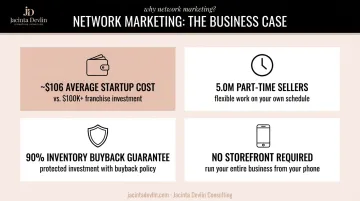
- Low startup cost: Average direct selling startup cost is approximately $106, compared with $100,000 or more for many franchises, per DSA advocacy data
- Flexible participation: The DSA reports 5.0 million part-time and 400,000 full-time US direct sellers in 2024 — the part-time option is genuinely accessible
- Inventory protection: DSA member companies are required to offer a 90% buyback guarantee on unsold inventory purchased within the last 12 months
- No physical storefront required: The entire business runs from a phone or laptop
The Community Dimension
The mentorship structure built into network marketing — uplines, team calls, training systems — provides something that most solo business launches don't: a ready-made support system. For women building businesses without formal business education or a corporate network behind them, that infrastructure provides accountability, skill development, and access to people who have already navigated the same challenges.
The Social Selling Advantage
Women have a measurable edge in modern network marketing because social media rewards authentic relationship-building — exactly what the model requires. The US social commerce market was valued at $37 billion in 2021 and was projected to approach $80 billion by 2025, per McKinsey research — a direct result of purchasing behavior moving toward creator-driven recommendations over traditional advertising.
LTK, Instagram, and Facebook now function as genuine distribution channels. Women who build audiences and earn trust online aren't just promoting products — they're running businesses on top of those platforms.
What to Know Before You Start
Most women who struggle in network marketing started with an unrealistic picture of what the first six months actually look like — so here's what to expect before you begin.
Income Reality
Early earnings are modest. Herbalife's official 2024 Statement of Typical Distributor Earnings shows that among first-year distributors who earned money in a typical month, 50% earned more than $154 before expenses. The top 10% earned more than $1,144 monthly. These figures are before business expenses and are specific to one company — but they represent the income reality most income disclosures reflect.
The takeaway: early income in network marketing comes primarily from personal retail sales, not team commissions. Building a customer base comes first.
Hobby vs. Business Mindset
More network marketing careers stall here than at any other point — and the difference is often invisible until months of momentum are already lost.
A hobby approach looks like: inconsistent posting, no activity targets, checking in when motivated, no tracking.
A business approach looks like: set hours, monthly sales goals, weekly outreach numbers, income tracking, reinvestment.
Jacinta Devlin started her direct sales career at 21 as a broke college student who thought jewelry parties and extra cash sounded fun. That casual entry eventually became a 12-year career, a million-dollar income, and a National Director of Sales role at Stella & Dot — but the shift required treating it as a serious career, not a side activity.
Practical Setup Checklist
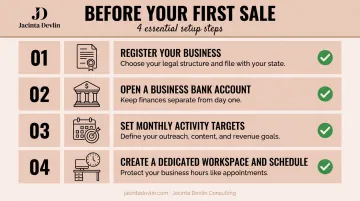
Before your first sale, handle these:
- Register your business — sole proprietorship or LLC depending on your state
- Open a separate business bank account — keeps tax tracking clean from day one
- Set your monthly activity targets — posts, follow-ups, conversations, not just income goals
- Create a dedicated workspace and schedule — even part-time requires structure
Skipping this phase costs months of momentum.
The Upline Problem
Your upline's quality matters enormously — and many uplines simply don't have the tools or experience to provide real business coaching. If yours can't or won't mentor you effectively, don't wait for that to change.
Jacinta Devlin built her Dream+Create coaching community specifically to fill this gap. It gives women in network marketing and social selling access to strategic guidance, proven sales systems, and peer accountability that most upline relationships never provide. A free one-week trial is available for women who want to experience that support firsthand.
How to Choose the Right Network Marketing Opportunity
Choosing the wrong company is the single most avoidable mistake in network marketing. Longevity, product quality, compensation structure, and ethics determine whether sustainable income is even possible — so evaluate them first, not as an afterthought.
Evaluation Criteria
Ask these questions before signing:
- Do you genuinely use and believe in this product? Reps who actually use what they sell consistently outperform those who don't — customers can tell the difference.
- Is the company at least 5+ years old and financially stable? New companies carry significantly higher failure risk.
- Can you earn meaningfully from personal sales alone? If the answer is no, treat that as a serious warning.
- Is the income disclosure statement publicly available and easy to read? The FTC reviewed income disclosure statements from 70 MLMs in 2023 and raised concerns about clarity — if a company's IDS is hard to find or hard to parse, that matters.
Red Flags to Avoid
- Recruitment is the primary income driver — product sales are secondary
- Large upfront inventory purchases required before you can sell
- Overly complex or vague compensation plans
- Pressure to recruit before you've completed a single sale
Where Women Have Built the Strongest Businesses
DSA member companies in these categories represent well-established starting points for research:
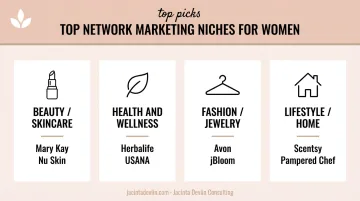
| Category | Example DSA Members |
|---|---|
| Beauty / Skincare | Mary Kay, Nu Skin |
| Health & Wellness | Herbalife, USANA |
| Fashion / Jewelry | Avon, jBloom |
| Lifestyle / Home | Scentsy, Pampered Chef |
These categories work well because they align with communities women have already built — and products they already recommend to friends and followers. That built-in credibility shortens the sales cycle from the start.
How to Build and Grow Your Network Marketing Business
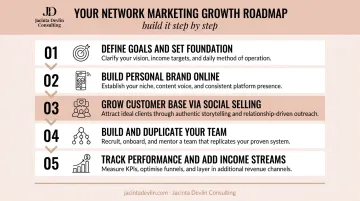
Step 1: Define Your Goal and Set Up Your Foundation
Get clear on your actual objective before you sell anything. Supplemental income of $500/month requires a completely different strategy than building a full-time team business. Each path demands different time commitments, tools, and expectations.
Set up properly: business registration, separate bank account, monthly activity plan. Not income goals — activity goals. The income follows the activity.
Step 2: Build Your Personal Brand and Online Presence
Your social media presence is your business card. Choose one or two platforms where your target customer already spends time — Instagram, Facebook, and LTK are strong starting points — and show up there consistently.
Lead with your lifestyle, values, and genuine product experience. Not the business opportunity. Not income claims. People buy from people they trust, and trust is built through content that reflects who you actually are.
Step 3: Grow Your Customer Base Through Social Selling
Master the basics before scaling:
- Share real product experiences through content, not just promotional posts
- Build trust before asking for the sale
- Use direct messaging intentionally — relationship first, pitch never
- Target 10–20 loyal retail customers before turning any attention to team-building
That last point is what separates sustainable earners from those who burn out chasing recruitment numbers. A strong retail base creates income stability that no amount of recruiting can replicate.
The results bear this out. One of Jacinta Devlin's coaching clients grew from $500 months to consistently selling $5,000+ per month — the shift happened when she stopped chasing new recruits and started building genuine audience relationships through social platforms.
Step 4: Build and Duplicate Your Team Strategically
When you're ready to recruit, quality beats quantity. Look for women who are entrepreneurial, coachable, and consistent — enthusiasm alone doesn't build a lasting team.
Your role as an upline is to duplicate your own successful habits, not just transfer information. That means:
- Building a clear onboarding process new members can follow immediately
- Providing the same tools and content that drove your own results
- Tracking team activity monthly, not just rank advancement
Kendra C., who leads a team of 1,200+ women with ONEHOPE Wine, described working with Jacinta as "game changing" even after nine years in direct sales — because having someone create stretch goals and provide outside accountability unlocked growth she hadn't found internally.
Step 5: Track Performance and Expand Your Income Streams
Review monthly: personal sales volume, team sales volume, new customer acquisition, and retention. Identify what's working, then double down before expanding.
As your network marketing income stabilizes, adjacent income streams become accessible:
- Affiliate marketing through platforms like Amazon and LTK
- Brand partnerships with retailers aligned with your niche
- Content creation that generates its own revenue
- Coaching or consulting based on your own earned expertise
Joy W., a Park Lane Jewelry top seller who worked with Jacinta, surpassed her previous annual income within six months and added brand partnerships and new income streams on top of her direct sales business. That's the multi-income model that creates long-term financial security, rather than tying your livelihood to a single company's compensation plan.
Frequently Asked Questions
Why should women consider a network marketing business opportunity?
Network marketing offers one of the lowest-cost paths to business ownership available — with startup costs averaging around $106, flexible hours, and no income ceiling. For women balancing career goals with caregiving, health, or other life responsibilities, that combination of accessibility and flexibility is genuinely rare.
What network marketing opportunities are most profitable for women?
Women have historically built the strongest incomes in beauty, wellness, fashion, and lifestyle categories — products they authentically use and recommend. Research DSA-listed companies in those categories and prioritize ones with publicly available income disclosure statements before committing.
What percentage of network marketers are women?
According to WFDSA's 2024 Global Annual Direct Selling Statistical Data Report, women make up 73% of the active US direct selling salesforce and 72.1% of global independent sales representatives — making this one of the most female-dominated industries in entrepreneurship.
Can you make a full-time income from network marketing?
Full-time income is possible but not typical early on — the DSA reports just 400,000 full-time direct sellers versus 5 million part-time participants in 2024. Those who reach full-time levels treat it like a real business: clear goals, tracked activity, and daily consistent effort.
What skills do you need to succeed in network marketing?
Relationship-building, content consistency, basic social media skills, and the ability to handle rejection without taking it personally. None of these are innate — they're all coachable with the right guidance and hands-on practice.
How is modern network marketing different from traditional MLM?
Today's model is built on social selling, personal branding, and digital platforms rather than home parties and cold calling. Women who build genuine audiences on Instagram, TikTok, or LTK have a scalable distribution channel that older models never offered — and the relationship-based nature of those platforms suits the way most women naturally communicate.