

This isn't retreat. It's redirection.
If you're high-achieving, ambitious, and capable — yet burned out, overlooked, or quietly wondering whether there's another path — you're not alone. The women asking that question are often the most talented ones in the room. They're not leaving because they lack drive. They're leaving because the cost of staying has become too high.
This post covers the real reasons women are leaving corporate, the skills that transfer directly into entrepreneurial success, the mindset shift required, and what income actually looks like on the other side.
TL;DR
- Women are leaving corporate at record rates due to promotion inequity, pay gaps, and inflexibility — ambition isn't the issue
- Corporate skills in sales, leadership, and project management translate directly into profitable businesses
- The biggest obstacle isn't strategy or capital — it's shifting from employee mindset to CEO mindset
- 68% of women business owners report their business as their primary income source
- A planned exit consistently outperforms a reactive leap
Why So Many Women Are Leaving Corporate Right Now
The Numbers Behind the Movement
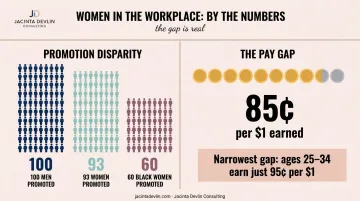
The data tells a clear story. The McKinsey/LeanIn Women in the Workplace 2025 report confirms that women receive less career support and fewer advancement opportunities than their male counterparts — despite being equally dedicated to their careers. For every 100 men promoted to manager, only 93 women are promoted. For Black women, that number drops to 60.
The pay gap compounds the problem. Pew Research found that in 2024, women earned 85 cents for every dollar men earned based on median hourly earnings. Even among women ages 25–34 — where the gap is narrowest — they still earn 95 cents per dollar.
That's not a rounding error. Over a 30-year career, those missing cents add up to hundreds of thousands of dollars — gone.
The Wellbeing Gap, Not the Ambition Gap
Here's what the narrative gets wrong: women aren't leaving because they lack ambition. LeanIn/McKinsey data shows 80% of women want promotion, compared to 86% of men — a negligible difference.
What isn't negligible is the support gap: fewer sponsors, fewer stretch assignments, fewer advocates in the room when promotions are decided.
The "ambition gap" framing has it backwards. Women aren't burning out because they stopped caring. They're burning out because they've been caring deeply in environments that don't return that investment.
Push Factors Stacking Up
Several forces have converged to make entrepreneurship a more rational choice than another corporate role:
- Rigid return-to-office mandates that disproportionately affect women managing caregiving responsibilities
- Invisible load — the mental and logistical weight of caregiving that corporate schedules structurally ignore
- Micro-bias that accumulates over years into a pattern of being overlooked, talked over, or under-credited
- Limited flexibility that makes balancing work and family feel like a daily negotiation
The women who succeed as entrepreneurs are rarely the ones who left in desperation. They're the ones who saw the writing on the wall early, started planning their exit, and left on their own terms. That planned, intentional exit is often the first decision that sets them up to win.
The Corporate Skills That Become Entrepreneurial Superpowers
Years in Corporate Aren't Wasted — They're Capital
The skills that felt undervalued in corporate are frequently the exact skills that build a profitable business. The presentations you gave to skeptical executives? That's sales. The projects you coordinated across four departments? That's operations management. The relationships you built while navigating difficult colleagues? That's client development.
GEM's 2023/24 Women's Entrepreneurship Report found that women's perceived business startup skills have increased 79% over the past two decades. Experience is compounding — and corporate experience is a significant part of that.
The Direct Skill Transfer Map
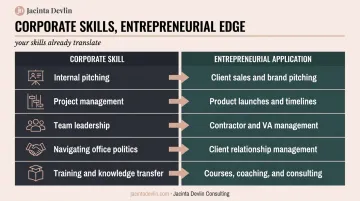
| Corporate Skill | Entrepreneurial Application |
|---|---|
| Internal pitching and presenting | Selling to clients and pitching brand partnerships |
| Project management and execution | Launching products, managing timelines, delivering results |
| Leading and managing teams | Building contractor networks, managing virtual assistants |
| Navigating office politics | Managing client relationships under pressure |
| Training and knowledge transfer | Creating courses, coaching programs, or consulting offers |
Women who spent years in sales, marketing, training, or operations already have domain expertise that clients actively seek out. The work is in packaging and positioning that expertise, not building it from scratch.
The Less Obvious Asset: Resilience
Transferable skills are the visible part. The less obvious asset is resilience — and it's often the one that matters most in early-stage business.
Corporate women have already survived high-stakes environments. They've been scrutinized in boardrooms, managed difficult personalities, and delivered under pressure. Most first-time founders have to develop this resilience the hard way. Women leaving demanding corporate careers often arrive at entrepreneurship with it already built in.
One of Jacinta Devlin's clients, a former corporate marketer, described her coaching experience as generating "a-ha moments that keep me coming back and raising the bar for myself." The knowledge was already there. The coaching gave her the framework to deploy it. That distinction — between having the skills and knowing how to monetize them — is where most corporate-to-entrepreneur transitions succeed or stall.
The Mindset Shift: From Employee to CEO
The Real Obstacle Isn't Strategy
Most women who leave corporate have the skills. Many have savings. Some have a business idea. What stops them is mindset — specifically, the conditioning that corporate environments spend years building.
High achievers in corporate learn to:
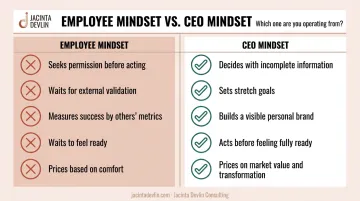
- Seek permission before acting
- Wait for performance reviews to know if they're doing well
- Measure success by someone else's metrics
- Define "ready" as a specific credential or title
Entrepreneurship dismantles every one of those patterns.
The Employee Mindset Traps
These are the specific patterns that derail former corporate women most often:
- Waiting to feel ready before launching — there is no perfect moment
- Playing small to avoid criticism or judgment from peers
- Pricing based on comfort rather than on market value or the transformation delivered
- Treating failure as verdict rather than as data to adjust from
These aren't character flaws. They're conditioned responses to environments that penalized risk and rewarded compliance. Recognizing them as learned — not fixed — is where the shift begins.
What the CEO Mindset Looks Like
The contrast is concrete:
- Making decisions with incomplete information rather than waiting for certainty
- Setting goals that stretch beyond what feels safe
- Building a visible personal brand instead of staying under the radar
- Taking full ownership of outcomes — without approval from above
Knowing these patterns exist is a start. Breaking them while also building a business is where most high achievers stall. Working with a coach who has made this transition herself speeds up that shift — someone who can spot the blind spots you carry out of corporate before they cost you momentum.
Why Women Who Leave Corporate Often Out-Earn Their Former Salaries
The Income Ceiling Problem
No matter how hard a corporate woman works, her income is bounded by salary bands, annual review cycles, and organizational hierarchy. A record-breaking year might yield a 4% raise. In her own business, there is no band. Revenue scales with effort, strategy, and leverage — not a manager's approval.
The pay data reinforces this. Women earning 85 cents per dollar in corporate have a built-in income gap that compounds over a career. Entrepreneurship removes the structural ceiling entirely.
The Evidence on Outcomes
The numbers on women and entrepreneurship are striking:
- 68% of women business owners report their business as their primary personal income source (NWBC, 2024)
- Women-owned businesses generate $3.3 trillion in annual revenue
- Nearly 500,000 women-owned businesses with revenue of $250K–$999K grew aggregate revenues by approximately 30%
- FreshBooks' 2019 women-specific report found 70% of women in the independent workforce earned the same or more than in traditional employment
These results show up across business models, industries, and income levels.
What Income Looks Like in Practice
Jacinta Devlin's clients show what's possible with the right strategy:
- Christina R. quit her corporate job within 6 months and scaled to selling hundreds of thousands monthly through Amazon and LTK
- Joy W. surpassed her previous annual salary in 6 months, growing from $500 months to $5,000+ consistently
- Sharon B. went from $4,000 in her first year of Amazon selling to $20,000+ per month
These results come from stacking income streams — affiliate marketing, brand partnerships, e-commerce, and social selling — income channels that a W-2 salary structure doesn't allow.
One honest caveat: replacing a corporate income rarely happens in 90 days. The women who do it fastest are those who plan their exit, validate their offer before quitting, and invest in expert guidance from the start.
How to Make a Smart Exit, Not a Reckless Leap
Build Before You Jump
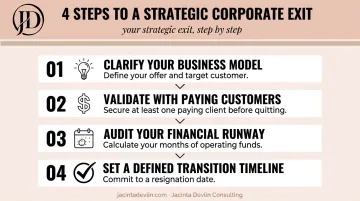
The most common regret among women who leave corporate isn't that they left — it's that they left before the foundations were in place. A strategic exit means having certain things confirmed before submitting your resignation:
- Clarify your business model — know what you're selling and who you're selling it to
- Validate with paying customers — at least one client paying real money before you quit
- Audit your financial runway — know exactly how many months you can operate without replacing your salary
- Set a defined transition timeline — a date on the calendar creates accountability
Christina R.'s path is instructive: she built her content business on the side while still employed, grew her Instagram and a Facebook Group to 36,000+ members, and secured her first brand partnerships — all before quitting her full-time job at the 6-month mark.
The Role of Expert Guidance
Most women who compress their timeline from corporate to profitable business share one thing: they invested in expert guidance early — not after six months of trial-and-error. A coach who has already built what you're building can help you skip the costly mistakes and move directly toward what works for your specific skills, offer, and market.
Jacinta Devlin Consulting works with women at every stage of this transition. The 12-week Business Launch Program is designed specifically for women still employed — covering market research, branding, website development, sales funnels, and a full launch plan, with done-for-you options available. For those ready to scale, the Business Growth Program provides weekly 1:1 strategy calls. Key areas covered across both programs include:
- Market positioning and offer development
- Branding, website, and sales funnel setup
- Social media strategy and content systems
- Revenue scaling and affiliate/influencer income streams
After working with over 50,000 women in the social selling and entrepreneurship space, Jacinta's approach is grounded in one reality: a clear strategy with the right coach behind it cuts years off the learning curve.
To find out which program fits your stage, Jacinta offers a free 15-minute consultation call — no commitment, just clarity.
Frequently Asked Questions
How can women leaving corporate get out of the corporate mindset?
The shift means actively replacing approval-seeking and risk-aversion with ownership and bold decision-making. Working with a coach who has made this transition herself, or surrounding yourself with a community of women building businesses, gets you there faster than trying to rewire on your own.
What is the average cost of business coaching for women leaving corporate?
Coaching ranges from a few hundred dollars for group programs to several thousand for 1:1 strategy — Jacinta Devlin's programs start at $3,500+. The right coach pays for herself quickly through avoided mistakes and faster income growth, so ROI matters more than sticker price.
What are the 80/20 and 70/30 rules in coaching?
The 80/20 rule holds that the coach speaks 20% of the time while the client speaks 80% — coaching is about drawing out answers, not lecturing. The 70/30 variation applies a similar ratio, emphasizing client-led discovery and accountability as the primary mechanism for change.
What business models work best for women transitioning from corporate?
Service-based businesses (consulting, coaching), social selling, affiliate and influencer marketing, and e-commerce are particularly strong fits — because they directly leverage the relationship-building, communication, and sales skills most corporate women already have.
How long does it typically take to replace a corporate salary after starting a business?
Women who plan their transition, validate their offer before quitting, and invest in coaching often see meaningful income within 6 to 18 months. Joy W. surpassed her previous annual income in just 6 months; Christina R. quit her corporate job in the same timeframe.