

Resilience coaching for women entrepreneurs goes beyond the corporate buzzword of "bouncing back." In a business context, it's the personalized work of building the mental frameworks that keep you selling, posting, and pitching when everything in you wants to quit. It's the difference between a woman who folds after three "no's" and one who treats them as data.
This article breaks down why resilience is the foundational skill female entrepreneurs actually need, the specific setbacks it addresses, how coaching builds lasting career confidence, and practical habits you can start building right now.
TL;DR
- Resilience coaching builds the mental foundation to grow through real setbacks, not just bounce back from them
- Women entrepreneurs face specific challenges (imposter syndrome, income swings, visibility fear, rejection) that resilience coaching directly addresses
- Good coaching gives you strategies tailored to your situation — rewiring how you respond to failure instead of repeating old patterns
- The outcome isn't just feeling better — it's selling more, showing up consistently, and building a business that reflects your potential
- Most clients see momentum in the first 30–60 days; measurable revenue growth typically follows within 6–12 months
Why Women Entrepreneurs Need Resilience More Than Any Other Skill
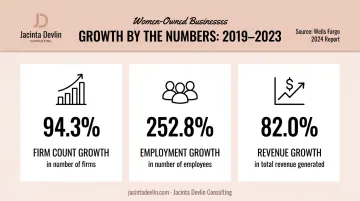
Women are building businesses at a remarkable pace. According to a 2024 Wells Fargo report, growth in women-owned firms outpaced men's by 94.3% for firm count, 252.8% for employment, and 82.0% for revenue between 2019 and 2023. Those numbers represent real businesses, built by women who kept going when it wasn't easy.
But growth statistics don't tell you what it costs to get there. Behind every successful female entrepreneur is a season of slow sales, self-doubt, and moments where quitting felt like the only rational option. The ones who made it through didn't just have better strategies. They had stronger resilience.
Resilience Is a Skill, Not a Personality Trait
The American Psychological Association defines resilience as the process of successfully adapting to difficult or challenging experiences through mental, emotional, and behavioral flexibility — and critically, they emphasize it's not a trait only some people have. It involves behaviors, thoughts, and actions that anyone can learn and develop. For entrepreneurs, that distinction is worth sitting with: resilience isn't fixed. It's a set of skills that coaching can directly accelerate.
The Structural Support Gap No One Talks About
Employees have built-in resilience infrastructure: managers who give feedback, peer support systems, clear performance loops. When something goes wrong, they have a structure to catch them.
Entrepreneurs have none of that. When a launch fails or a client ghosts you, there's no performance review to process it, no manager to recalibrate expectations. There's just you and your thoughts at 11pm.
Clients who've worked with Jacinta Devlin describe a before-and-after that centers on exactly this gap. "I was literally all over the place" becomes "I always know what to do next." That shift isn't just strategic clarity — it's the resilience infrastructure solo entrepreneurs are missing.
The gap between a $2k month and a $20k month is rarely the tactics themselves. It's having the structure and support to keep executing through the hard stretches — until those tactics have time to work.
The Real Setbacks Female Entrepreneurs Face
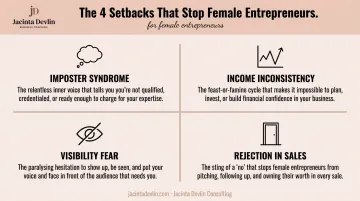
Imposter Syndrome and the "Who Am I to Do This" Spiral
Even experienced entrepreneurs question whether they're qualified enough to charge premium prices. This specific brand of self-doubt doesn't just hurt confidence — it directly sabotages income. Women undercharge before the business gets traction, deflect opportunities they're actually qualified for, and hesitate on visibility at the exact moment momentum would build.
The spiral is predictable: doubt → delay → missed revenue → more doubt.
Income Inconsistency and the Emotional Rollercoaster
A $500 month after a $5,000 month feels like failure — even when variable income is normal in early-stage online business. Women who haven't built resilience frameworks internalize that dip as personal proof they're not cut out for this.
One of Jacinta's clients, Joy W., experienced this exact pattern. She grew from $500 months to consistently selling $5k+ per month after building the systems and accountability structure that kept her in the game through the dips. The systems gave her staying power — and the revenue followed.
Visibility Fear: The Hidden Business Killer
For social sellers, content creators, and influencers, showing up consistently online requires psychological resilience most people underestimate. The fear of judgment, negative comments, and the pressure to be "on" constantly creates a specific kind of exhaustion.
A 2024 study published in Digital Health examined how popularity and online exposure affect influencers' emotional states and relationships — and the psychological burden is real. Showing up consistently is as much a resilience challenge as it is a content one.
Rejection in Sales and Client Acquisition
Direct sales, network marketing, and brand partnerships all involve consistent rejection. The data on the creator economy is sobering — The Tilt's creator economy research found content entrepreneurs averaged five months to earn their first dollar and 18 months to become fully self-supporting. That's 18 months of delayed results requiring sustained effort without guaranteed payoff.
Women without resilience frameworks take "no" personally. Women with them treat it as data and keep pitching.
The Starting Over Moment
Career pivots. Failed launches. Platforms that change overnight. These moments are inevitable in online business. Jacinta's own career demonstrates exactly this — she evolved from jewelry sales rep to Top 1% direct seller to National Director to influencer to business coach, each transition requiring her to rebuild with what she'd learned.
Resilience coaching doesn't just help you survive these moments. It teaches you to extract the lesson and rebuild faster each time.
How Resilience Coaching Builds Unshakeable Career Confidence
Confidence isn't something you find. It's something you build by doing hard things and surviving them. Resilience coaching accelerates that process through a few core mechanisms.
The Self-Awareness to Belief to Behavior Loop
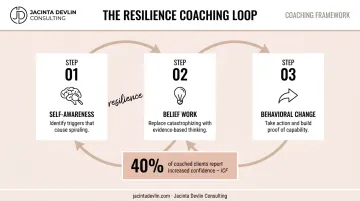
A resilience coach's first job is helping you see what you can't see yourself. That means identifying the thought patterns and beliefs that trigger self-doubt — then building replacement frameworks that lead to consistent action.
The progression looks like this:
- Self-awareness — recognizing the specific triggers that send you into a spiral (a low-engagement post, a client "no," a competitor announcement)
- Belief work — replacing catastrophizing with evidence-based counterarguments (a slow month is data, not verdict)
- Behavioral change — taking the action anyway, building the evidence that you can handle hard things
ICF data supports this: 40% of coached clients report increased self-esteem and confidence as a primary outcome. Confidence built this way isn't fragile. It's the accumulated evidence of showing up through difficulty — not from affirmations.
Goal Architecture: Building Proof Points
Resilience coaching breaks overwhelming goals into smaller milestones — proof points that stack into unshakeable self-belief. The psychology behind this is well-established: Bandura's self-efficacy research shows that mastery experiences (actually completing difficult tasks) are the strongest source of confidence.
Jacinta builds this into her program structure from Week 1, starting with goals and vision work before moving into systems and strategy. The result shows up in client language: "When you suggested I could make a goal of $100k, I thought you were nuts — I just had my first $20,000 month."
The belief shift came from stacked evidence, not motivation.
Accountability: The Mirror You Don't Have Alone
A resilience coach acts as both mirror and support system — reflecting back what you can't see yourself, challenging excuses without judgment, and holding you to the version of yourself you said you wanted to be.
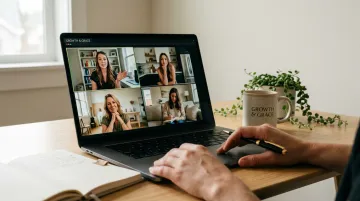
Jacinta's 1:1 model uses weekly Zoom calls for personalized strategy and direct feedback. Clients are consistent about it: "She knew how to hold me accountable and the strategies that would give me the most growth."
For entrepreneurs, that kind of structure replaces what employees take for granted: a manager, a feedback loop, a performance review. It's the scaffolding most solo business owners are missing.
Personalized, Not Generic
Generic programs don't address the specific fears, patterns, and goals of each individual woman. Jacinta's Business Growth Program is designed as an individualized intensive — not a course. As she puts it: "Most programs give you information. I give you strategy, accountability, and direct coaching support."
That individualized foundation carries into the group setting too. The Dream+Create Online Coaching Community gives women a space to build resilience together, form accountability partnerships, and grow from shared experience.
Practical Resilience Habits to Start Building Now
You don't have to wait for formal coaching to start building resilience. These habits work now.
The Pre-Rejection If/Then Plan
Before sending a pitch, making a sales call, or posting vulnerable content, create a quick mental if/then plan. Pairing a specific situation with a planned response means you've already decided how to react — before emotion takes over.
In practice, it sounds like:
- "If this post gets low engagement, I will analyze the format and test a different hook next time — not spiral."
- "If this brand pitch gets rejected, I will ask for feedback and send three more this week."
The plan doesn't eliminate the discomfort. It removes the decision-making from the emotional moment.
The Momentum Log
Track actions, not results — then keep a daily record of what you did — posts published, pitches sent, calls made, emails written — completely separate from what those actions produced.
This habit is especially critical for social sellers and content creators, where results are delayed and inconsistent. A 2016 meta-analysis of 138 studies found that monitoring goal progress promotes goal attainment, with effects strongest when progress is physically recorded. Decoupling effort from outcome keeps you moving before the revenue follows.
Build Your Support Network Deliberately
The APA's resilience research consistently names social support as one of the strongest predictors of adaptive coping. For entrepreneurs, this means:
- A mastermind or coaching community with women in similar spaces
- An accountability partner who will celebrate your actions, not just your results
- A coach who will challenge you when you're making excuses
The Dream+Create community is built around exactly that kind of support: women who have grown from $500 months to $5k+ months, formed brand partnership collaborations, and built each other's businesses through collective accountability.
What to Look for in a Resilience Coach for Women
Credentials Matter — But Experience Matters More
The best resilience coaches for women entrepreneurs have built real businesses, faced failure, rebuilt, and scaled. Credentials matter — 83% of coaching consumers say professional certification is important — but lived experience in your specific space matters more for practical, applicable coaching.
A coach who has never built a social selling business, navigated a failed product launch, or rebuilt from a slow season can't speak to those experiences with authority. When evaluating a coach, ask: has she actually done this?
Individual Roadmaps, Not Generic Curricula
The distinction between a coach who sells the same curriculum to everyone and one who builds individualized roadmaps is critical for resilience work. Generic advice doesn't address your specific fears, patterns, or goals. It addresses an average that may not describe you at all.
Look for:
- Weekly 1:1 calls, not just access to a course library
- Customized strategy built around your specific business goals
- Accountability that's responsive to where you actually are, not a predetermined module sequence
- A coach who reviews your application to confirm it's the right fit (not a checkout button)
Find a Coach Whose Journey Reflects the Outcome You Want
When evaluating any coach, trace her actual path. Jacinta Devlin started as a broke college student, became a Top 1% seller and million-dollar earner, rose to National Director of Sales and Field Training, built a successful influencer brand, and now coaches 50,000+ women in growing their own businesses. That progression is directly relevant to the women she works with — because she has lived each stage they're navigating.
Look for a coach whose specific journey maps to the outcome you're building toward. That alignment is what makes coaching practical rather than inspirational.
Frequently Asked Questions
What is resilience coaching for women?
Resilience coaching is a personalized coaching process that helps women identify and overcome the mental and emotional barriers that stall business and career growth. It builds the confidence, adaptability, and coping strategies needed to move through setbacks with a clear plan rather than spinning out.
What are the 70/30 and 80/20 rules in coaching?
The 80/20 rule (Pareto Principle) focuses attention on the 20% of activities that drive 80% of results — helping entrepreneurs prioritize ruthlessly. The 70/30 coaching principle suggests spending roughly 70% of conversations on forward-focused action and 30% on reflection — so momentum always points toward next steps.
What is the average cost for a resilience coach?
According to the ICF, North American coaching sessions average $272 per hour. Comprehensive 1:1 programs, like Jacinta's Business Growth Program, start at $3,500+ depending on scope and business level.
How long does it take to see results from resilience coaching?
Most clients see initial momentum within the first 30–60 days. Measurable revenue outcomes — consistent $5k–$10k months — typically emerge within 6–12 months of following the system with consistent effort. Mindset shifts often happen earlier; revenue follows behavior change.
What's the difference between resilience coaching and life coaching?
Life coaching addresses broad personal goals, balance, and general direction. Resilience coaching specifically targets the mental toughness, coping strategies, and confidence needed to push through high-stakes setbacks — particularly in the high-pressure environment of running an online business where income is variable and rejection is constant.
Can resilience coaching help me grow my business revenue?
When you stop shrinking from rejection, stop undercharging out of fear, and stay consistent through slow periods, revenue follows. The internal blocks — imposter syndrome, visibility fear, income anxiety — are the same blocks that cap external results. Resilience coaching addresses the root, not just the symptoms.