
Introduction
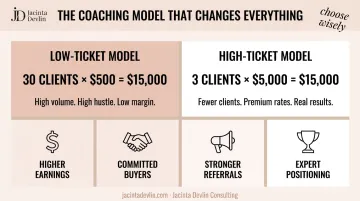
You're skilled at what you do. You get results for clients. And yet, month after month, revenue stays flat — because you're undercharging, avoiding sales conversations, or running a model that requires 30 clients just to pay the bills.
The gap isn't talent. It's pricing and strategy.
Women-owned businesses currently account for just 6% of total US business revenues, despite women owning 14.2 million businesses nationwide. That gap doesn't close by working harder within a broken model — it closes by rebuilding the model itself.
That's where high-ticket sales coaching comes in. This guide covers how to build and price a premium offer, the sales strategies that move prospects to "yes," the mindset blocks that stall revenue, and how to choose a coach who can get you to consistent $5k–$50k+ months.
TL;DR
- High-ticket coaching means fewer clients, higher revenue, and a more sustainable business model.
- Building a strong offer starts with a specific niche, a clear transformation promise, and pricing that reflects outcomes over hours.
- Selling premium offers requires consistent visibility, a reliable lead generation system, and disciplined follow-up.
- Mindset blocks — guilt, fear of rejection, imposter syndrome — are the #1 reason women undercharge, not lack of skill.
- The right coach brings real-world results, personalized strategy, and a model that builds your capabilities, not dependence.
What Is High-Ticket Sales Coaching and Why It Works for Women Entrepreneurs
High-ticket sales coaching helps you build, price, and sell premium offers — typically positioned above $3,000 — that deliver deep, personalized transformation rather than generic information. It's the opposite of a transactional model where you need dozens of clients per month just to hit your income goals.
The structural difference matters. In a low-ticket model, volume is survival. In a high-ticket model, you earn more per client, work with fewer people, and deliver deeper results. For women running service-based businesses, that math translates directly into more revenue without a longer work week.
Why the Model Works
- Higher earnings per client — one $7,500 client generates the same revenue as 15 clients at $500
- More committed buyers — clients who invest at a premium level follow through; they show up, do the work, and get results
- Stronger referrals — high-ticket clients who transform their businesses talk about it
- Expert positioning — premium pricing signals authority in your niche before a prospect ever gets on a call with you
The coaching industry itself is growing fast. The 2025 ICF Global Coaching Study reports 122,974 coach practitioners worldwide — up 15% from 2023 — with global coaching revenue reaching $5.34 billion. The US business coaching market alone is sized at $20 billion for 2026, according to IBISWorld.
For women entrepreneurs specifically, that expanding market creates real opportunity — and the high-ticket model is the clearest path to capturing it without trading more time for more income.
How to Build a High-Ticket Offer That Sells
Nail Your Niche and Ideal Client Profile
The most common mistake when building a premium offer: trying to help everyone. Broad messaging doesn't build trust. Specificity does.
Your ideal client profile (ICP) should capture:
- Primary pain point — the specific problem they're actively trying to solve
- Desired outcome — what "success" concretely looks like for them
- Decision-making triggers — what finally moves them from considering to buying
- Preferred platforms — where they spend time and where they find solutions
Once you have this, your unique value proposition (UVP) becomes sharper. A strong UVP focuses on the transformation a client experiences — not the features of your program. "12 weeks of weekly calls and a content strategy" is a feature list. "Your first $10k month in 90 days" is a transformation.
Premium UVPs are specific, outcome-driven, and written for one person — not a broad market. That clarity also makes the next step easier: designing a program structure that delivers on the promise.
Design and Structure the Program
Program format decisions shape both your delivery and your perceived value. Options include:
- 1:1 coaching — highest perceived value, most personalized, justifies premium pricing
- Group mastermind — scalable with community benefits, works well at mid-ticket price points
- Retreat or VIP day — intensive format, strong transformation in compressed time
- Productized service — done-for-you delivery alongside coaching (branding, funnels, content)
The non-negotiable in any high-ticket program: a clearly defined end result. Clients don't buy programs — they buy outcomes. "Your brand launched with a full sales funnel and your first paying clients" is what closes a premium sale. Vague deliverables don't justify a premium price.
Jacinta Devlin's 12-week Business Launch Program, for example, takes clients from zero to a fully launched brand — including market research, branding, website, email marketing, sales funnels, and a complete launch plan. The specificity of that outcome is exactly what commands premium investment.
Price Your Offer for Transformation, Not Time
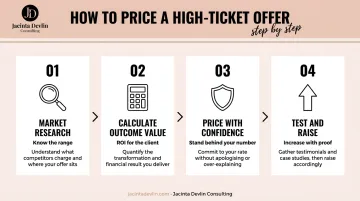
Pricing by the hour is one of the fastest ways to cap your income and undervalue what you deliver. Here's how to approach it:
- Research what comparable programs charge in your market — know the range before you set a number.
- Calculate the value of the outcome — if your program helps a client earn an additional $50k this year, a $5k investment is a straightforward decision.
- Set a price you can confidently stand behind — hesitation in your voice kills more sales than price ever will.
- Test and raise — start where it feels right, collect results and testimonials, then increase rates as social proof accumulates.
Research on price-quality signaling confirms what most experienced coaches know intuitively: price communicates quality, especially when buyers can't easily evaluate the service before buying. A low price doesn't signal accessibility — it signals low confidence in what you deliver.
Undercharging also attracts the wrong clients. Premium buyers who invest seriously tend to show up, do the work, and get results. That creates testimonials, referrals, and documented proof — the assets that sustain and grow a high-ticket practice over time.
Proven Strategies to Sell High-Ticket Offers as a Woman Entrepreneur
Build Visibility Through Social Media and Content
Consistent, authentic content is the highest-leverage sales activity for most women entrepreneurs. It builds trust before the sales conversation even starts.
The goal isn't going viral — it's showing up regularly on the platforms where your ideal clients spend time and demonstrating expertise through every post, reel, story, and live.
Thought leadership content specifically does the heavy lifting of pre-handling objections. When a prospect has watched 20 videos of you breaking down the exact problem they're struggling with, the discovery call becomes a natural next step — not a hard sell.
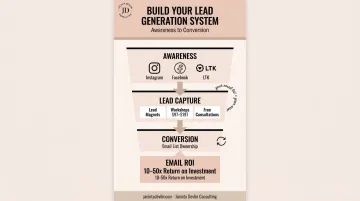
Platform strategy matters too. LTK's 2024 Creator Journey report found that 66% of consumers actively shop and make purchases through creators, with creator marketing expected to reach more than $35 billion. Used with intent, these platforms become genuine lead generation engines:
- Instagram — build authority through reels, stories, and consistent posting
- LTK — monetize recommendations and attract brand-aligned buyers
- Facebook — nurture community and drive warm traffic to offers
Lead Generation, Nurturing, and the Follow-Up System
Social media builds awareness, but it doesn't replace a lead generation system you own. That means building an email list through:
- Free lead magnets — downloads, guides, and checklists that attract qualified prospects (e.g., "10 Affiliate Programs to Apply For," "5 Ways to Make Sales Online")
- Low-cost workshops — paid entry-point events ($97–$197) that demonstrate your expertise and create natural upsell opportunities into premium programs
- Free consultations — short strategy calls that qualify fit and open the path to enrollment
Email matters because you own it. Unlike social followers, your list doesn't disappear if an algorithm changes. Litmus reports 35% of companies see $10–$36 return per $1 spent on email, with another 30% seeing $36–$50 — making it one of the strongest ROI channels available.
Referrals round out the system. Nielsen data shows 88% of consumers trust recommendations from people they know more than any other channel — and satisfied high-ticket clients are your most credible source of new ones. A formal referral program isn't required; clients who get results talk. Proactively asking and making it easy to share simply accelerates what already happens naturally.
Once a prospect books, the discovery call is where lead generation converts to enrollment. Keep it consultative rather than scripted — understand their specific situation, connect it clearly to the outcome your program delivers, and let genuine fit close the deal. Pressure tactics don't work on aligned buyers.
How to Overcome the Mental Barriers to High-Ticket Sales
Mindset isn't a soft topic — it's the actual reason most women entrepreneurs stall. The blocks are real and they're widespread.
KPMG's research found that 75% of female executives report having personally experienced imposter syndrome at some point in their careers. For women entrepreneurs pricing premium offers, the internal resistance is even louder because the stakes feel personal.
The most common blocks:
- Guilt about premium pricing — "Who am I to charge that?"
- Fear of rejection — avoiding sales conversations entirely to sidestep the possibility of no
- Imposter syndrome — waiting to feel "ready" before raising rates or launching
- Over-justifying the investment — explaining your price to death instead of standing behind it
Sales is service. When your offer delivers a genuine transformation, withholding it from people who need it isn't humility — you're doing them a disservice. You're connecting a ready buyer to a result they're already seeking.
That reframe changes how you approach client alignment, too. You're not trying to convince skeptical prospects — you're finding people who already want what you offer. When your messaging is specific and your niche is clear, the right buyers self-select in. Sales stops feeling pushy.
Finally, on pricing confidence: undercharging attracts low-commitment clients. The WEF notes that in independent work, men charge an average of 48% more than women for the same type of work. That gap isn't driven by results — it's driven by confidence. Higher pricing sets higher expectations, and clients who invest significantly tend to take the work more seriously and see stronger results.
What to Look for in a High-Ticket Sales Coach
The Criteria That Actually Matter
Not every business coach has built a real business. The most important filter: proven real-world results, not just teaching theory.
Look for:
- A coach who has personally achieved what they're teaching — not just coached others toward it
- An individualized approach with customized strategy, not scripts and templates applied to every client
- A coaching model that builds your capabilities and independence — not one that creates reliance on the coach
- Documented client results with specific numbers, not vague testimonials
Red Flags to Avoid
The FTC is direct: a coaching program that promises guaranteed income, large returns, or a "proven system" is likely a scam. Watch for:
- Over-promised income outcomes with no verifiable evidence
- Pressure tactics or manufactured urgency during enrollment
- Group-only programs with zero personalization
- Coaches whose only business success came from selling coaching to other coaches
What This Looks Like in Practice
Jacinta Devlin spent 15+ years in direct sales as a Top 1% seller, million-dollar earner, and National Director of Sales & Field Training at Stella & Dot — where she trained over 50,000 women. She's also built her own income streams through an Amazon storefront, LTK partnerships, and brand deals with Gucci, Nordstrom, Sephora, and Target.
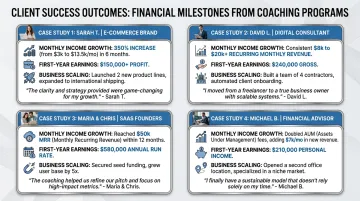
Client outcomes from her coaching programs include:
- Sharon B. going from $4k her first year to $20,000+ per month on Amazon
- Christina Roach quitting her full-time job within 6 months and now selling hundreds of thousands monthly through Amazon and LTK
- Lisa K. hitting $100k in her first year after a $1,250 launch day
- Amanda O. scaling from a $2,500/month goal to consistent $10,000+ months
Programs start at $3,500 and are customized for each client's business. No DIY courses, no generic playbooks. The Dream+Create Online Coaching Community provides ongoing support, networking, and community for women building online businesses at every stage.
Frequently Asked Questions
What is the 80/20 rule in coaching?
The Pareto Principle means 80% of your revenue comes from 20% of your clients. In coaching, that's the core argument for going high-ticket: serve fewer, better-fit clients at a premium rather than chasing volume that yields diminishing returns.
What are the 3 C's of coaching?
According to Sandler's sales coaching framework, the 3 C's are Conviction, Commitment, and Competency. In a high-ticket relationship, the coach brings conviction and structured methodology while clients bring commitment — and competency develops through consistent, guided practice.
How much does high-ticket sales coaching typically cost?
The ICF reports an average session fee of $234/hour for professional coaching. Package programs like Jacinta Devlin Consulting's start at $3,500+, with comprehensive launch programs at $7,497 — best evaluated against the revenue increase the program makes possible.
How do you price a high-ticket coaching offer?
Base your price on the value of the transformation delivered, not the hours you spend delivering it. Research comparable programs in your niche, set a price you can confidently stand behind, and raise rates incrementally as testimonials and case studies accumulate. Price is also a quality signal — starting too low often attracts low-commitment clients and undermines positioning.
How do women entrepreneurs overcome fear of selling high-ticket offers?
Reframe selling as connecting a ready buyer to a transformation they're already looking for. Fear of selling usually disappears when your messaging is specific enough that the wrong prospects disqualify themselves, and the right ones feel like you're speaking directly to them.
When is the right time to invest in high-ticket sales coaching?
The ideal time is when you have clarity on what you offer and some lead flow, but you're hitting a pricing, conversion, or strategy bottleneck. Coaching accelerates what's already working. That said, clients have started Jacinta Devlin's programs with fewer than 500 followers — readiness is more about mindset and commitment than metrics.