
It's strategy.
The concept of affiliate marketing is simple: share a link, earn a commission. But converting followers into buyers requires a specific setup, the right programs, and content that actually drives action. Most creators skip the fundamentals and wonder why their links get ignored.
This guide walks through the exact steps to start making money on Instagram with affiliate marketing — what to set up, what factors drive real earnings, and the mistakes that quietly cap income before it ever gets started.
TL;DR
- Earn commissions through Stories, Reels, bio links, and discount codes — no product required
- Earnings depend on niche relevance, engagement rate, and commission structure — not follower count
- Success follows a clear path: pick a niche, join affiliate programs, optimize your profile, and create content that converts
- FTC disclosure is legally required and builds long-term trust — skip it at real risk
- Creators who treat affiliate marketing like a real business — with strategy, consistency, and tracking — are the ones who hit $5k+ months
How to Make Money on Instagram with Affiliate Marketing: Step-by-Step
Each step below builds on the last. Skip the setup fundamentals — niche clarity, the right account type, program fit — and you'll see low conversions even when the content itself is strong.
Step 1: Choose a Profitable Niche
Niche specificity is the foundation. The more clearly you define who you're talking to and what problems you solve, the easier it becomes to select products your audience will actually buy.
High-converting niches on Instagram include fashion, beauty, skincare, wellness, home, and lifestyle — categories where product discovery happens naturally through visual content.
A practical starting exercise:
- List 3–5 products you already use and genuinely love
- Search for affiliate programs that carry those exact products
- Cross-reference your list with what your audience already asks about
When your program selection matches what you genuinely use and believe in, recommendations land differently. Your audience can tell — and that trust is what drives clicks to conversions.
Step 2: Join the Right Affiliate Programs and Networks
Two pathways exist: affiliate networks (which aggregate many brand programs in one place) and direct brand programs (applied to individually).
Key criteria for evaluating any program:
- Commission rate and structure
- Cookie duration (how long after a click you earn credit)
- Payment threshold and schedule
- How well the brand aligns with your content
Programs worth knowing:
| Program | Best For | Key Details |
|---|---|---|
| LTK | Fashion & lifestyle creators | 5K+ followers required; average commissions 10–25%, up to 30% |
| Amazon Associates | Broad product coverage | ~500+ followers required; 3 qualifying sales in 180 days; Luxury Beauty at 10%, most electronics at 1–4% |
| ShareASale / Awin | Access to many brand programs | Advertiser-specific rates; no public follower minimums |
| Rakuten | Established creators | Advertiser-set rates; no public follower minimum |
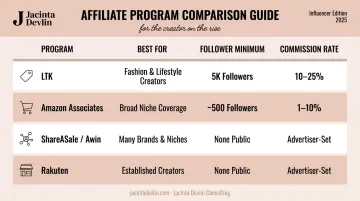
For fashion and lifestyle creators, LTK is particularly Instagram-native — it's built around product linking and has a built-in shopping audience. Jacinta Devlin has personal partnerships through LTK and Amazon, and coaches clients toward these platforms specifically because of the direct purchase infrastructure they provide.
Start with 2–3 programs that genuinely match your content. Fit matters far more than volume, especially early on.
Step 3: Optimize Your Instagram Profile for Affiliate Conversions
Switch to a Creator or Business account before anything else. Instagram's professional accounts provide access to Insights — follower demographics, peak activity times, and post performance data. Without this, you're guessing at what content drives clicks and sales.
Link-in-bio strategy:
Instagram doesn't support clickable links in feed captions, so affiliate links need a single destination that houses multiple options. A link aggregator tool like Linktree (or a dedicated landing page) solves this. Your bio should include a direct call-to-action pointing followers there — something clear, like "Shop my picks →" rather than a generic URL.
Bio essentials for affiliate conversions:
- Clear niche signal (who you help / what you cover)
- One call-to-action pointing to your link-in-bio
- Link aggregator page with organized affiliate categories
Step 4: Create Content That Converts — Not Just Content That Gets Views
Affiliate content that performs doesn't look promotional. It shows the product in context — an outfit of the day, a skincare routine, a "what I actually use in my kitchen" walkthrough. The goal is to help followers visualize themselves using the product and answer the "why this?" question before they even think to ask it.
Highest-converting formats:
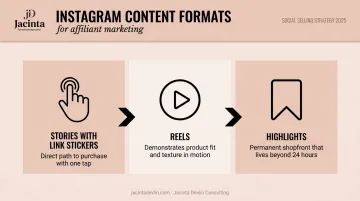
- Stories with link stickers — direct path from content to purchase; link stickers redirect viewers to your affiliate URL when tapped
- Reels — short-form video builds purchase confidence by showing texture, fit, or functionality in a way static images can't
- Highlights — saving affiliate Stories to Highlights keeps them visible beyond the 24-hour window, creating a permanent shopfront on your profile
On FTC compliance: The FTC requires clear disclosure of any financial relationship with a brand. Use #ad or #affiliate directly in the content — not buried in hashtags or hidden after a "more" link.
Instagram's paid partnership label may help, but the FTC explicitly states platform tools alone aren't sufficient. When in doubt, disclose in both places.
Transparent disclosure, done well, actually improves long-term conversion rates. Audiences trust creators who are upfront about earning commissions far more than those who aren't.
Step 5: Track Performance and Optimize Consistently
Most affiliate programs include a dashboard showing clicks, conversions, and earnings by product or link. Review this data weekly — not monthly, weekly.
What to look for:
- Which content formats generate the most clicks
- Which products convert (not just get clicks, but actually sell)
- Which calls-to-action drive action vs. which get ignored
When a program consistently underperforms, cut it and shift effort toward higher-commission products or better-converting formats. The creators seeing real income growth aren't the ones who post more — they're the ones who pay attention to what's actually working.
Key Factors That Determine How Much You Earn
Two creators in the same niche with similar follower counts can earn vastly different amounts. Here's what actually drives earnings:
Engagement Rate Over Follower Count
A creator with 8,000 engaged followers can out-earn someone with 80,000 passive ones. HypeAuditor's 2025 data shows nano influencers (1K–5K followers) average 4–5% engagement, while micro influencers (5K–50K) average 2.5–3.5%. The platform median across all accounts sits around 0.36%.
Affiliate income follows click-through and conversion — not impressions. An audience that buys is always worth more than one that scrolls.
Commission Structure and Product Price Point
The math matters. Promoting a $20 item at 5% earns $1. A $200 item at 15% earns $30 — from one sale.
Commission rates vary significantly by platform and category:
- Amazon Luxury Beauty: 10% commission
- Amazon Electronics: 1–4% (most categories)
- LTK: 10–25% average, up to 30% depending on the retailer
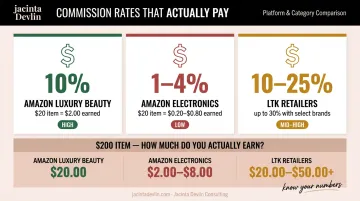
High-ticket products require fewer conversions to hit meaningful income targets — which is why Jacinta's clients consistently prioritize premium brand partnerships over high-volume, low-margin ones.
Posting Consistency
Consistent posting maintains visibility, which directly impacts affiliate link traffic. Later's research shows micro accounts averaging around 3 feed posts per week, with larger accounts pushing 5+. LTK's ideal creator applicant posts daily and regularly highlights products they use.
A useful ratio: keep affiliate content to roughly 1 in every 5–10 posts. Too many affiliate posts in a row erode the trust that makes your recommendations convert in the first place.
Content Strategies That Maximize Affiliate Sales
Choosing the right programs matters — but how you present products determines whether followers actually click, buy, and come back for more.
Stories, Highlights, and Reels
- Stories with link stickers offer the most direct path from content to purchase. Save high-performing affiliate Stories to Highlights so they stay accessible well past the 24-hour window
- Reels drive discovery — eMarketer notes luxury-brand Reels video views grew 234% in Q2 2025 — and the format lets you demonstrate fit, texture, or results in ways static posts simply can't
Social Proof Through Storytelling
Go beyond "link in bio." Explain why you use the product, what problem it solves, and what you'd do without it. Specific personal context — "I've worn these boots three times a week since October" — does more to reduce buyer hesitation than any discount code.
Strategic Repetition Without Over-Promoting
Audiences rarely buy on first exposure. Effective creators reference the same product across multiple pieces of content: an unboxing, a follow-up review a month later, a casual mention in a different context, a styling tip in a related post. Each new angle reinforces trust without feeling repetitive.
The problem isn't frequency — it's repeating the same promotional caption with nothing new to add.
Common Mistakes That Limit Your Affiliate Earnings
Promoting Everything, Converting Nothing
Joining too many unrelated programs confuses your audience about your niche. It erodes trust and dilutes conversion rates across every program. Relevance and quality consistently outperform volume.
Skipping Disclosure
Undisclosed affiliate promotions violate FTC guidelines and Instagram's policies. Beyond legal risk: when followers discover undisclosed promotions (and they do), the trust damage is disproportionate to any short-term gain. Proper disclosure actually builds credibility with your audience — and that credibility is what drives conversions long-term.
Ignoring Analytics
Posting without reviewing performance data is the most common reason creators plateau. Without knowing which products, formats, and CTAs drive purchases, you're optimizing blind. Monthly performance reviews should be a fixed part of your routine — weekly if you can manage it.
Treating Instagram as Your Only Traffic Source
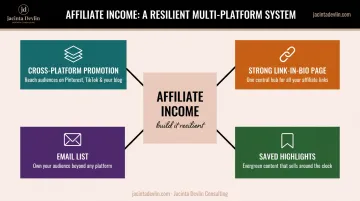
Relying on a single platform creates income vulnerability. A more resilient affiliate income system spreads your presence across multiple touchpoints:
- Cross-platform promotion — repurpose content to Pinterest, TikTok, or a blog
- A strong link-in-bio page — your home base when the algorithm isn't delivering
- An email list — the one channel no platform can take from you
- Saved Highlights — keeps evergreen affiliate content discoverable year-round
Conclusion
Instagram affiliate marketing is a legitimate, scalable income strategy. Results come down to choosing the right niche and programs, creating content that builds real trust, and treating it like a business — not a side experiment you check in on occasionally.
The gap between creators earning $200/month and those hitting consistent $5,000–$50,000+ months comes down to strategic execution and personalized guidance. Jacinta Devlin's coaching — through the Business Growth Program and the Dream+Create community — is built specifically for ambitious women who want a proven, individualized strategy to build and scale affiliate income.
Her clients back that up: one grew from 500 followers to $5k+ in monthly sales; another went from $4k her first year on Amazon to over $20,000 per month.
If you're ready to stop guessing and start scaling, a free 15-minute growth chat is the place to start.
Frequently Asked Questions
Can you make money with affiliate marketing on Instagram?
Yes — Instagram affiliate marketing is a real and proven income stream. Earnings depend on what you promote, how engaged your audience is, and how consistently you post — not on having a massive following.
Can you make $10,000 a month with affiliate marketing?
$10,000/month is achievable — creators in fashion, beauty, and lifestyle niches who pair high-commission programs with a trusted, engaged audience get there fastest. Niche selection and content consistency are the two biggest levers.
How many followers do you need to start affiliate marketing on Instagram?
Most programs have low or no minimums — Amazon Associates generally requires around 500 followers, and LTK requires 5,000 followers on a public, engaged profile. Engagement rate and niche relevance matter far more than follower count when it comes to actual earnings.
How do you add affiliate links to Instagram?
Affiliate links are shared through your link-in-bio (using a tool like Linktree), Story link stickers, product tags via Instagram Shopping, and discount codes in captions. Feed post captions don't support clickable links, so the link-in-bio is your primary destination hub.
Do you have to disclose affiliate links on Instagram?
Yes. FTC guidelines require clear disclosure of any financial relationship with a brand. Use #ad, #affiliate, or a written disclosure in the content itself — and don't rely solely on Instagram's paid partnership tag, as the FTC notes platform tools alone may not be sufficient.
What are the best affiliate programs for Instagram?
LTK is the strongest option for fashion and lifestyle creators, with average commissions of 10–25%. Amazon Associates covers nearly every category, while ShareASale (via Awin) and Rakuten connect you to hundreds of brand-specific programs. The best fit depends on your niche and what your audience already buys.